
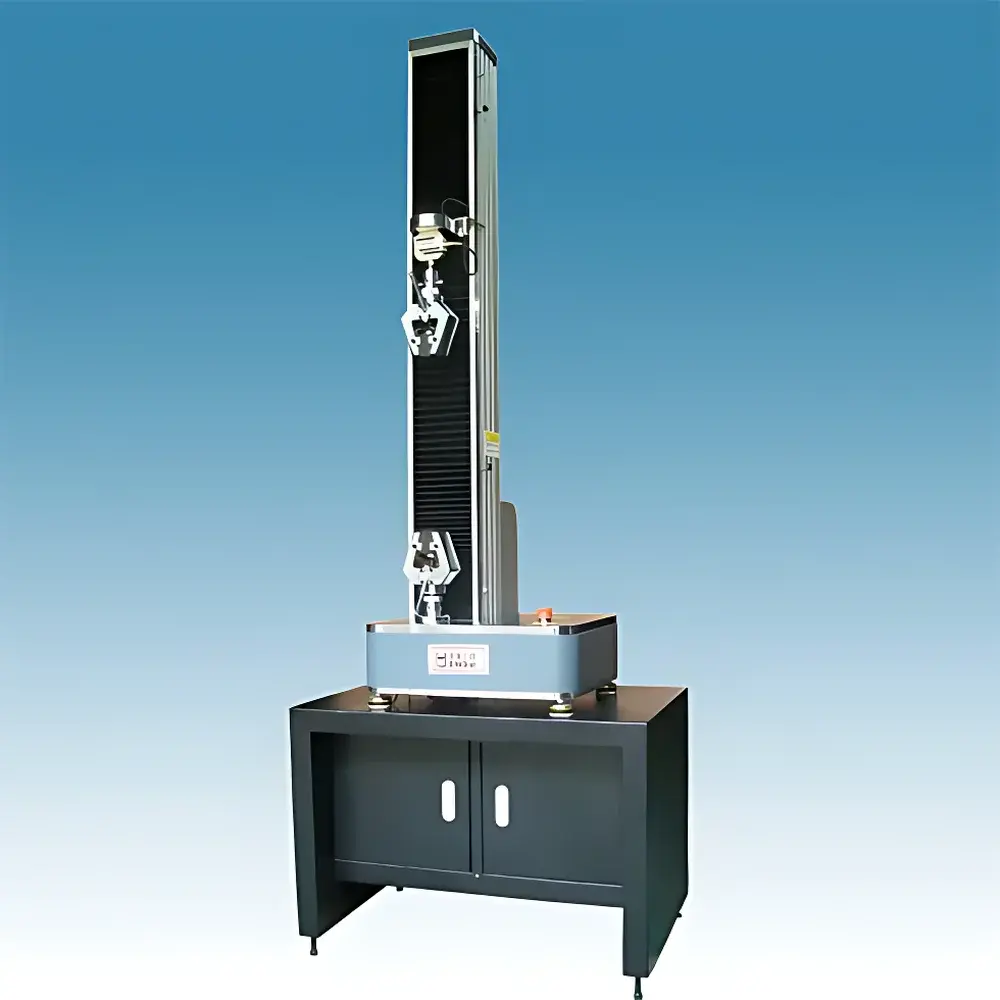
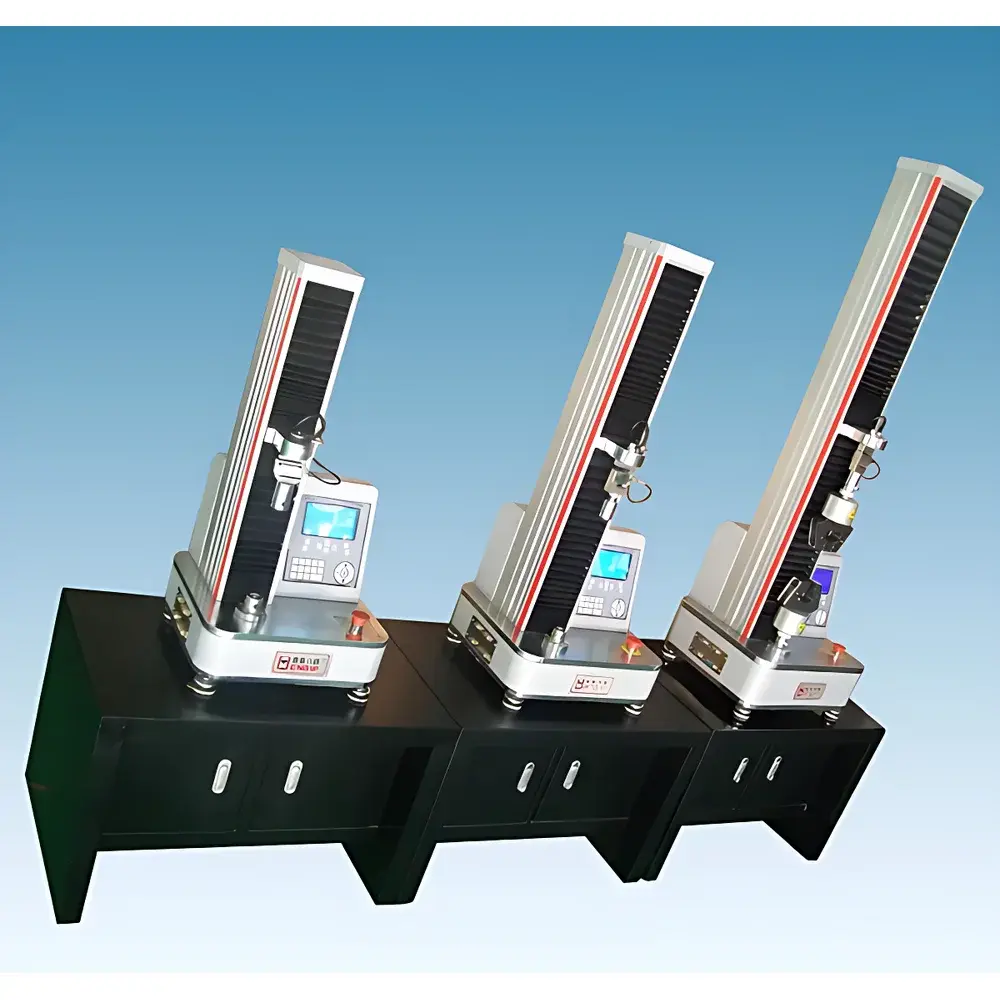
Hengyi HY-0580HHJU 180° Peel Adhesion Tester for Lithium-Ion Battery Separators
| Brand | Hengyi / Hengyitest |
|---|---|
| Origin | Shanghai, China |
| Manufacturer Type | Direct Manufacturer |
| Regional Category | Domestic (China) |
| Model | HY-0580HHJU |
| Instrument Type | Electromechanical Universal Testing Machine |
| Load Capacity Options | 1N–5000N (multiple transducers available) |
| Accuracy Class | ≤0.5 |
| Effective Test Width | 120 mm |
| Effective Vertical Travel | 800 mm |
| Speed Range | 0.001–500 mm/min |
| Speed Accuracy | ±0.5% of indicated value |
| Force Resolution | ±500,000 counts (full-scale, no range switching) |
| Force Measurement Accuracy | ±0.5% of reading |
| Displacement & Strain Accuracy | ±0.5% of reading |
| Stress/Strain Control Range | 0.002–6% FS/s |
| Power Supply | 220 V AC, 750 W |
| Dimensions (W×D×H) | 470 × 400 × 1510 mm |
| Weight | 120 kg |
Overview
The Hengyi HY-0580HHJU 180° Peel Adhesion Tester is a precision electromechanical universal testing system engineered specifically for quantitative peel force characterization of lithium-ion battery separators — a critical quality control parameter influencing cell safety, ionic conductivity, and interfacial stability. Based on the standardized 180° peel geometry per ASTM D903, ISO 8510-2, and GB/T 2792, the instrument applies controlled tensile separation between a separator film and its coated electrode substrate (e.g., cathode or anode), measuring the force required to progressively delaminate the interface at a fixed angle and rate. Its single-column, benchtop architecture integrates high-rigidity structural design with closed-loop servo control of force, displacement, and strain — enabling reproducible measurement of peel strength (N/mm), peak load, average peel force, and interfacial failure mode analysis. The system complies with fundamental metrological requirements defined in GB/T 2611–2007 (General Technical Requirements for Testing Machines), GB/T 16491–2008 (Electronic Universal Testing Machines), and GB/T 16852.1–2008 (Calibration of Static Uniaxial Testing Machines), ensuring traceability and regulatory acceptability across R&D, QC, and third-party certification laboratories.
Key Features
- Single-column, compact benchtop frame with high torsional rigidity and minimal thermal drift — optimized for stable long-duration peel tests under ambient lab conditions.
- Precision ground ball-screw drive system coupled with Panasonic AC servo motor (Japan) — delivering smooth, low-noise motion with speed resolution down to 0.001 mm/min and repeatability < ±0.2%.
- Load measurement via high-stability S-type load cells from Transducer Techniques (USA), calibrated to ≤0.5% accuracy across full scale; supports interchangeable transducers (1N to 5000N) without recalibration.
- Real-time triple-closed-loop control: force, displacement, and strain — configurable via intuitive Windows-based software interface (English/Chinese bilingual).
- Integrated safety architecture: electronic travel limits, overload protection (110% FS), automatic emergency stop on overvoltage/overcurrent detection, and programmable test termination by time, load, or deformation.
- High-resolution optical encoder (Omron, Japan) ensures displacement measurement accuracy of ±0.5% and enables precise tracking of peel front propagation during dynamic delamination.
- Multi-curve real-time display: force vs. displacement, force vs. time, displacement vs. time, and stress vs. strain — with on-the-fly calculation of peel strength, yield point, and elongation at break.
Sample Compatibility & Compliance
The HY-0580HHJU accommodates standard separator specimens (e.g., polyolefin microporous films, ceramic-coated PE/PP, PVDF-based composites) mounted on rigid electrode substrates (Al/Cu foil or current collector laminates). Customizable peel fixtures ensure consistent 180° alignment per ISO 2740 and ASTM F903. The system meets mechanical and metrological compliance requirements for battery material qualification under GB/T 3923 (textile tensile), GB/T 1040 (plastic tensile), IEC 62660-1 (secondary lithium cells), and UL 1642 (lithium battery safety). Data integrity conforms to GLP principles, with audit-trail-capable software supporting 21 CFR Part 11 readiness when configured with user authentication and electronic signature modules.
Software & Data Management
The embedded Windows application provides ISO/IEC 17025-aligned data handling: automatic saving of raw force-displacement datasets (.csv/.xlsx), annotated test curves, statistical summaries (mean, SD, CV%), and customizable report templates (PDF/HTML). Users may define multi-step test protocols (pre-load dwell, ramp-to-peel, constant-rate separation), assign sample IDs with batch metadata, and export results directly to LIMS or ERP systems. All calibration parameters, operator logs, and system diagnostics are timestamped and archived — satisfying internal QA documentation requirements and external accreditation audits.
Applications
- Quantitative peel adhesion assessment of ceramic-coated separators on cathode foils (NMC, LFP) and anode foils (graphite/Si-C).
- Evaluation of binder formulation effects (e.g., CMC/SBR vs. PVDF) on separator-electrode interfacial bonding strength.
- Accelerated aging studies: measuring peel force degradation after thermal cycling (60–85°C), humidity exposure (30–90% RH), or electrolyte soaking (LiPF6/EC:DMC).
- QC release testing for separator suppliers per OEM specifications (e.g., CATL, BYD, LG Energy Solution).
- Failure analysis of delamination events observed in pouch cell teardowns or post-cycle impedance rise.
- Comparative screening of novel separator architectures (electrospun nanofibers, PI membranes, composite laminates).
FAQ
What standards does this tester support for battery separator peel testing?
ASTM D903, ISO 8510-2, GB/T 2792, IEC 62660-1 Annex D, and UL 1642 Clause 9.2 — with full traceability to national metrology institutes via factory calibration certificates.
Can the system be used for non-battery applications?
Yes — it is fully compliant with GB/T 1040 (plastics), GB/T 3923 (fabrics), ASTM D638, and ISO 527, making it suitable for adhesive tapes, medical device packaging, flexible electronics, and polymer laminates.
Is software validation documentation available for regulated environments?
IQ/OQ documentation packages and 21 CFR Part 11 configuration guides are provided upon request for pharmaceutical, medical, and automotive Tier-1 supplier deployments.
How is force sensor calibration maintained over time?
Built-in auto-diagnostic routines verify load cell linearity and zero offset before each test sequence; annual third-party calibration is recommended per ISO/IEC 17025.
What fixture options are available for 180° peel geometry?
Standard pneumatic clamp fixtures with adjustable peel angle guides (±0.5° tolerance); custom tooling (e.g., micro-clamps for <5 mm width strips) available under NRE agreement.



