
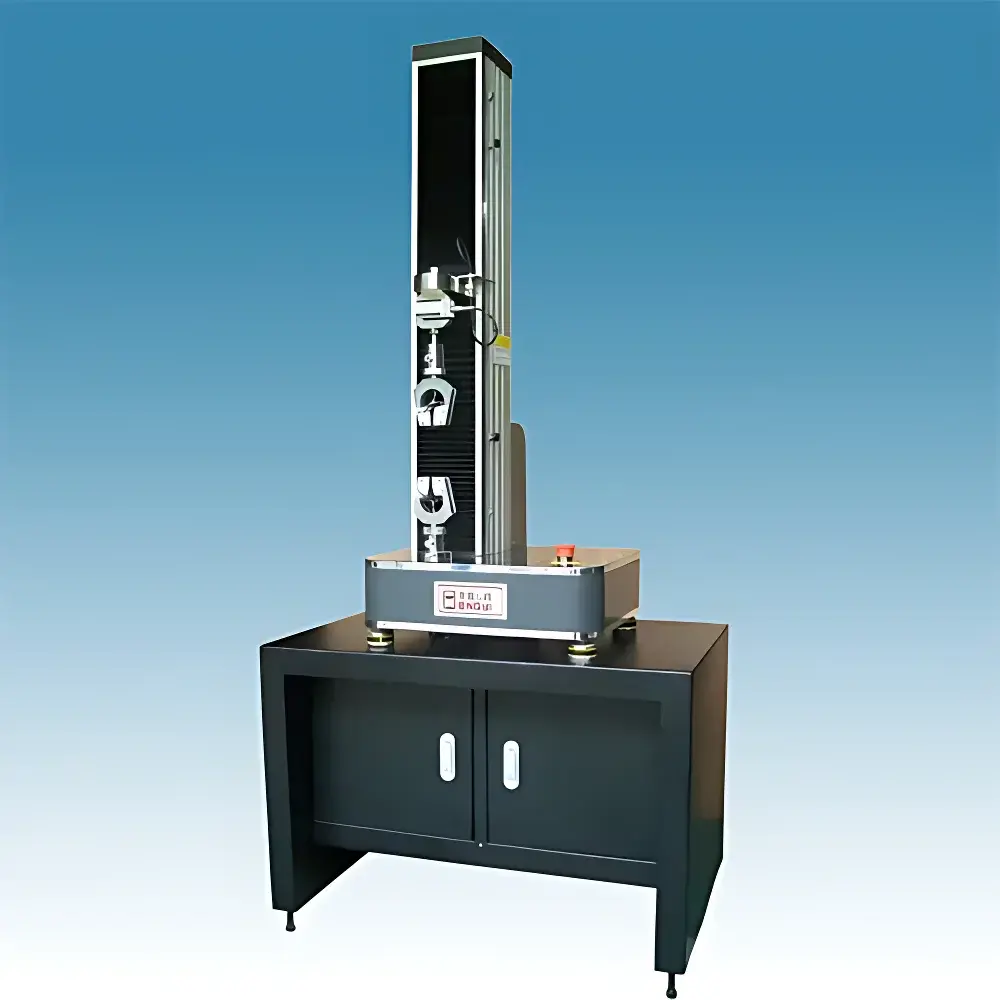
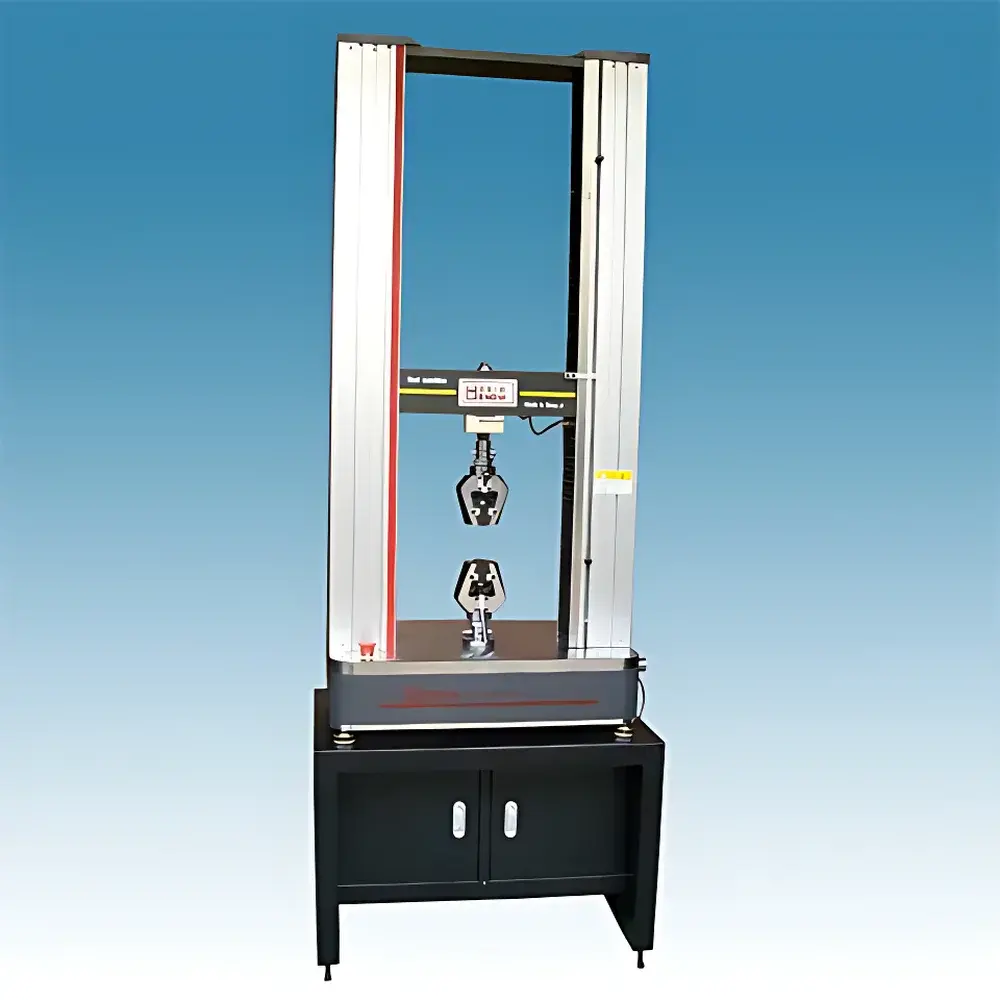
Hengyi HY-0580KIN Electronic Universal Testing Machine for Young’s Modulus Measurement
| Brand | Hengyi |
|---|---|
| Origin | Shanghai, China |
| Manufacturer Type | Direct Manufacturer |
| Country of Origin | China |
| Model | HY-0580KIN |
| Instrument Type | Electronic Universal Testing Machine |
| Max Load Capacity | 5000 N |
| Load Cell Accuracy | 0.01% |
| Measuring Accuracy | ±1% |
| Control Mode | Full PC Control |
| Valid Width | 150 mm |
| Stroke | 800 mm (extendable) |
| Test Speed Range | 0–500 mm/min |
| Speed Accuracy | ±0.5% |
| Stroke Accuracy | ±0.5% |
| Displacement Accuracy | ±0.5% |
| Safety Features | Electronic Limit Protection, Emergency Stop Button |
| Unit Weight | ~100 kg |
Overview
The Hengyi HY-0580KIN Electronic Universal Testing Machine is a precision-engineered system designed for the quantitative determination of Young’s modulus and other fundamental mechanical properties—including tensile strength, compressive yield, flexural stiffness, peel resistance, and puncture behavior—across a broad spectrum of solid materials. Based on servo-controlled electromechanical actuation and high-fidelity load-cell transduction, the system operates under quasi-static loading conditions compliant with ASTM E8/E8M (tension), ASTM D695 (compression), ASTM D790 (flexure), and ISO 527-1/2 standards. Its modular architecture supports both standard-compliant routine QC testing and exploratory mechanical characterization in academic and industrial R&D laboratories. The machine integrates a rigid dual-column frame, low-inertia crosshead drive, and real-time synchronized acquisition of force, displacement, and strain (when paired with extensometers), enabling traceable, reproducible mechanical property extraction under controlled environmental conditions.
Key Features
- High-resolution load measurement with 0.01% full-scale accuracy using temperature-compensated S-type load cells, certified to ISO 376 Class 0.5
- Wide dynamic test speed range (0.001–500 mm/min) with closed-loop velocity control and ±0.5% speed fidelity across the entire range
- 800 mm standard stroke (field-extendable) and 150 mm effective test width accommodate ASTM-standard specimen geometries and custom fixtures
- Full PC-based control interface with real-time graphical display of force–displacement, stress–strain, and time-based curves
- Dual-safety architecture: programmable electronic stroke limits and hardware-triggered emergency stop circuit meeting IEC 60204-1 requirements
- Modular fixture compatibility—including wedge-action grips, compression platens, three-point bending fixtures, and peel test jigs—for multi-modal mechanical evaluation
- Robust aluminum-alloy frame with precision-ground linear guides ensures minimal deflection (<0.02 mm at 5000 N) and long-term geometric stability
Sample Compatibility & Compliance
The HY-0580KIN accommodates specimens from thin polymer films (≥25 µm) to rigid composites and metallic coupons (up to 15 mm thick). It supports standardized sample preparation per ASTM D638 (plastics), ASTM E8 (metals), ISO 527 (polymeric films), and GB/T 1040 (Chinese national standards). All force and displacement data are acquired and timestamped in accordance with GLP principles. When configured with optional extensometers and calibrated reference standards, the system meets audit requirements for ISO/IEC 17025-accredited laboratories. Data export formats include CSV, XML, and PDF reports compliant with FDA 21 CFR Part 11 when used with validated software modules (e.g., Hengyi TestSuite v4.2+).
Software & Data Management
Hengyi TestSuite software provides ISO 17025-aligned test method templates, automated calculation of Young’s modulus (initial tangent, secant, or chord methods), Poisson’s ratio (with dual-axis strain input), and statistical reporting per ISO 5725. Each test session logs operator ID, calibration status, environmental metadata (optional ambient sensor integration), and digital signature for audit trails. Raw data files retain full resolution (1 kHz sampling rate) and support post-hoc reanalysis. Software updates are delivered free of charge for registered users; extended functionality—such as cyclic loading protocols, creep/stress-relaxation modules, or custom report generation—is available via licensed add-ons. All software binaries undergo annual third-party verification for deterministic execution and numerical integrity.
Applications
- Quality assurance of thermoplastics, elastomers, adhesives, and fiber-reinforced composites in automotive and aerospace supply chains
- Mechanical validation of biomedical polymers (e.g., PEEK, PLA, hydrogels) per ISO 10993-12 and USP
- Teaching and research applications in university materials science labs, including fracture mechanics and viscoelastic modeling
- Regulatory submission support for medical device packaging (ASTM F88 seal strength, ASTM F1140 burst testing)
- Non-destructive validation of additive manufacturing parts via micro-tensile coupon testing (per ASTM F2921)
- Custom protocol development for emerging materials—including shape-memory alloys, MXenes, and bio-based nanocomposites
FAQ
What standards does the HY-0580KIN comply with for Young’s modulus determination?
The system supports testing protocols aligned with ASTM E111, ISO 527-2, and GB/T 22315, with configurable calculation algorithms for initial tangent, secant, and offset modulus definitions.
Can the machine be integrated into an existing LIMS or MES environment?
Yes—via OPC UA or TCP/IP API interfaces, the HY-0580KIN supports bidirectional data exchange with laboratory information management systems (LIMS) and manufacturing execution systems (MES) without proprietary middleware.
Is third-party calibration certification available?
Hengyi provides optional UKAS-accredited calibration certificates (traceable to NPL or NIST standards) for load cells and displacement encoders upon request.
What maintenance intervals are recommended for sustained accuracy?
Biannual verification of load cell linearity and crosshead alignment is advised; annual recalibration is required for ISO/IEC 17025 compliance. Preventive maintenance kits and service contracts are available globally.
Does the system support high-temperature or environmental chamber integration?
Yes—the base frame is compatible with commercially available environmental chambers (−70 °C to +300 °C), with feedthrough-rated cabling and thermal expansion compensation in firmware.



