
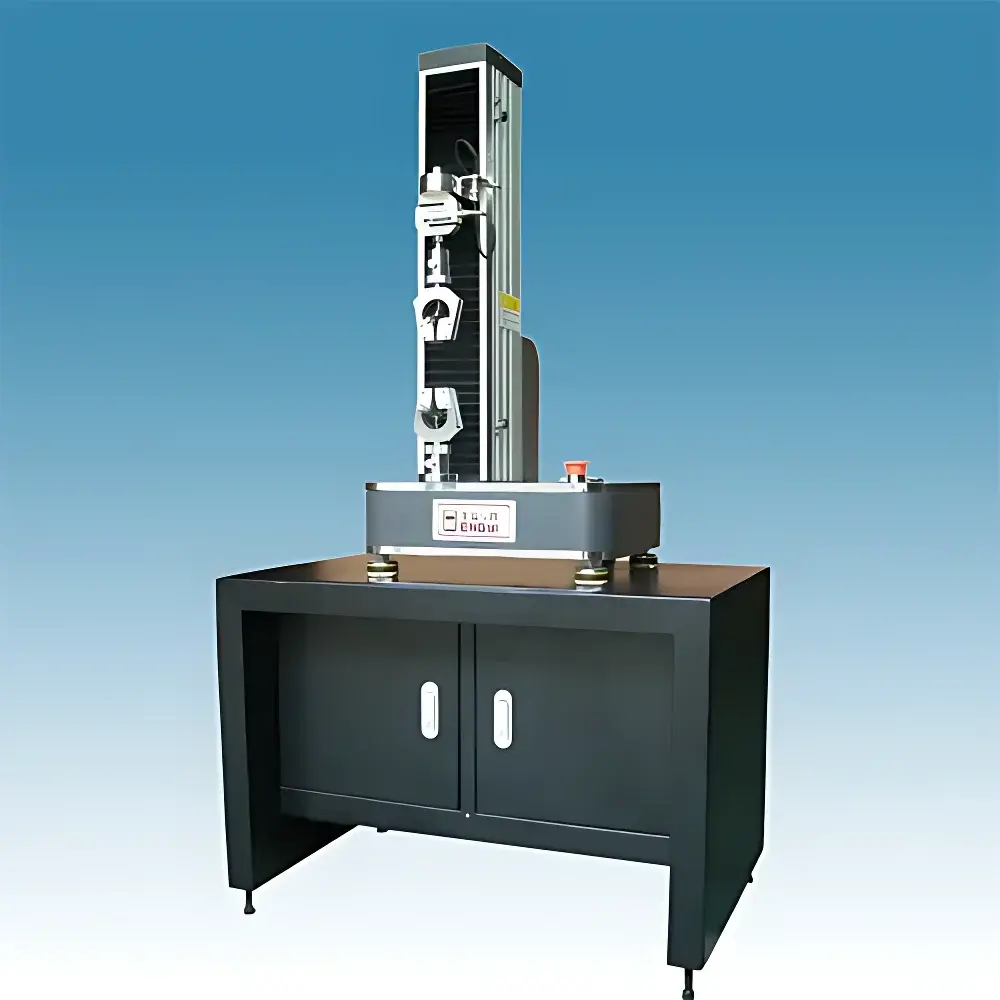
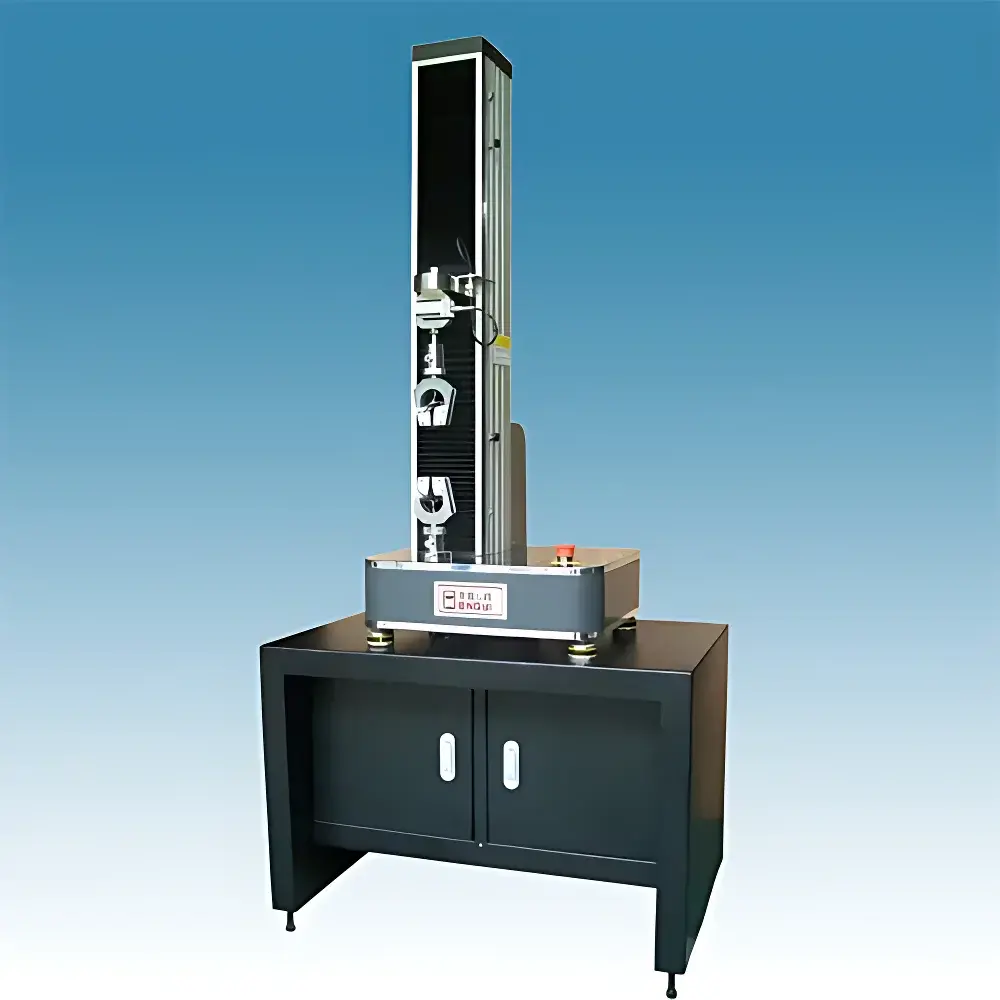
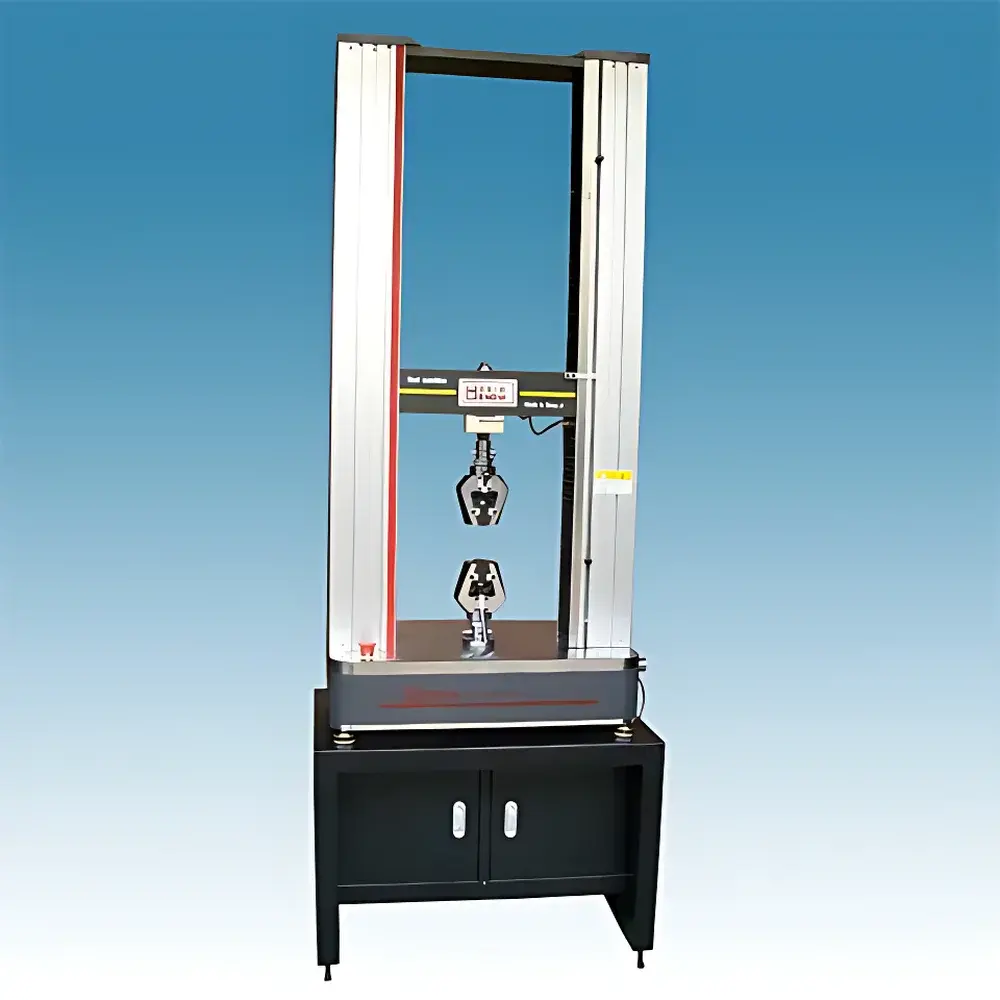
Hengyi HY-0580MNC Single-Column Universal Testing Machine
| Brand | Hengyi |
|---|---|
| Origin | Shanghai, China |
| Manufacturer Type | Direct Manufacturer |
| Country of Origin | China |
| Model | HY-0580MNC |
| Instrument Type | Electromechanical Universal Testing Machine |
| Load Capacity Options | 1 N to 5000 N (interchangeable load cells) |
| Force Accuracy | ≤ ±0.5% of reading |
| Effective Test Width | 120 mm |
| Effective Test Height | 800 mm |
| Crosshead Speed Range | 0.001–500 mm/min (adjustable) |
| Speed Accuracy | ±0.5% of set value |
| Displacement Measurement Accuracy | ±0.5% of reading |
| Strain Measurement Accuracy | ±0.5% of reading |
| Force Resolution | ±500,000 counts (full-scale, no range switching) |
| Stress Control Rate Range | 0.005–6 %FS/s |
| Strain Control Rate Range | 0.002–6 %FS/s |
| Constant-Load/Displacement/Strain Hold Accuracy | ±0.1% FS (≥10% FS), ±1% FS (<10% FS) |
| Safety Features | Electronic travel limit, overload protection (110% FS), auto-diagnostic system |
| Power Supply | 220 V AC, 750 W |
| Dimensions (W×D×H) | 470 × 400 × 1510 mm |
| Weight | 120 kg |
Overview
The Hengyi HY-0580MNC is a precision-engineered single-column electromechanical universal testing machine designed for static mechanical characterization of materials under tension, compression, bending, shear, peel, and tear loading conditions. Built upon a rigid monolithic frame with high-stiffness linear motion guidance, the system employs a servo-controlled ball-screw actuator and high-resolution encoder feedback to deliver repeatable force and displacement control across its full operational envelope. Its modular architecture supports interchangeable load cells ranging from 1 N to 5000 N, enabling traceable force measurement per ISO 7500-1 Class 0.5 and ASTM E4 compliance. The machine operates under closed-loop digital control, supporting stress-, strain-, and displacement-rate modes — essential for standardized mechanical testing in R&D, quality assurance, and regulatory submission workflows.
Key Features
- Single-column compact design optimized for benchtop integration in QC labs and academic research spaces
- High-fidelity force measurement system with ±500,000-count resolution, zero internal range switching, and uniform resolution across full scale
- Wide crosshead speed range (0.001–500 mm/min) with ±0.5% speed accuracy, suitable for quasi-static to medium-rate testing per ISO 6892-1 and ASTM D638
- Dual-speed manual jog controls and programmable return-to-start functionality for rapid sample setup and post-test recovery
- Integrated electronic travel limits and real-time overload protection (110% FS trigger) to safeguard both operator and instrumentation
- Self-diagnostic subsystem continuously monitors drive voltage, current, thermal load, and sensor integrity; initiates fail-safe shutdown on anomaly detection
- Modular fixture interface compliant with ISO 26203-2 and ASTM E1012 standards for alignment verification and repeatability assurance
Sample Compatibility & Compliance
The HY-0580MNC accommodates specimens up to 120 mm wide and 800 mm tall, supporting standardized test geometries for metals, polymers, elastomers, textiles, composites, adhesives, and thin-film substrates. It satisfies mechanical test requirements defined in GB/T 16491–2008 (Chinese equivalent of ISO 7500-1), GB/T 2611–2007 (general testing machine specifications), GB/T 3923 (woven fabric tensile), GB/T 1040 (plastics tensile), and ISO 527, ISO 178, ASTM D638, ASTM D790, ASTM D1876 (peel), and ASTM D624 (tear). Calibration certificates are traceable to national metrology institutes (NIM, CNAS-accredited), and system validation supports GLP-compliant audit trails when paired with compliant software.
Software & Data Management
The system ships with Hengyi TestSuite™ — a Windows-based, FDA 21 CFR Part 11-ready application supporting user-defined test methods, multi-step control profiles (e.g., ramp-hold-ramp), real-time curve overlay, and automated report generation in PDF/Excel formats. Audit trail logging records all parameter changes, test executions, and calibration events with user ID, timestamp, and reason-for-change fields. Raw data export includes force (N), displacement (mm), time (s), and calculated engineering stress/strain — formatted for third-party analysis in MATLAB, Python (NumPy/Pandas), or Minitab. Software permits customizable pass/fail criteria, statistical batch reporting (mean, SD, CV%), and direct integration with LIMS via CSV or OPC UA.
Applications
- Tensile strength and elongation-at-break testing of polymer films, medical tubing, and packaging laminates per ISO 527-2 and ASTM D882
- Compression modulus and yield point determination for foams, gels, and soft biomaterials (ISO 844, ASTM D3574)
- Bending stiffness and flexural modulus evaluation of PCB substrates, fiber-reinforced composites, and 3D-printed thermoplastics (ISO 178, ASTM D790)
- Peel adhesion quantification for pressure-sensitive tapes, labels, and biomedical patches (ASTM D903, PSTC-101)
- Tear resistance assessment of nonwovens, geotextiles, and synthetic leather (ASTM D1938, ISO 9073-4)
- Fastener proof loading and bolt preload verification for automotive and aerospace component suppliers
- Educational mechanics labs requiring ISO/ASTM-aligned instruction modules for material science curricula
FAQ
What load cell options are available for the HY-0580MNC?
Standard configurations include 1 N, 5 N, 10 N, 20 N, 50 N, 100 N, 200 N, 500 N, 1000 N, 2000 N, 3000 N, and 5000 N load cells — all calibrated to ISO 376 Class 0.5 and supplied with individual calibration certificates.
Does the system support automatic test sequencing?
Yes. TestSuite™ enables creation of multi-specimen test sequences with automatic crosshead repositioning, load cell auto-zeroing, and pass/fail logic branching based on real-time results.
Is the machine compatible with third-party environmental chambers?
The HY-0580MNC features a standardized 485/RS-232 port and analog I/O interface (±10 V) for synchronized operation with temperature/humidity chambers, allowing full environmental testing per ISO 6270-2 and ASTM D618.
How is force calibration maintained over time?
The system supports periodic verification using certified deadweight standards or reference load cells. Built-in linearity and hysteresis checks are executable via software without external hardware.
Can test reports be exported in regulated environments?
Yes. When deployed with enabled electronic signatures and audit-trail logging, reports comply with FDA 21 CFR Part 11, EU Annex 11, and ISO/IEC 17025 documentation requirements.



