
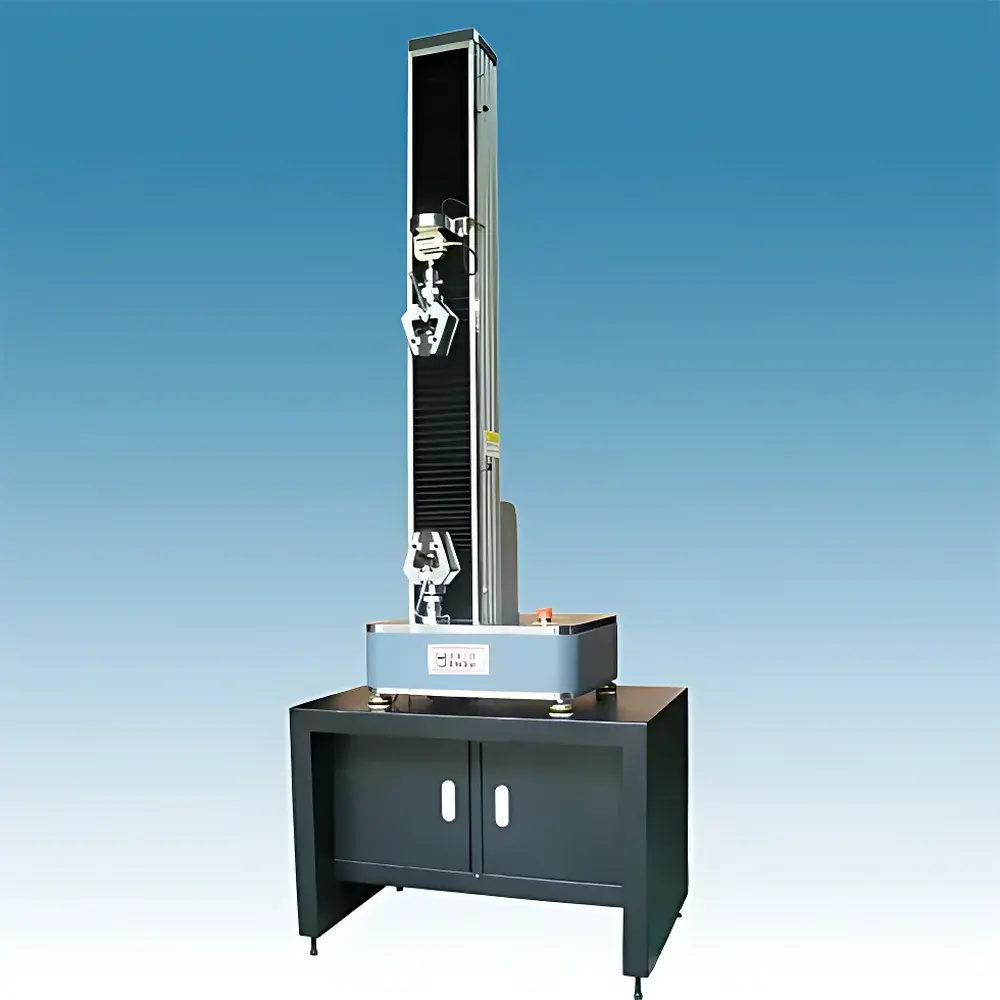
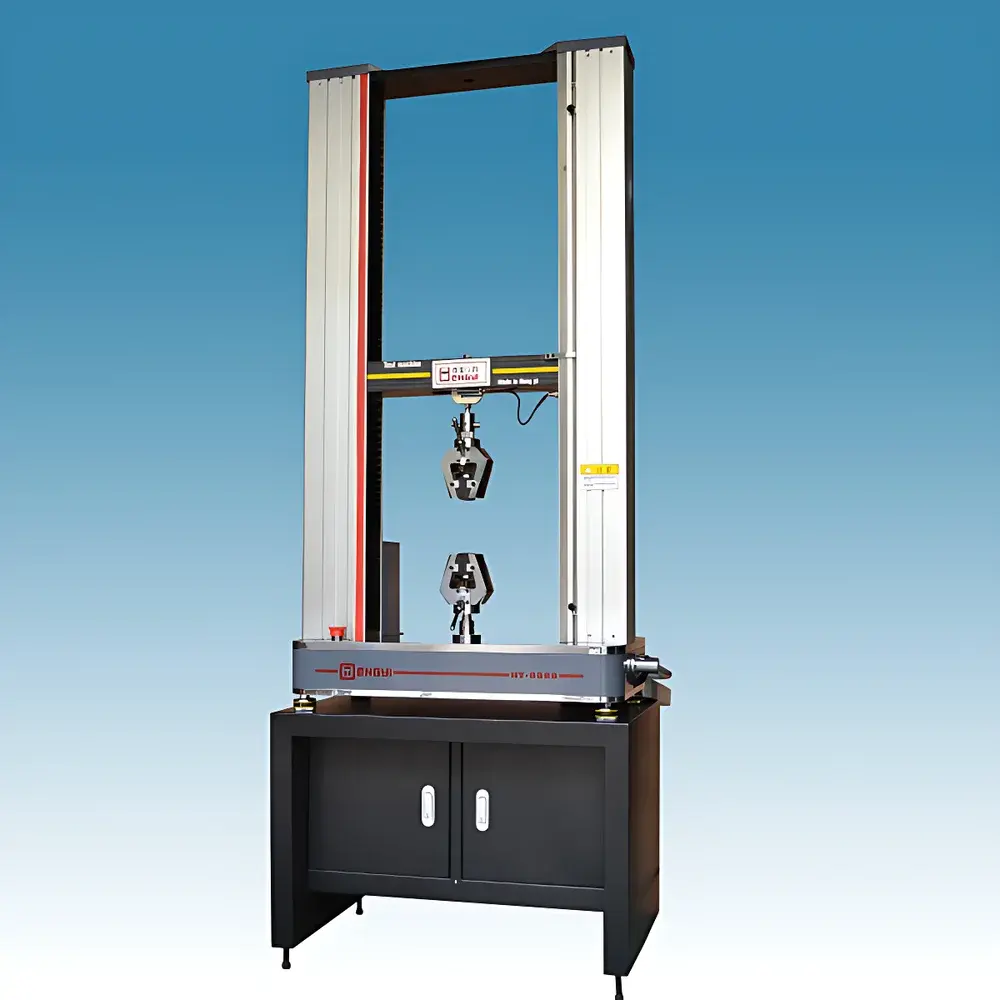
Hengyi HY-0580NJK Single-Column Electromechanical Universal Testing Machine for Biomedical Materials
| Brand | Hengyi |
|---|---|
| Origin | Shanghai, China |
| Manufacturer Type | Direct Manufacturer |
| Country of Origin | China |
| Model | HY-0580NJK |
| Instrument Type | Electromechanical Universal Testing Machine |
| Load Capacity Options | 1 N to 5000 N (interchangeable load cells) |
| Force Accuracy | ≤ ±0.5% of reading |
| Effective Test Width | 120 mm |
| Effective Vertical Travel | 800 mm |
| Speed Range | 0.001–500 mm/min (adjustable) |
| Speed Accuracy | ±0.5% of set value |
| Displacement Accuracy | ±0.5% of reading |
| Strain Control Range | 0.002–6% FS/S |
| Stress Control Range | 0.005–6% FS/S |
| Force Resolution | ±500,000 counts (full-scale, no range switching) |
| Constant-Load/Displacement/Strain Control Range | 0.5–100% FS |
| Protection Features | Electronic limit switches, overload protection (110% FS), automatic fault diagnosis, emergency stop |
| Power Supply | 220 V AC, 50 Hz, 750 W |
| Dimensions (W×D×H) | 470 × 400 × 1510 mm |
| Weight | 95 kg |
| Operating Environment | 20–40 °C, 20–80% RH |
Overview
The Hengyi HY-0580NJK is a single-column, electromechanical universal testing machine engineered for high-precision static and quasi-static mechanical characterization of biomedical materials and implantable devices. It operates on the principle of servo-controlled axial force application via a precision ball-screw-driven crosshead, enabling repeatable uniaxial loading under tension, compression, bending, shear, and peel configurations. Designed specifically for regulatory-compliant biomechanical evaluation, the system meets foundational requirements for ASTM F2118 (tensile testing of orthopedic biomaterials), ISO 5832 (metallic implants), ISO 13314 (compression testing of porous biomaterials), and USP (mechanical testing of surgical meshes and soft tissue scaffolds). Its modular architecture supports interchangeable load cells (1 N to 5000 N), ensuring traceable force measurement across orders of magnitude — critical for evaluating low-force soft tissues (e.g., vascular grafts, corneal stroma) and high-strength metallic fixation systems (e.g., spinal rods, intramedullary nails).
Key Features
- High-fidelity force measurement with ≤ ±0.5% accuracy and 500,000-count resolution, maintained uniformly across full scale without range switching
- Wide dynamic speed range (0.001–500 mm/min) with ±0.5% speed fidelity, supporting both slow creep protocols and rapid pull-to-failure tests
- Dual-mode control architecture: stress-rate and strain-rate regulation compliant with ISO 5832-3 and ASTM D638 for polymer-based implants
- Integrated electronic limit protection, real-time over-load detection (110% FS threshold), and automated fault diagnostics for drive, encoder, and load cell subsystems
- Motorized crosshead with dual-speed (fast/slow) positioning and programmable return-to-start functionality
- Robust aluminum-alloy frame with precision-ground linear guides, optimized for minimal deflection (<0.02 mm under 5 kN load)
- Compliance with IEC 61000-6-2/6-4 electromagnetic compatibility standards for laboratory integration
Sample Compatibility & Compliance
The HY-0580NJK accommodates standardized specimens per ISO 527-2 (plastics), ASTM D882 (thin films), and ISO 6892-1 (metals), as well as custom geometries for anatomically representative constructs. Validated applications include tensile testing of decellularized porcine aortic valves, three-point bending of PEEK spinal cages, compression of calcium phosphate bone void fillers, shear testing of dental composite interfaces, and cyclic fatigue of nitinol stents (up to 10⁶ cycles at programmable R-ratios). All test methods are fully auditable and support GLP/GMP documentation workflows, including electronic signatures, audit trails, and 21 CFR Part 11–compliant data integrity controls when paired with optional Hengyi TestSuite software.
Software & Data Management
Hengyi TestSuite v4.x provides ISO/IEC 17025-aligned test method templates, real-time parameter visualization (load vs. displacement, stress vs. strain, cycle count vs. hysteresis energy), and automated report generation in PDF/A-1b and XLSX formats. Raw data streams are timestamped with microsecond resolution and stored in encrypted SQLite databases with SHA-256 checksum validation. The software supports user-defined pass/fail criteria, statistical process control (SPC) charts (X̄-R, Cp/Cpk), and export to LIMS via ASTM E1384-compliant XML schemas. Calibration certificates are digitally embedded and version-tracked; all calibration events trigger automatic revalidation flags in the audit log.
Applications
- Mechanical qualification of resorbable sutures (ASTM D2256) and bioresorbable polymer screws (ISO 10993-12)
- Compression modulus and yield strength assessment of hydrogel-based cartilage replacements
- Peel adhesion testing of silicone-coated wound dressings per ISO 10993-10
- Bending stiffness evaluation of titanium cranial plates (ASTM F2503)
- Cyclic fatigue life determination of polyethylene tibial inserts (ISO 14243-1)
- Tensile failure analysis of electrospun nanofibrous vascular grafts under physiological strain rates
- Interfacial shear strength quantification between bone cement and PMMA-coated femoral stems
FAQ
Is the HY-0580NJK compliant with FDA 21 CFR Part 11 for electronic records and signatures?
Yes — when configured with Hengyi TestSuite v4.3+ and validated user access controls, it supports audit trails, electronic signatures, and data integrity safeguards required for regulated preclinical device testing.
Can the system perform cyclic fatigue testing up to 10⁶ cycles?
Yes — with optional high-cycle module (servo amplifier upgrade and thermal management kit), the system achieves stable waveform fidelity at frequencies up to 5 Hz and total cycle counts exceeding 10⁶ under controlled ambient conditions.
Does the machine support ASTM F2129 for corrosion testing of metallic implants?
No — the HY-0580NJK is a purely mechanical tester. Corrosion evaluation requires electrochemical instrumentation (e.g., potentiostats); however, it may be used post-corrosion to quantify residual mechanical integrity per ASTM F2129 Annex A1.
What load cell options are certified for ISO/IEC 17025 traceability?
All standard load cells (1 N to 5000 N) ship with factory calibration certificates traceable to NIM (China National Institute of Metrology) and optionally available with UKAS or DAkkS-accredited calibration upon request.
Is third-party validation support available for IQ/OQ/PQ documentation?
Yes — Hengyi provides URS templates, FAT/SAT protocols, and on-site IQ/OQ assistance through ISO 13485-certified field engineers for GMP-regulated laboratories.
Related Products



