
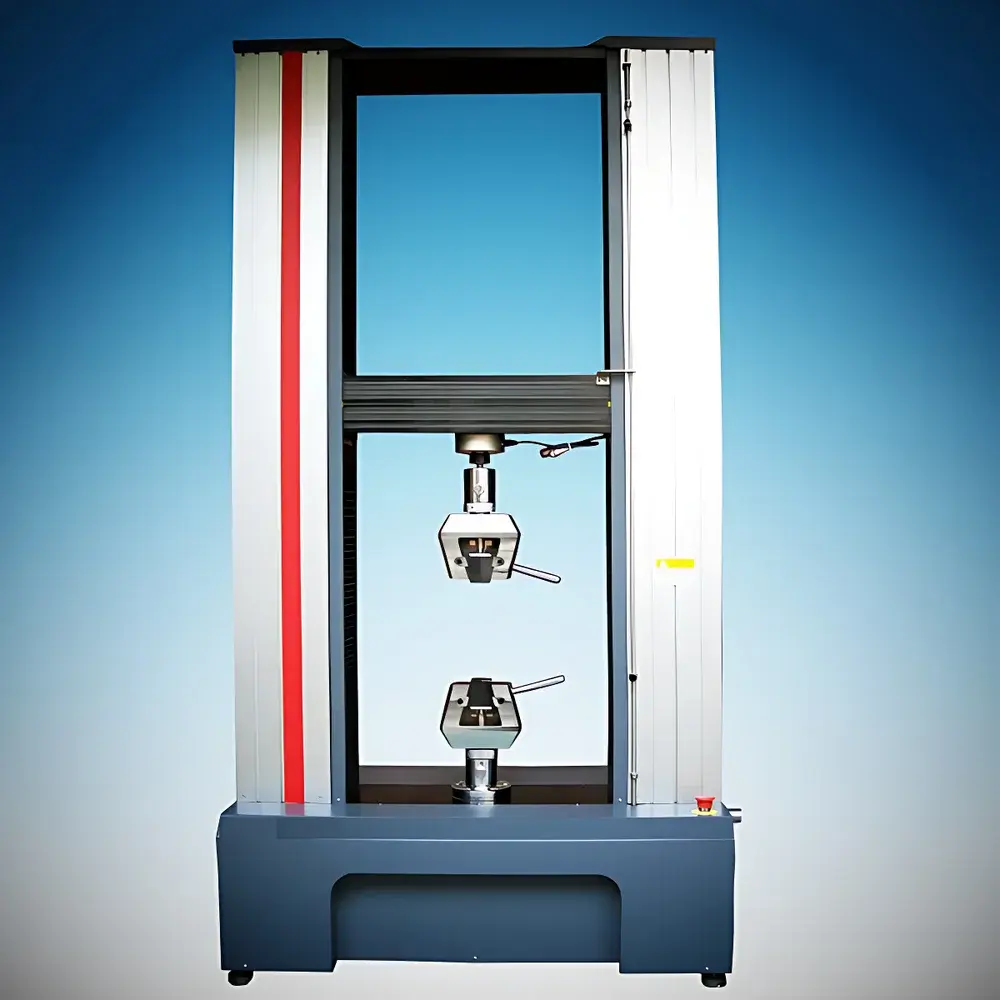
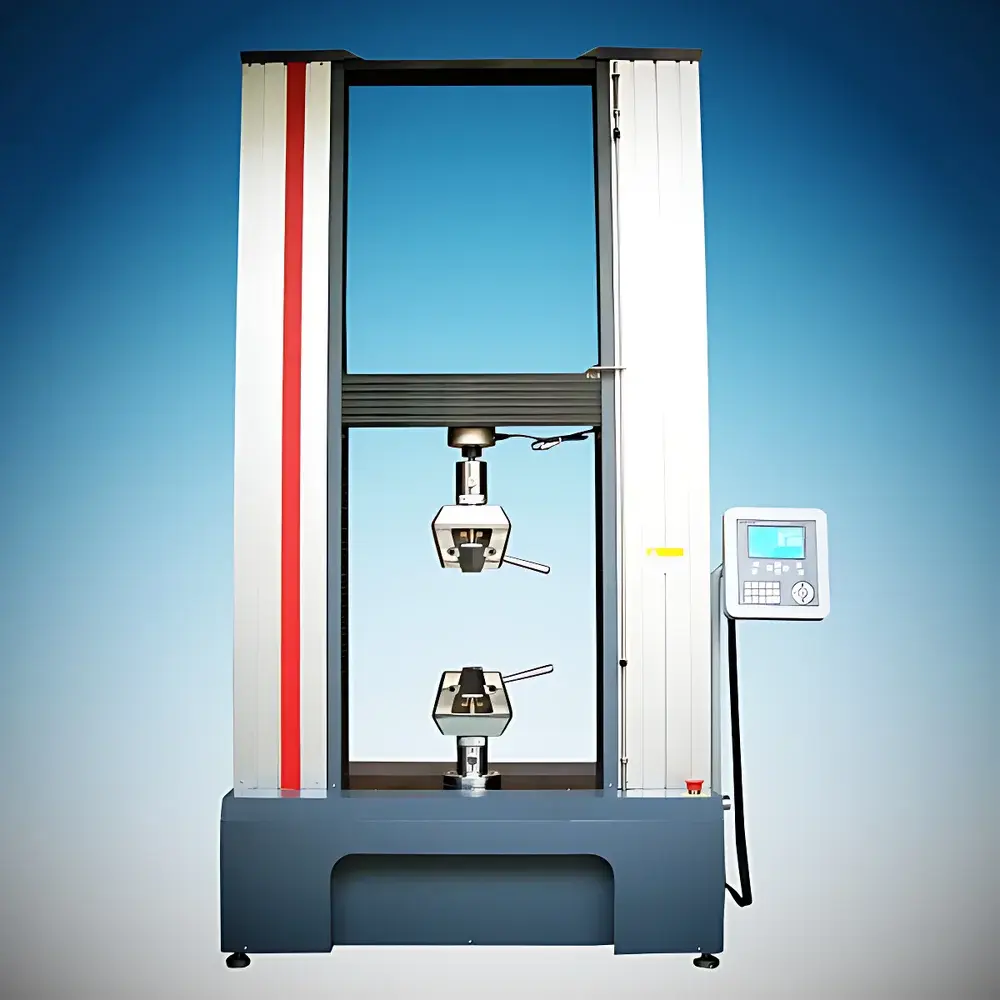
Hengyi HY-30080PUM Universal Electromechanical Tensile Testing Machine
| Key | Brand: Hengyi |
|---|---|
| Origin | Shanghai, China |
| Manufacturer Type | Direct Manufacturer |
| Country of Origin | China |
| Model | HY-30080PUM |
| Max Test Load | 300 kN |
| Force Measurement Range | 0.001–100% FS |
| Force Accuracy | ±0.5% |
| Test Stroke | 800 mm |
| Displacement Resolution | 0.001 mm |
| Control Mode | Stress/Strain/Displacement Closed-Loop |
| Speed Range | 0.001–500 mm/min |
| Speed Accuracy | ±0.5% of reading |
| Weight | 1650 kg |
| Dimensions (W×D×H) | 1000 × 680 × 2300 mm |
| Power Supply | 380 V AC, 3 kW |
Overview
The Hengyi HY-30080PUM is a high-capacity, electromechanical universal testing machine engineered for precision static mechanical characterization of metallic and non-metallic materials under uniaxial loading conditions. Designed in strict compliance with ISO 7500-1 (Class 0.5 accuracy), ASTM E4, and GB/T 16491–2008 (Chinese national standard for electronic universal testing machines), it delivers traceable force measurement across its full 300 kN capacity range. The system employs a dual-column, portal-type structural architecture with reinforced steel frames and preloaded ball-screw actuation to minimize deflection and ensure axial alignment—critical for valid tensile, compression, bending, shear, peel, tear, creep, and relaxation testing per ISO 6892-1, ASTM E8/E9, ASTM D638/D790, and GB/T 228.1–2021. Its closed-loop servo control enables precise regulation of stress, strain, or displacement rates, supporting both routine quality control and advanced R&D workflows in metallurgical laboratories, wire & cable manufacturing, and aerospace material certification.
Key Features
- Class 0.5 force accuracy (±0.5% of reading) validated per ISO 7500-1 and GB/T 16491–2008, with full-scale resolution up to 1:500,000 internal counts—no range switching required.
- High-stiffness龙门 (portal) frame with 600 mm effective test width and 800 mm vertical travel, expandable vertically/horizontally to accommodate large billets, extrusions, and structural composites.
- Wide dynamic speed range: 0.001–500 mm/min, with speed stability maintained within ±0.5% of setpoint—enabling low-strain-rate creep studies and high-speed rupture testing.
- Integrated safety architecture: electronic limit switches, overload protection (110% FS cut-off), emergency stop circuitry, and real-time self-diagnostic monitoring of drive voltage, current, and load cell integrity.
- Modular fixture compatibility: standardized T-slot crosshead and base table accept ASTM-compliant tensile grips (pneumatic/wedge-action), compression platens, three/four-point bending fixtures, shear adapters, peel jigs, and tear fixtures—all calibrated per ISO 9513.
- Dual-mode displacement measurement: high-resolution encoder (0.001 mm resolution) supplemented by optional extensometers (contact or non-contact) meeting ISO 9513 Class 1 requirements for modulus and yield point determination.
Sample Compatibility & Compliance
The HY-30080PUM accommodates cylindrical, rectangular, and irregular-section specimens—including aluminum rods (e.g., 6061-T6, 7075-T73), copper bars (C10100, C11000), brass alloys, stainless steels, titanium grades, polymer composites, and elastomeric compounds. It supports specimen gauges up to 300 mm in length and cross-sections exceeding 100 × 100 mm². All mechanical tests comply with internationally recognized standards: tensile testing per ISO 6892-1 and ASTM E8; compression per ISO 13314 and ASTM E9; bending per ISO 178 and ASTM D790; and shear per ISO 3597 and ASTM D5379. Calibration certificates are traceable to NIM (National Institute of Metrology, China) and compatible with ISO/IEC 17025-accredited laboratory audits. System validation documentation satisfies GLP and GMP requirements for regulated industries, including raw material release and supplier qualification programs.
Software & Data Management
The machine operates via Hengyi’s proprietary TestMaster v4.2 software—a Windows-based platform compliant with FDA 21 CFR Part 11 for electronic records and signatures. It provides real-time force-displacement-strain data acquisition at ≥1 kHz sampling rate, automatic calculation of ReH, ReL, Rp0.2, Rm, A%, Z%, E, n, and m values, and customizable report generation in PDF, Excel, and XML formats. Audit trails log all user actions, parameter changes, calibration events, and test interruptions. Data export supports third-party analysis tools (MATLAB, Origin, Minitab) and LIMS integration via ODBC. Software modules include creep/relaxation protocol builder, multi-step cyclic testing, and pass/fail tolerance banding aligned with customer-specific specifications or ASTM E2382.
Applications
- Metal product certification: tensile strength and ductility verification of drawn copper rods (ASTM B187), extruded aluminum profiles (ASTM B221), and forged billets per AMS 2301.
- Quality assurance in wire & cable production: elongation-at-break and yield behavior of annealed copper conductors (IEC 60228).
- Research on high-temperature alloy behavior: stress-relaxation testing of nickel-based superalloys under controlled thermal environments (when integrated with environmental chambers).
- Composite material development: interlaminar shear strength (ILSS) of carbon-fiber-reinforced polymers using short-beam shear fixtures.
- Failure analysis labs: comparative fracture surface morphology correlation with mechanical performance metrics across batch lots.
- Academic materials science: fundamental deformation mechanism studies via synchronized digital image correlation (DIC) and high-resolution extensometry.
FAQ
What standards does the HY-30080PUM comply with for force calibration?
It conforms to ISO 7500-1 Class 0.5, ASTM E4, and GB/T 16491–2008, with factory calibration traceable to NIM reference standards.
Can the system perform creep testing at elevated temperatures?
Yes—when paired with a certified environmental chamber (e.g., −70°C to +300°C), the machine supports ISO 291 and ASTM D2990 creep protocols with automatic hold-and-measure functionality.
Is the software compliant with FDA 21 CFR Part 11 requirements?
Yes—TestMaster v4.2 includes role-based access control, electronic signatures, full audit trail, and secure data archiving to meet Part 11 and Annex 11 regulatory expectations.
What extensometer options are supported for high-accuracy modulus measurement?
Both clip-on axial extensometers (ISO 9513 Class 1, 10–50 mm gauge lengths) and non-contact video extensometers (with sub-pixel edge detection) are fully integrated and auto-recognized by the software.
Does the machine support automated test sequence execution?
Yes—users can define multi-step programs (e.g., preload → ramp → hold → unload → retest) with conditional logic, pass/fail criteria, and automatic report generation per test cycle.



