
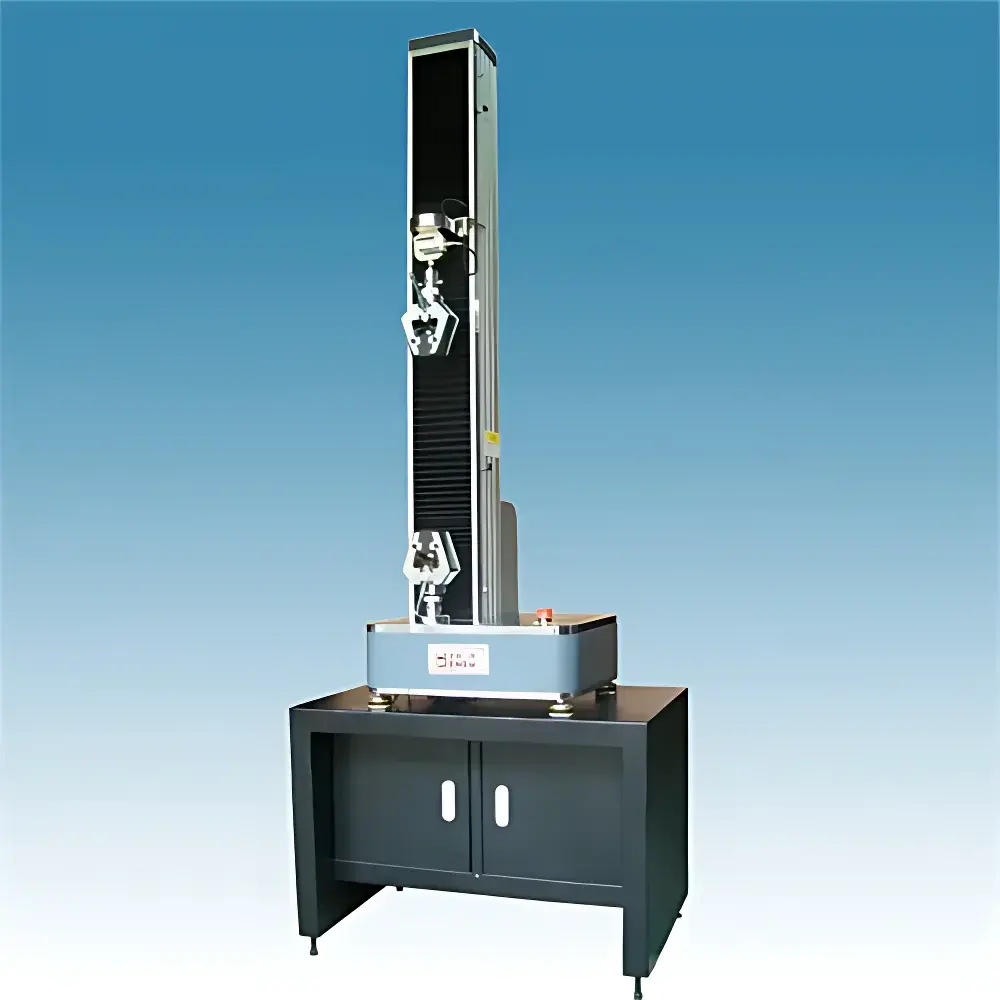
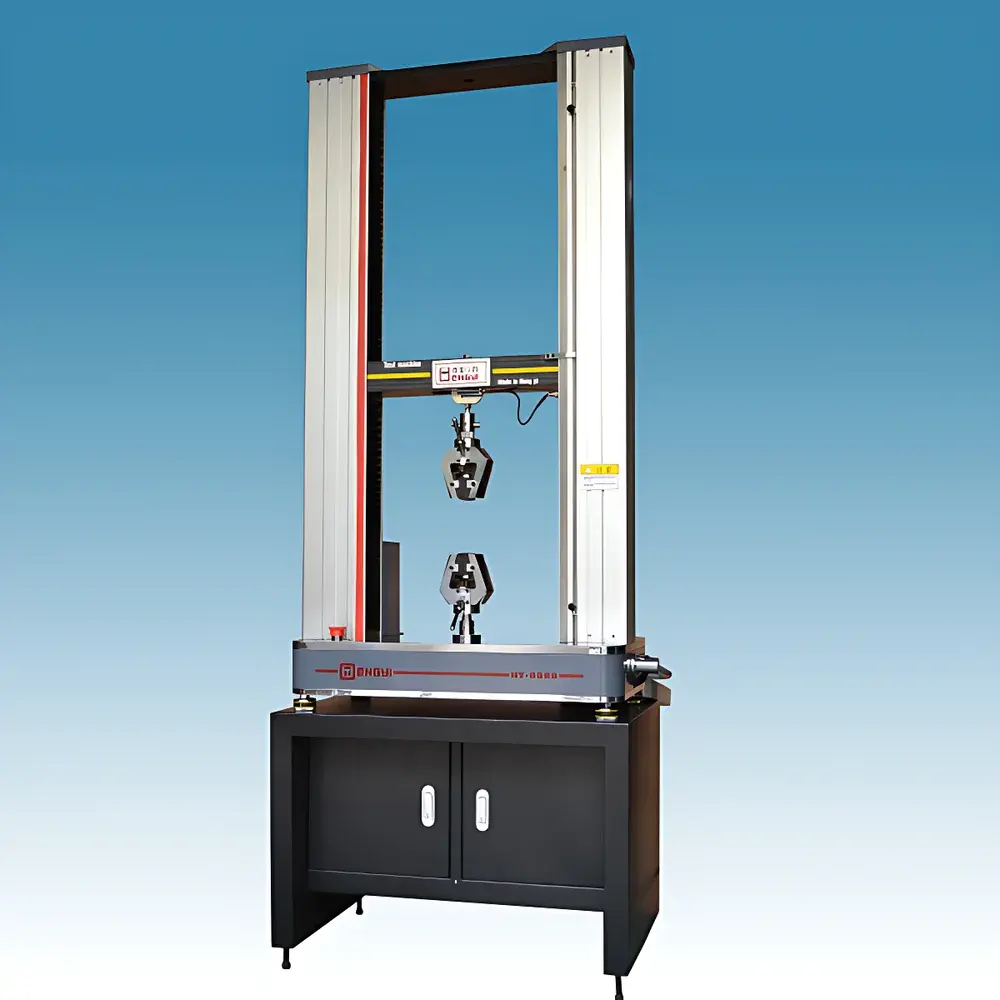
Hengyi HY-0580RTYU Single-Column Universal Testing Machine for Textile Materials
| Brand | Hengyi |
|---|---|
| Origin | Shanghai, China |
| Manufacturer Type | Direct Manufacturer |
| Product Category | Domestic |
| Model | HY-0580RTYU |
| Instrument Type | Electromechanical Universal Testing Machine |
| Load Capacity Options | 1 N to 5000 N (interchangeable load cells) |
| Force Accuracy | ≤ ±0.5% of reading |
| Effective Test Width | 120 mm |
| Effective Vertical Travel | 800 mm |
| Speed Range | 0.001–500 mm/min |
| Speed Accuracy | ±0.5% of set value |
| Displacement Accuracy | ±0.5% of reading |
| Strain Measurement Accuracy | ±0.5% of reading |
| Control Modes | Stress, Strain, and Displacement Control |
| Safety Features | Electronic limit protection, overload protection (110% FS), automatic return, programmable stop conditions |
| Power Supply | 220 V AC, 750 W |
| Dimensions (W×D×H) | 470 × 400 × 1510 mm |
| Weight | 120 kg |
| Compliance | GB/T 2611, GB/T 16491, GB/T 16852.1, GB/T 3923, GB/T 1040, ISO 7500-1, ASTM E4, ASTM D638, ASTM D3759, JIS K7113 |
Overview
The Hengyi HY-0580RTYU is a single-column electromechanical universal testing machine engineered for high-precision mechanical characterization of low-to-medium force-range materials—particularly textile fabrics, nonwovens, technical textiles, thin films, elastomers, and polymer-based composites. It operates on the principle of controlled uniaxial loading via a precision ball-screw-driven crosshead, with real-time measurement of tensile, compressive, flexural, peel, tear, and shear responses. Its modular architecture supports standardized test protocols across R&D laboratories, quality control departments, and academic institutions where repeatability, traceability, and regulatory alignment are essential. Designed in accordance with international metrological standards—including ISO 7500-1 (static calibration of force-measuring systems) and ASTM E4 (verification of force-measuring instruments)—the system delivers Class 0.5 accuracy per ISO 7500-1 and meets the stringent requirements of GB/T 16491-2008 for electronic testing machines.
Key Features
- Single-column rigid frame with aluminum alloy extrusion housing and hardened steel guide columns, optimized for stability during low-force textile tensile tests (1 N – 5 kN range)
- High-resolution force measurement: 500,000-count A/D conversion, no internal range switching, full-scale resolution maintained across all load cells
- Wide-speed actuation: 0.001–500 mm/min, digitally regulated via closed-loop servo control with ±0.5% speed fidelity
- Multi-mode closed-loop control: stress rate (0.005–6% FS/s), strain rate (0.002–6% FS/s), and displacement rate—each with dual-threshold accuracy specifications per load level
- Dual-speed manual jog control and programmable auto-return function for rapid specimen setup and post-test reset
- Integrated electronic limit switches and software-enforced overload cutoff (110% of selected load cell capacity) for operator and equipment safety
- Modular fixture interface compatible with pneumatic clamps, roller grips, trouser-tear fixtures, and ASTM D5034-compliant grab-test assemblies
Sample Compatibility & Compliance
The HY-0580RTYU accommodates flat, woven, knitted, braided, and nonwoven textile specimens up to 120 mm wide and 800 mm gauge length—covering standard configurations defined in GB/T 3923.1 (breaking strength and elongation of fabrics), ISO 13934-1, ASTM D5034 (grab test), ASTM D5035 (strip test), and ISO 9073-3 (nonwovens tensile). Its mechanical design and control firmware comply with GB/T 2611-2007 (general technical requirements for testing machines), GB/T 16852.1-2008 (static uniaxial machine verification), and ISO 7500-1:2018 (calibration of force-proving instruments). All measurement data adhere to GLP principles, supporting audit-ready documentation for ISO/IEC 17025-accredited labs and FDA-regulated textile medical device validation.
Software & Data Management
Equipped with Hengyi’s proprietary TestMaster v4.x software, the system provides intuitive test method configuration, real-time curve visualization (load vs. displacement, stress vs. strain), and automated report generation in PDF/Excel formats. The software supports user-defined test sequences—including multi-step ramp-hold-relax profiles—and integrates digital signature functionality for 21 CFR Part 11 compliance in regulated environments. Raw data export includes timestamped metadata (operator ID, environmental conditions, calibration certificate IDs), enabling full traceability from acquisition to analysis. Optional API access allows integration with LIMS or MES platforms via TCP/IP or OPC UA protocols.
Applications
- Tensile strength and elongation at break of apparel, geotextiles, filtration media, and protective fabrics (e.g., flame-retardant, antimicrobial, or conductive textiles)
- Peel adhesion testing of laminated textiles and coated substrates per ASTM D903
- Tear resistance evaluation using tongue, trapezoid, or Elmendorf methods (with optional accessories)
- Compression behavior of 3D spacer fabrics and padding materials under quasi-static loading
- Mechanical aging studies—cyclic loading/unloading, creep, and stress relaxation over extended durations
- Validation of textile performance in biomedical applications (e.g., suture anchor pullout, wound dressing integrity)
FAQ
What load cell options are available for textile-specific testing?
Standard configurations include 1 N, 5 N, 10 N, 50 N, 100 N, 500 N, and 1000 N load cells—all calibrated to ISO 376 Class 0.5 and supplied with NIST-traceable certificates.
Does the system support ASTM D5034 and ISO 13934-1 out-of-the-box?
Yes. Preloaded test templates, fixture geometry definitions, and reporting formats conform directly to both standards; no custom scripting required.
Can deformation be measured without extensometers?
Crosshead displacement is used for strain calculation per GB/T 3923.1; however, optional non-contact video extensometry or clip-on axial extensometers (with ±0.5% strain accuracy) are supported for Poisson’s ratio or localized strain analysis.
Is remote diagnostics and firmware update capability included?
Yes. Built-in Ethernet port enables secure remote access for troubleshooting, calibration verification, and over-the-air firmware updates—subject to customer network policy approval.
What maintenance intervals are recommended for long-term accuracy retention?
Annual verification against certified reference standards is advised; biannual mechanical inspection of drive train and grip alignment is recommended for high-throughput labs operating >8 hours/day.



