
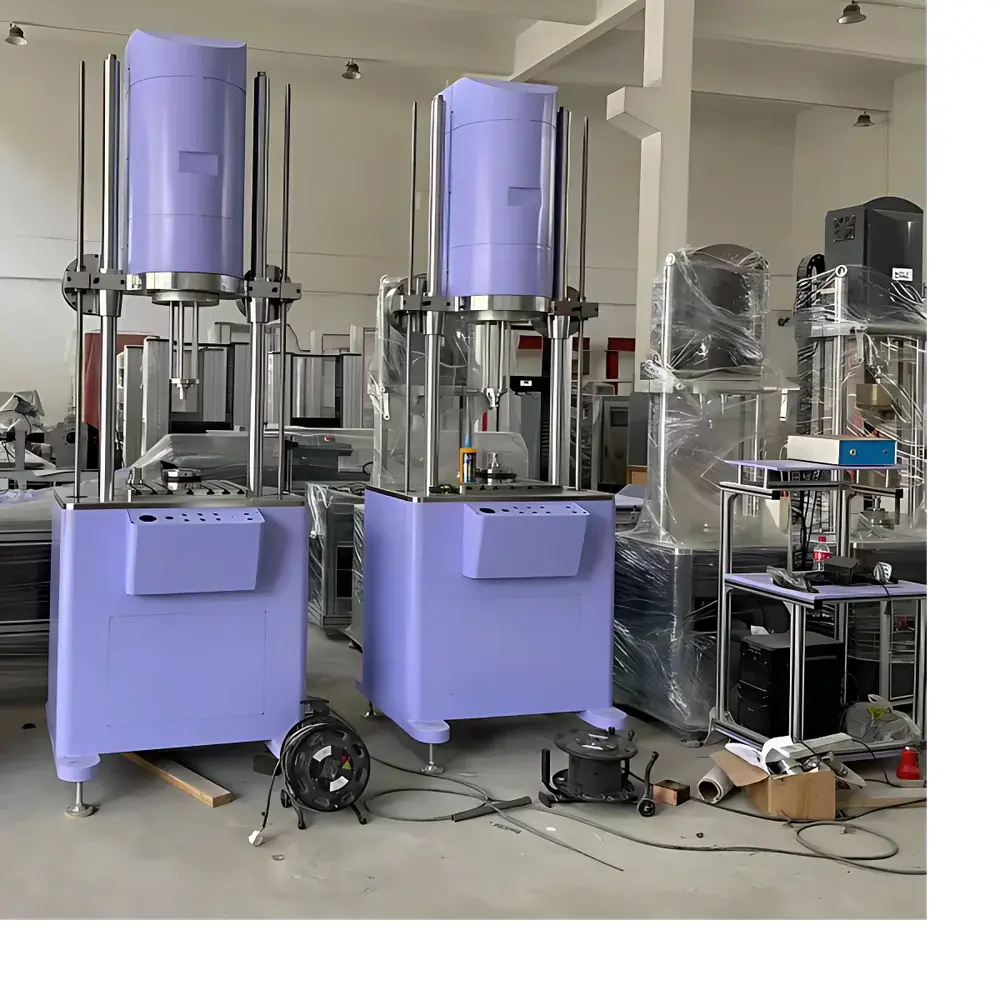
Hengyi HY(DP)50205FH Electromechanical Dynamic-Torsional Combined Fatigue Testing Machine
| Key | Brand: Hengyi |
|---|---|
| Origin | Shanghai, China |
| Manufacturer Type | Direct Manufacturer |
| Model | HY(DP)50205FH |
| Max Test Load | ±5000 N / ±50 N·m |
| Frequency Range | 0–50 Hz |
| Host Weight | 800 kg |
| Compliance | ISO 7500-1, ASTM E4, ASTM E2137, ISO 14801, ISO 17987 (for orthopedic implant fatigue), GLP-ready data traceability |
Overview
The Hengyi HY(DP)50205FH Electromechanical Dynamic-Torsional Combined Fatigue Testing Machine is a precision-engineered system designed for high-fidelity, multi-axis mechanical endurance evaluation of orthopedic implants, biomaterials, and functional medical devices. It operates on closed-loop electromechanical actuation principles—employing dual independent servo-controlled actuators for simultaneous axial (tension/compression) and torsional loading—enabling true biaxial or triaxial fatigue simulation under programmable waveforms. Unlike hydraulic systems, its all-electric architecture eliminates fluid contamination risks, reduces maintenance overhead, and ensures sub-millisecond synchronization between force, torque, displacement, and angular position channels. The machine is specifically configured to meet the biomechanical test requirements defined in ISO 14801 (dental implants), ISO 7206-4/6 (femoral stems), ISO 17987 (spinal fixation systems), and ASTM F2193 (pedicle screw fatigue), making it suitable for preclinical validation, regulatory submission support (FDA 510(k), CE MDR Annex I), and long-term durability assessment under physiologically relevant loading spectra.
Key Features
- Dual-actuator architecture: Independent ±5000 N linear actuator and ±50 N·m rotary actuator, both with real-time closed-loop control and synchronized waveform generation
- Programmable dynamic loading: Supports sinusoidal, triangular, square, trapezoidal, ramp, and block-spectrum waveforms at frequencies from DC to 50 Hz—with phase offset capability between axial and torsional components
- High-resolution measurement: Force resolution 0.01 N; torque resolution 0.01 N·m; linear displacement resolution 0.01 mm; angular resolution 0.01°; all conforming to ISO 7500-1 Class 1 accuracy
- Modular environmental integration: Standard mounting interfaces for optional high-temperature furnaces (up to 300 °C), environmental chambers (−70 °C to +150 °C), or corrosion test enclosures (ASTM B117 salt spray compatibility)
- Comprehensive hardware protection: Overload cutoff (force/torque/angle), specimen fracture detection, thermal shutdown, overcurrent/overvoltage monitoring, and self-diagnostic fault logging
- Ergonomic test space: 450 mm lateral clearance, 500 mm vertical stroke range, and customizable fixture adaptability for femoral stem, spinal rod, dental abutment, and stent geometries
Sample Compatibility & Compliance
The HY(DP)50205FH accommodates standardized and custom specimens per ISO 5832, ASTM F1712, and ISO 13357, including metallic (Ti-6Al-4V, CoCrMo), polymer (UHMWPE, PEEK), ceramic (zirconia, alumina), and shape-memory alloy (NiTi) constructs. Its load frame geometry supports ASTM F2193-compliant pedicle screw bending-torsion protocols, ISO 14801 cyclic torsion-to-failure testing of dental implants, and ISO 17987 multi-cycle flexural-torsional loading of spinal rods. All test procedures are fully traceable under GLP and GMP frameworks: audit trails record operator ID, calibration timestamps, environmental sensor readings, and raw channel data with cryptographic hashing. System software complies with FDA 21 CFR Part 11 requirements for electronic records and signatures—including role-based access control, electronic signatures, and immutable event logs.
Software & Data Management
The embedded Windows-based control platform provides full test orchestration via intuitive GUI with virtual keyboard navigation. Real-time acquisition captures force, torque, axial displacement, angular rotation, and temperature (when equipped) at up to 10 kHz sampling rate. Users define complex test sequences—including stepwise amplitude modulation, frequency sweeps, and conditional termination triggers (e.g., 10% torque degradation, cycle count threshold, or stiffness drop >5%). Curve visualization supports overlay of multiple channels, dynamic axis scaling, grid customization, and export in SVG/PNG formats. Data is stored in vendor-neutral HDF5 format with embedded metadata (test standard, specimen ID, environmental conditions). Reporting modules generate compliant PDF, Word, and Excel outputs containing full traceability: equipment calibration certificates, operator credentials, environmental logs, raw data excerpts, statistical summaries (mean cycles to failure, Weibull parameters), and annotated stress-life (S-N) plots.
Applications
- Femoral stem fatigue validation under combined axial-torsional loading per ISO 7206-4
- Spinal fusion rod fatigue life assessment under asymmetric bending-torsion per ISO 17987
- Dental implant-abutment interface integrity testing under cyclic off-axis loading (ISO 14801)
- Shape memory alloy (SMA) wire and stent fatigue characterization across transformation temperature ranges
- Biodegradable polymer scaffold degradation-coupled mechanical endurance profiling
- Orthopedic soft-tissue anchor pullout-torsion fatigue per ASTM F2193 Annex A3
FAQ
What standards does this system support for orthopedic implant testing?
It natively supports ISO 7206-4/6 (hip/knee stems), ISO 14801 (dental implants), ISO 17987 (spinal systems), ASTM F2193 (pedicle screws), and ASTM E2137 (general fatigue methodology). Custom protocol implementation is available upon request.
Can the system perform tests under physiological temperature or saline immersion?
Yes—via integration with optional environmental chambers or custom-designed corrosion-resistant test enclosures compatible with ASTM B117 and ISO 10993-12 protocols.
Is the software compliant with FDA 21 CFR Part 11 for regulated submissions?
Yes—the system includes full electronic signature workflows, audit trail generation, user permission tiers, and data integrity safeguards required for FDA, EMA, and MDR submissions.
What is the maximum specimen length accommodated in compression mode?
Standard compression height is 500 mm; extension kits increase this to 800 mm. Fixture configurations are modular and adaptable to ISO 5832-3 and ASTM F1712 specimen geometries.
Does the system offer remote diagnostics or predictive maintenance capabilities?
Built-in health monitoring logs actuator current draw, thermal profiles, and encoder feedback anomalies. Service alerts are configurable via email/SNMP and integrate with enterprise CMMS platforms.



