
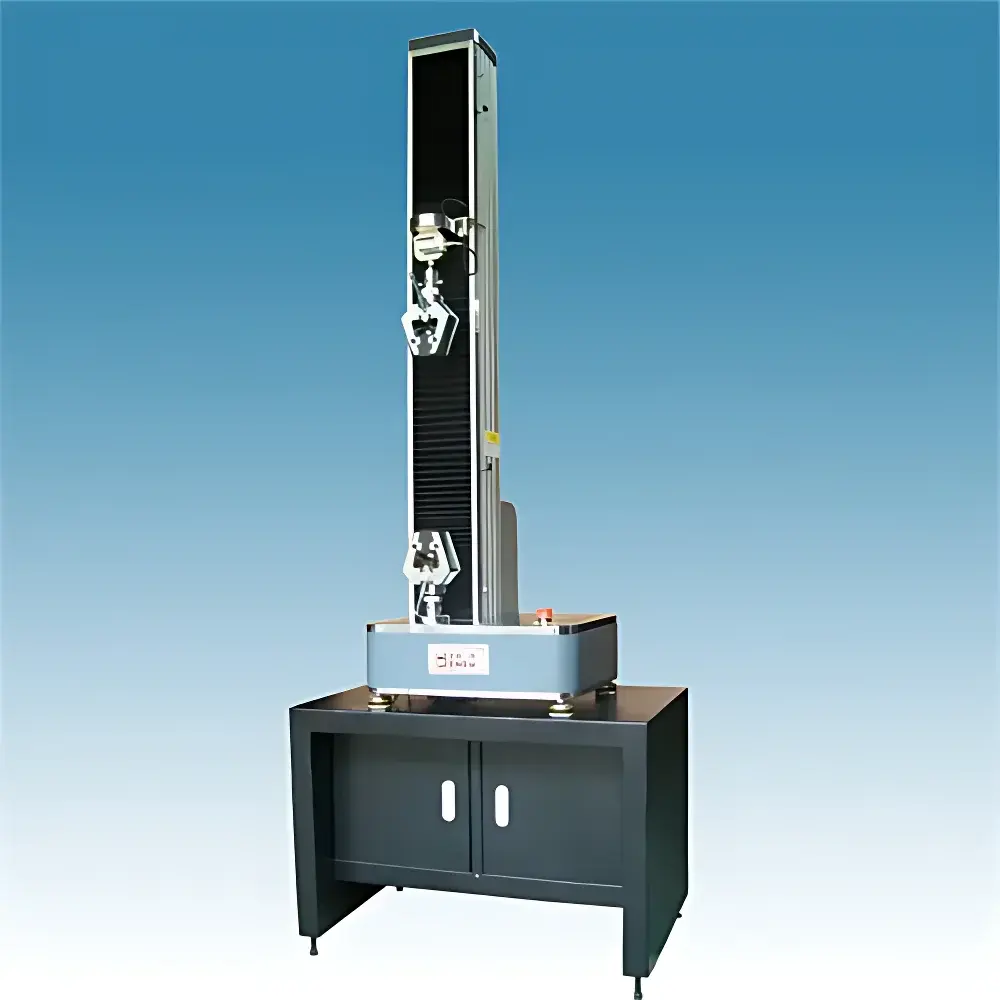
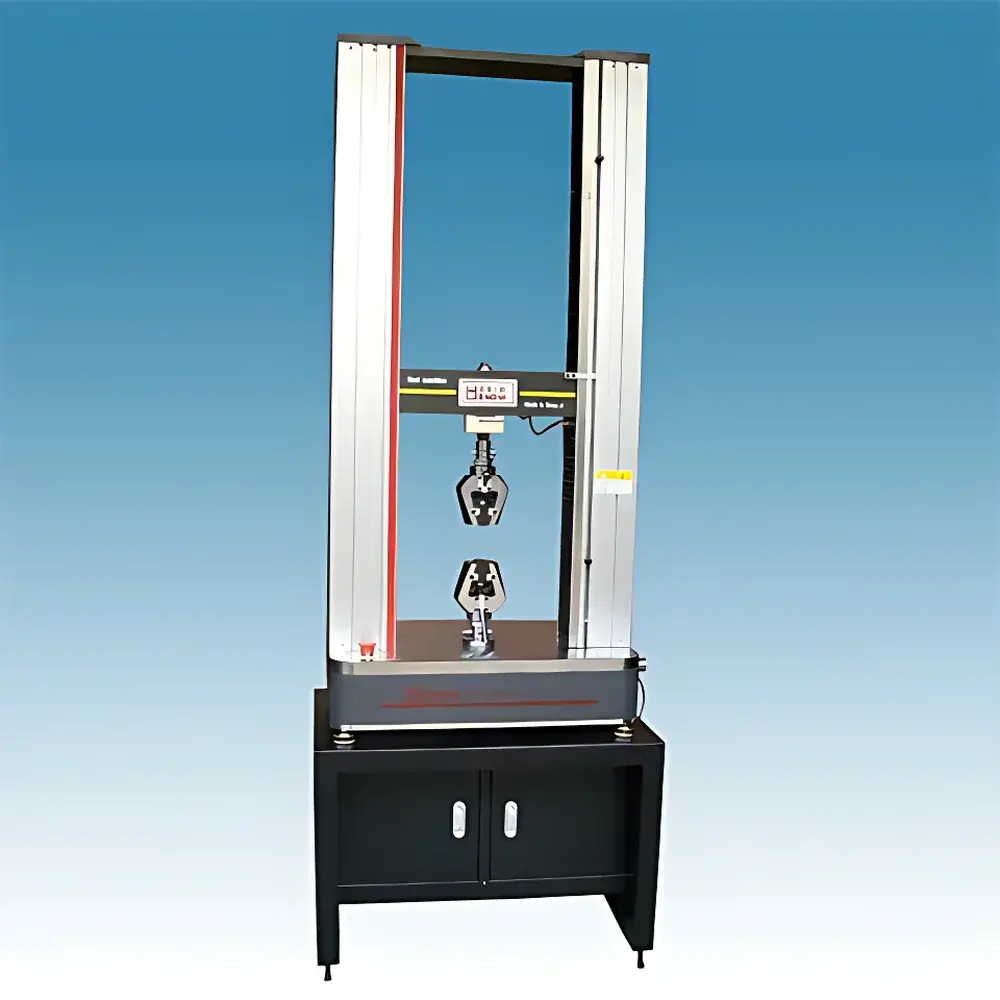
Hengyi HY-0580TUYUMK Universal Testing Machine
| Brand | Hengyi |
|---|---|
| Origin | Shanghai, China |
| Manufacturer Type | Direct Manufacturer |
| Regional Category | Domestic (China) |
| Model | HY-0580TUYUMK |
| Instrument Type | Electromechanical Universal Testing Machine |
| Max Load Capacity | 5–5000 N (selectable) |
| Accuracy Class | 0.5 |
| Effective Test Width | 120 mm |
| Effective Vertical Travel | 800 mm |
| Speed Range | 0.001–500 mm/min |
| Speed Accuracy | ±0.5% of reading |
| Force Resolution | ±500,000 counts (full-scale, no range switching) |
| Displacement Accuracy | ±0.5% of reading |
| Strain Measurement Accuracy | ±0.5% of reading |
| Control Modes | Stress, Strain, Load, and Displacement closed-loop |
| Compliance | GB/T 16491–2008, ISO 527, ASTM D638/D882/D3763, JIS K7113, DIN 53455 |
Overview
The Hengyi HY-0580TUYUMK Universal Testing Machine is an electromechanical materials testing system engineered for high-precision mechanical characterization of metals, polymers, composites, biomaterials, and medical packaging under tension, compression, peel, shear, and flexure loading conditions. Based on servo-controlled electromechanical actuation and real-time closed-loop feedback, the system implements four independent control modes—load, displacement, stress, and strain—to ensure stable, repeatable test execution across diverse material classes and standard-compliant protocols. Designed to meet the structural and metrological requirements of GB/T 16491–2008, it delivers traceable force measurement with 0.5-class accuracy and sub-micron displacement resolution over a wide dynamic range (0.1% to 99.999% of full scale). Its modular architecture supports rapid fixture interchangeability, enabling seamless transition between tensile grips, peel jigs (90° and 180°), puncture probes, three-point bending fixtures, and custom bio-tissue clamps—making it suitable for both routine QC verification and exploratory research in regulated environments.
Key Features
- Electromechanical actuation with brushless servo motor and precision ball-screw transmission for low-noise, high-reproducibility motion control
- Four closed-loop control strategies (load, displacement, stress, strain) with automatic switching and real-time parameter tuning
- High-resolution force transduction: ±500,000 internal counts, no auto-ranging required, constant resolution across full 5–5000 N capacity range
- Adjustable crosshead speed from 0.001 to 500 mm/min, with speed accuracy maintained within ±0.5% of setpoint
- Dual-speed manual jog function and programmable return-to-start for efficient sample handling and throughput optimization
- Integrated electronic limit protection, overload cutoff (>110% FS), and self-diagnostic routines for drive, load cell, and encoder subsystems
- Rigid aluminum-alloy frame with dual-layer baked enamel finish for long-term dimensional stability and corrosion resistance
- Compact footprint (470 × 400 × 1510 mm) and 100 kg mass optimized for laboratory benchtop integration without floor anchoring
Sample Compatibility & Compliance
The HY-0580TUYUMK accommodates specimens ranging from micro-scale hydrogels (≥2 mm width) to rigid metallic implants (≤120 mm test width, ≤800 mm vertical travel). It supports standardized testing of biomedical soft tissues—including tendon, ligament, skin, intestinal membrane, collagen scaffolds, and synthetic hydrogels—using compliant fixtures that minimize slippage and edge damage. For packaging and polymer applications, it executes ASTM F904 (peel strength), ASTM D882 (thin film tensile), ISO 11339 (adhesive bond strength), and GB/T 2790/2791 (180°/90° peel) with calibrated angular alignment. All hardware and firmware comply with GB/T 16491–2008 for electronic testing machines; data acquisition meets GLP audit-trail requirements when paired with validated software configurations. Optional calibration certificates are traceable to CNAS-accredited national standards.
Software & Data Management
The system operates with Hengyi’s proprietary PC-based control and analysis software, supporting Windows 10/11 and featuring intuitive workflow-driven test setup, real-time curve overlay, and multi-channel synchronized data logging (load, displacement, strain, time). Raw data exports in CSV and XML formats enable third-party statistical analysis (e.g., JMP, MATLAB, Python pandas). Curve fitting includes Young’s modulus derivation via initial linear region slope, yield point detection using 0.2% offset method, and fracture energy calculation via area-under-curve integration. Reports conform to ISO/IEC 17025 documentation standards, including operator ID, environmental conditions (optional sensor input), calibration status, and digital signature fields. FDA 21 CFR Part 11 compliance is achievable through optional software validation packages and role-based access control modules.
Applications
- Mechanical evaluation of orthopedic and dental implant materials (titanium alloys, PEEK, bioactive ceramics, shape-memory NiTi)
- Tensile and suture retention testing of surgical meshes, sutures, wound closure strips, and hemostatic gauzes per ISO 10993-12
- Peel adhesion quantification of medical device pouches, blister packs, and sterile barrier systems (ASTM F88/F904)
- Compression and creep behavior of hydrogels, tissue-engineered constructs, and drug-eluting matrices
- Three-point bending stiffness of bone cements, dental resins, and cranial fixation plates
- Quantitative texture analysis of food-grade gels, meat analogs, and pharmaceutical tablets (TPA extension)
- Quality control of polymer films, laminates, foils, and nonwovens used in diagnostics, wearables, and transdermal patches
FAQ
What is the maximum allowable specimen height for compression testing?
The effective vertical test space is 800 mm, permitting compression tests on specimens up to 750 mm in height when using standard platens.
Can the system perform cyclic loading or fatigue tests?
Yes—via programmable waveform generation (sine, triangle, trapezoidal), the controller supports load/displacement-controlled cycling up to 5 Hz with dwell intervals and amplitude ramping.
Is third-party calibration support available?
Hengyi provides factory calibration reports traceable to CNAS; field recalibration services and ISO/IEC 17025-compliant certification are available through authorized regional partners.
Does the software support automated pass/fail criteria based on specification limits?
Yes—users can define upper/lower tolerance bands per parameter (e.g., tensile strength ≥25 MPa, elongation at break 150–220%), triggering visual alerts and exportable compliance flags.
What safety certifications does the instrument carry?
The unit conforms to IEC 61000-6-2 (EMC immunity) and IEC 61000-6-4 (EMC emission); CE marking is applicable under Machinery Directive 2006/42/EC when installed with certified guarding.



