
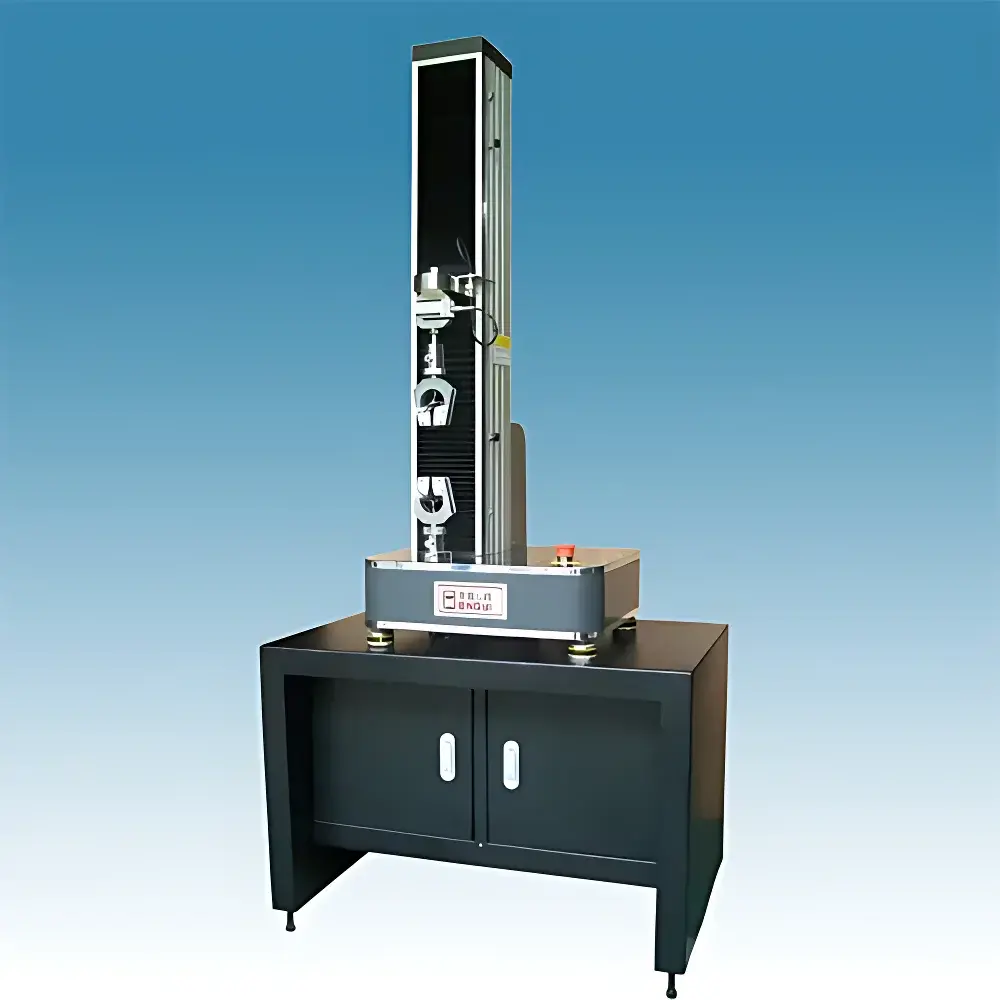
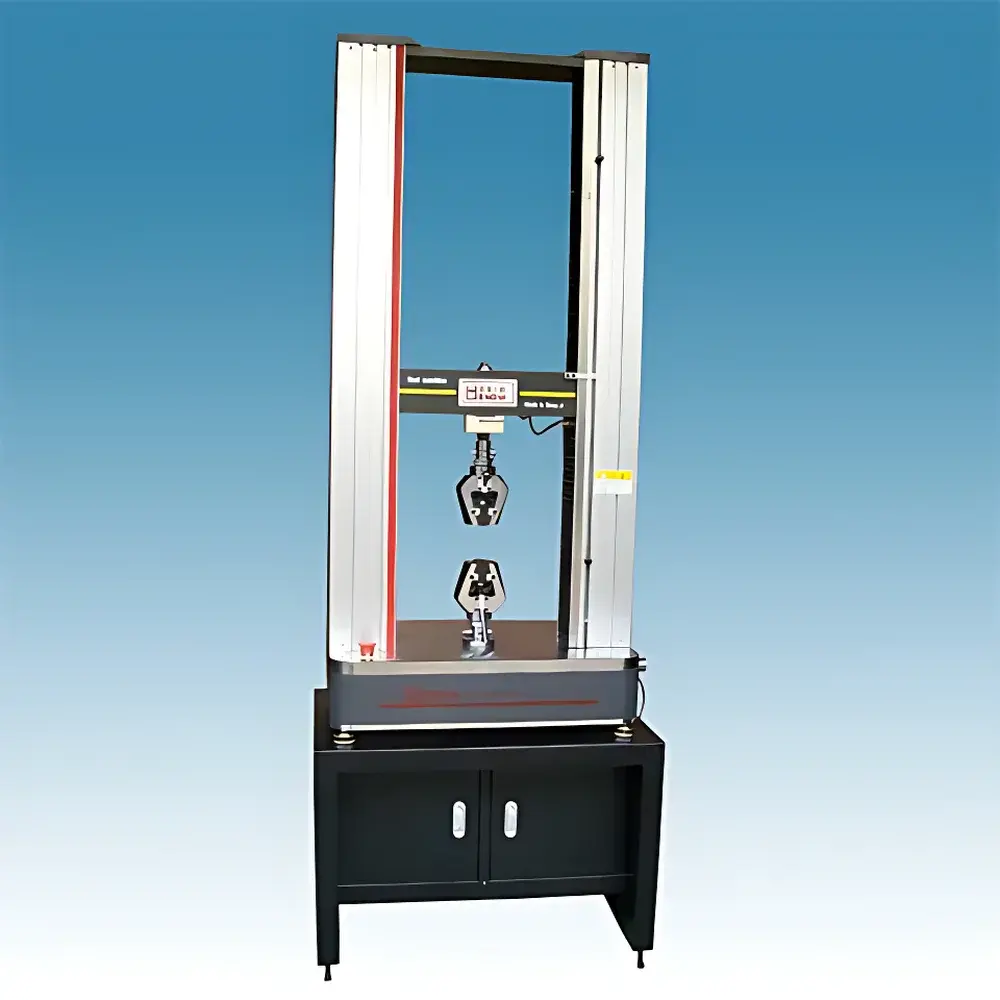
Hengyi HY-0580TYUU Universal Testing Machine for Corn Stover Compression Stress Relaxation and Creep Testing
| Brand | Hengyi |
|---|---|
| Origin | Shanghai, China |
| Manufacturer Type | Direct Manufacturer |
| Country of Origin | China |
| Model | HY-0580TYUU |
| Instrument Type | Electromechanical Universal Testing Machine |
| Load Capacity | 5000 N (max) |
| Force Accuracy Class | 0.5 |
| Effective Test Width | 120 mm |
| Effective Stroke | 800 mm |
| Speed Range | 0.001–500 mm/min |
| Speed Accuracy | ±0.5% of indicated value |
| Displacement & Strain Measurement Accuracy | ±0.5% of indicated value |
| Control Modes | Stress, Strain, and Displacement Control |
| Compliance | ASTM D695, ISO 604, GB/T 1041, GB/T 24370, GB/T 228.1, ISO 527, ISO 178, DIN 53455 |
Overview
The Hengyi HY-0580TYUU is a high-precision electromechanical universal testing machine engineered specifically for static mechanical characterization of low-density biomass materials—particularly corn stover, wheat straw, and rice straw—under uniaxial compression. It operates on the fundamental principle of controlled displacement or force-driven loading to quantify time-dependent viscoelastic behavior, including stress relaxation and creep response during densification. Designed in accordance with ISO 604 (rigid plastics), ASTM D695 (compressive properties of rigid plastics), and GB/T 24370 (mechanical properties of agricultural fiber composites), the system delivers traceable, reproducible data essential for feedstock pre-processing optimization, pellet/briquette quality control, and bio-composite formulation development. Its single-column architecture supports both compression and tensile testing within one frame, enabling standardized evaluation of modulus, yield strength, compressive strength, and deformation recovery across heterogeneous natural fibers.
Key Features
- High-resolution load cell with full-scale capacity up to 5000 N and accuracy class 0.5 per ISO 7500-1 and GB/T 16825.1.
- Adjustable compression fixture assembly: precision-machined cylindrical die set with 60 mm internal diameter and 140 mm height, optimized for uniform axial compaction of irregular biomass specimens.
- Multi-mode closed-loop control: independent stress, strain, and displacement rate regulation with real-time feedback—enabling precise execution of ISO 11721 stress-relaxation protocols and ASTM D2990 creep tests.
- Dynamic test speed range from 0.001 to 500 mm/min, calibrated to ±0.5% of setpoint, supporting both quasi-static densification (e.g., 50 mm/min for industrial briquetting simulation) and slow-rate relaxation profiling.
- Integrated safety architecture: electronic limit switches, overload protection at 110% F.S., automatic emergency stop upon abnormal current/voltage/pressure conditions, and programmable end-of-test return-to-home.
- Modular software interface compliant with GLP/GMP documentation requirements, supporting 21 CFR Part 11–ready audit trails, user-level access control, and timestamped raw data export in CSV and XML formats.
Sample Compatibility & Compliance
The HY-0580TYUU accommodates cylindrical biomass specimens (diameter ≤60 mm, height ≤140 mm) and standard polymer/plastic test bars (e.g., ISO 527 Type 1A, ASTM D638 Type IV). It meets mechanical testing requirements for ASTM D695 (compressive strength), ISO 604 (compressive modulus), ISO 178 (flexural properties), GB/T 1041 (tensile/compressive properties of plastics), and GB/T 24370 (mechanical performance of plant fiber-based panels). All calibration procedures follow ISO/IEC 17025 guidelines, and force verification is traceable to national metrology institutes via accredited third-party certificates.
Software & Data Management
The proprietary Hengyi TestMaster v4.2 software provides synchronized acquisition of force, displacement, time, and derived parameters (stress, strain, relaxation modulus, creep compliance). It auto-calculates standard metrics including ReH (upper yield strength), Rp0.2 (0.2% offset yield), Rm (tensile/compressive strength), E (Young’s modulus), and Rt values per ISO 6892-1 and GB/T 228.1. Curve overlays, statistical reporting (mean ± SD, CV%), and customizable report templates support ISO/IEC 17025-compliant documentation. Raw data files are stored with embedded metadata (operator ID, environmental conditions, calibration date), ensuring full traceability for regulatory audits.
Applications
- Quantifying compressive stress relaxation kinetics of corn stover briquettes during storage and transport.
- Evaluating binder efficacy in lignocellulosic pellet formulations by comparing relaxation half-life (t1/2) and residual stress retention.
- Determining optimal compaction pressure–time profiles for industrial densification lines based on density–strength trade-off analysis.
- Characterizing temperature- and humidity-dependent viscoelastic transitions in agro-waste composites under simulated field conditions.
- Validating finite element models of biomass deformation using experimentally derived stress–strain–time datasets.
FAQ
What standards does the HY-0580TYUU support for biomass compression testing?
It complies with ASTM D695, ISO 604, GB/T 24370, GB/T 1041, and ISO 11721 for stress relaxation and creep testing of fibrous agricultural materials.
Can the system perform both stress relaxation and creep tests automatically?
Yes—via programmable multi-step control sequences that switch between force-hold (relaxation) and displacement-hold (creep) modes without manual intervention.
Is the load cell calibration traceable to international standards?
All force sensors are factory-calibrated against reference standards certified to ISO/IEC 17025, with optional NIST-traceable recalibration kits available.
Does the software meet FDA 21 CFR Part 11 requirements?
TestMaster v4.2 includes electronic signatures, audit trail logging, role-based permissions, and data integrity safeguards aligned with 21 CFR Part 11 Annex 11 expectations.
What is the maximum specimen height accommodated in compression mode?
The effective test space allows specimens up to 800 mm in height; however, for standardized stover compression, the recommended die height is 140 mm with 60 mm internal diameter.



