
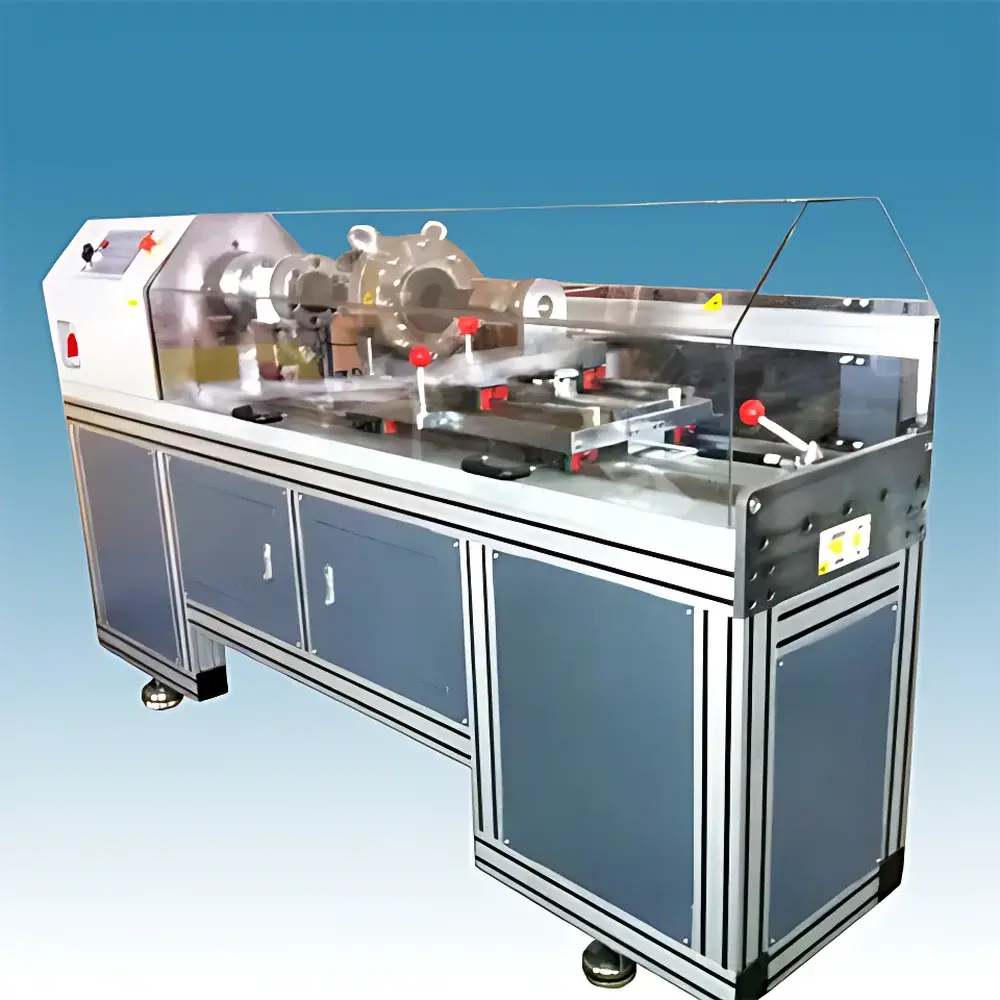
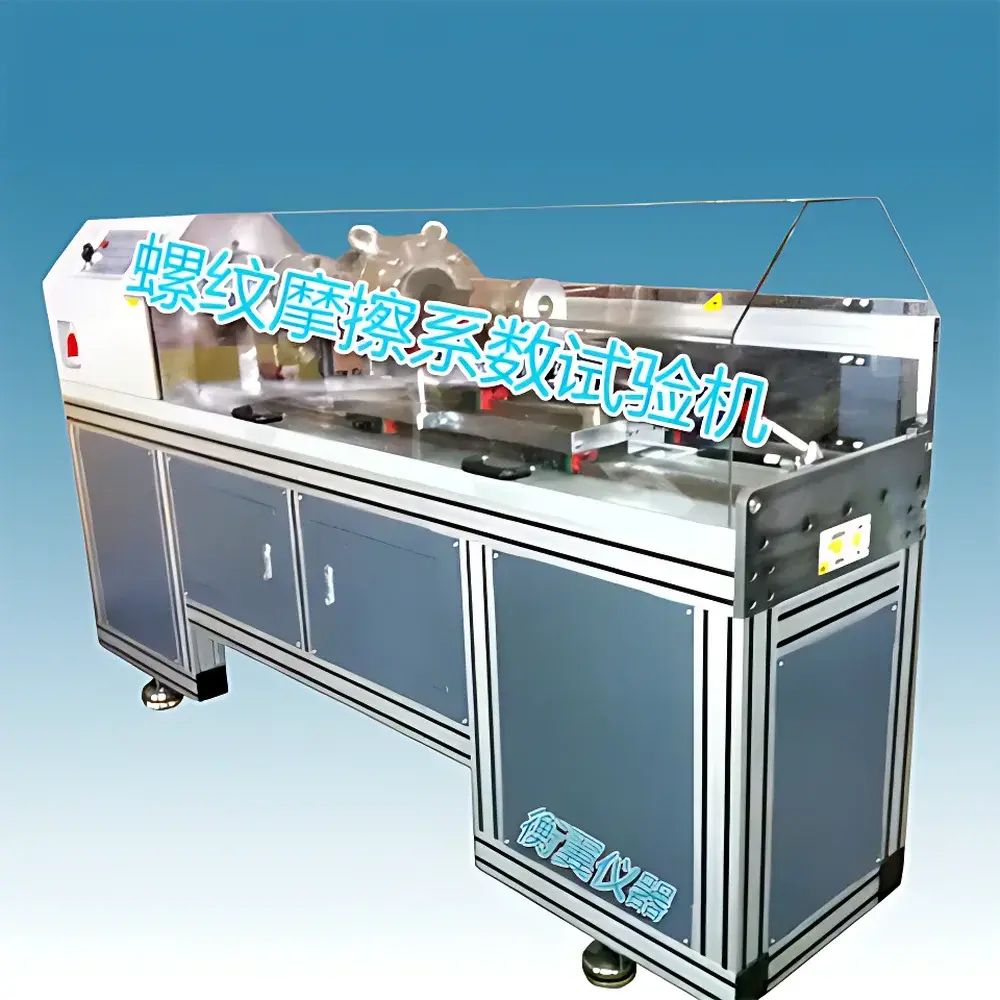
Hengyi HY-1000N·m Multi-Functional Bolt & Nut Friction Coefficient Testing Machine
| Brand | Hengyi / Hengyitest |
|---|---|
| Origin | Shanghai, China |
| Manufacturer Type | Direct Manufacturer |
| Regional Category | Domestic (China) |
| Model | HY-1000N.MU7JKJKty |
| Max Torque | 1000 N·m |
| Torque Measurement Range | 1–1000 N·m |
| Torque Resolution | 1/500000 |
| Torsion Angle Range | 0–100000° (or continuous) |
| Motor Power | 5 kW |
| Axial Force Range | 3–300 kN |
| Torque Accuracy | ±1% of reading (typ. ±0.5%) |
| Torsion Angle Accuracy | ±1% of reading (typ. ±0.5%) |
| Rotational Speed Range | 0–40 rpm |
| Speed Accuracy | ±0.5% of set value |
| Clamp Distance | 300 mm |
| Specimen Thread Size | M8–M22 (customizable) |
| Dimensions (L×W×H) | ~1800 × 540 × 1250 mm |
| Weight | 1800 kg |
| Compliance Standards | ISO 16047, GB/T 3098.9–2002, ASTM F568M, DIN 267-27, JIS B1051 |
Overview
The Hengyi HY-1000N·m Multi-Functional Bolt & Nut Friction Coefficient Testing Machine is a precision-engineered torsion testing system designed for quantitative mechanical characterization of threaded fasteners under controlled torque-tension coupling conditions. Based on the Couette-type torsional measurement principle—where axial preload and rotational torque are simultaneously applied and synchronized—the instrument enables full decoupling of frictional contributions across three critical interfaces: thread flank contact, bearing surface (under-head or nut face), and total system resistance. This architecture supports first-principles derivation of key parameters including coefficient of total friction (µtot), thread friction coefficient (µth), bearing surface friction coefficient (µb), and the torque coefficient (K), all in strict accordance with ISO 16047 and GB/T 3098.9–2002. The system integrates a high-stiffness dual-axis load frame, a servo-controlled AC motor with planetary gear reduction, and a calibrated high-precision torque transducer (0.02% FS linearity) coupled with a quadrature optical encoder for sub-arcsecond angular resolution. Static and dynamic torsional behavior—including yield torque, ultimate torque, breakaway torque, and torsional fatigue cycles—is captured with traceable metrological integrity.
Key Features
- Simultaneous real-time acquisition of axial force (3–300 kN), total torque (1–1000 N·m), and torsion angle (0–100000° or continuous) at sampling rates up to 1 kHz
- Dual-load-path architecture enabling independent measurement of thread torque and bearing surface torque via integrated split-sensor methodology per ISO 16047 Annex A
- High-resolution torque transducer with 1/500000 internal resolution and verified accuracy of ±0.5% of reading across 0.2–100% of full scale
- Programmable torsion speed from 0.01 to 40 rpm with closed-loop velocity control and ±0.5% speed stability
- Bidirectional rotation capability with automatic reversal logic for cyclic torsion and low-cycle fatigue protocols
- Modular clamping system accommodating standard metric threads from M8 to M22; custom jaw sets available for non-standard fastener geometries
- ARM32-based embedded controller with deterministic real-time OS, ensuring jitter-free synchronization between force, torque, and angular position signals
Sample Compatibility & Compliance
The HY-1000N·m system is validated for testing structural bolts, high-strength hex nuts, flange bolts, locknuts, and specialty fasteners used in aerospace (e.g., NASM, MS standards), automotive powertrain assemblies, wind turbine tower connections, and pressure vessel flanges. It supports specimen configurations per ISO 898-1, ASTM F568M, DIN 267-27, and JIS B1051. All calibration and verification procedures comply with ISO/IEC 17025 requirements for testing laboratories. Test reports include full audit trails compliant with GLP and 21 CFR Part 11 when paired with optional electronic signature modules. Data outputs meet traceability requirements for AS9100 Rev D and IATF 16949 certified manufacturing environments.
Software & Data Management
The proprietary Hengyi TestMaster™ software provides ISO 16047-compliant test sequence automation—including preload ramping, torque-controlled tightening, angle-controlled yield detection, and multi-step relaxation protocols. Raw data streams (torque, axial force, angle, time) are stored in HDF5 format with embedded metadata (operator ID, calibration certificate IDs, environmental timestamps). Export options include CSV, XML (for LIMS integration), and PDF reports with embedded plots of T–θ, F–θ, and µ–θ curves. Software includes built-in statistical process control (SPC) tools for batch analysis, Cp/Cpk calculation, and outlier detection per ISO 22514. Audit logs record all user actions, parameter changes, and calibration events with immutable timestamps.
Applications
- Quantitative validation of lubricant performance on coated or phosphated fasteners
- Verification of torque-tension relationships for assembly process development (e.g., joint stiffness, scatter analysis)
- Failure mode analysis of galling, thread stripping, or shank yielding under combined loading
- Qualification testing of new fastener materials (e.g., Ti-6Al-4V, Inconel 718, composite inserts)
- Support for DFMEA and PFMEA documentation in APQP-driven product launches
- Calibration reference for shop-floor torque tools per ISO 6789-2
- Research into tribological behavior of nano-coated threads under variable humidity and temperature conditions
FAQ
Does the system support automated ISO 16047 Annex A thread torque separation?
Yes—the dual-sensor configuration and firmware algorithm enable real-time decomposition of total torque into thread and bearing components without manual post-processing.
Can the machine perform cyclic torsion fatigue tests?
Yes—it supports programmable sinusoidal, trapezoidal, and block-wave torsion profiles with user-defined amplitude, frequency, and mean torque offset, up to 100,000 cycles.
Is third-party calibration certification included?
A factory calibration certificate traceable to NIM (National Institute of Metrology, China) is supplied; optional UKAS or DAkkS accredited calibration is available upon request.
What is the minimum measurable friction coefficient resolution?
Based on system noise floor and signal-to-noise ratio, the effective resolution for µtot is 0.001, with repeatability better than ±0.003 under controlled lab conditions.
How is axial force applied during torsion—hydraulic or electromechanical?
Axial preloading is achieved via a servo-controlled ball-screw actuator with closed-loop PID regulation, eliminating hydraulic fluid dependency and enabling precise force ramping profiles.



