
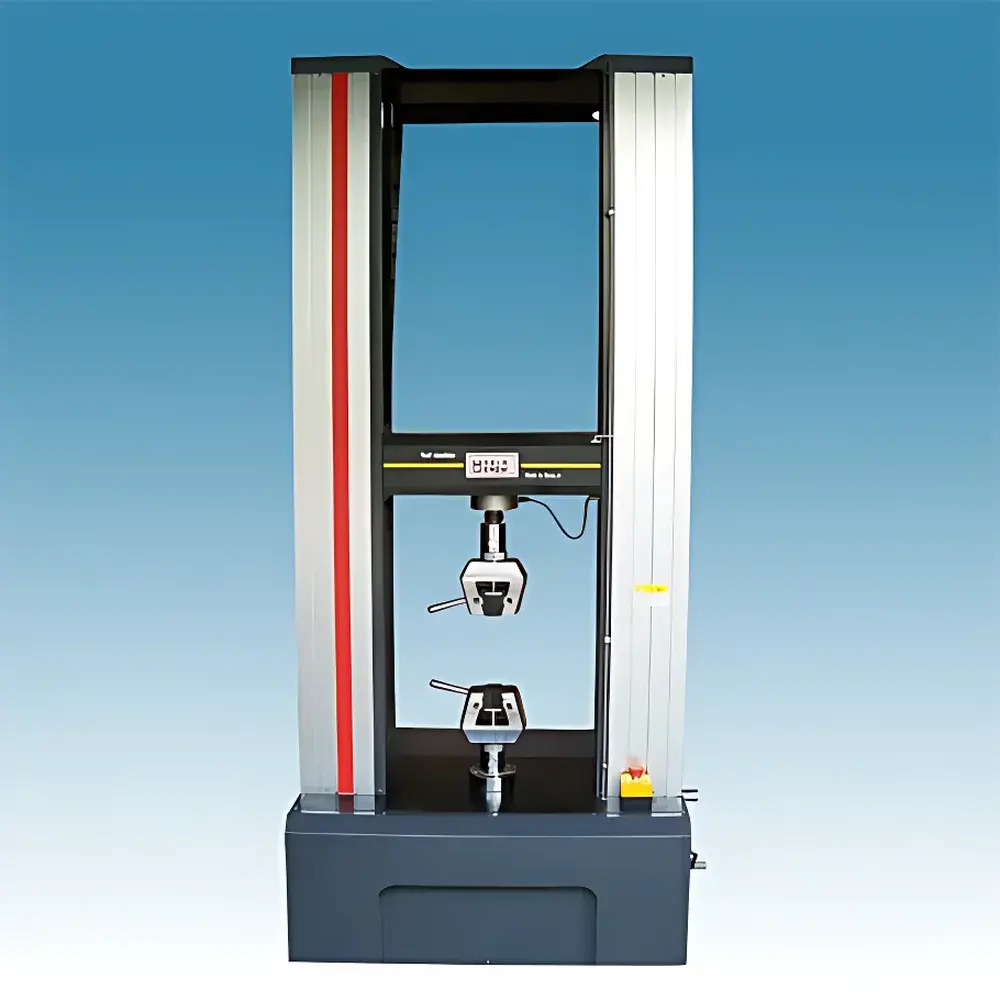
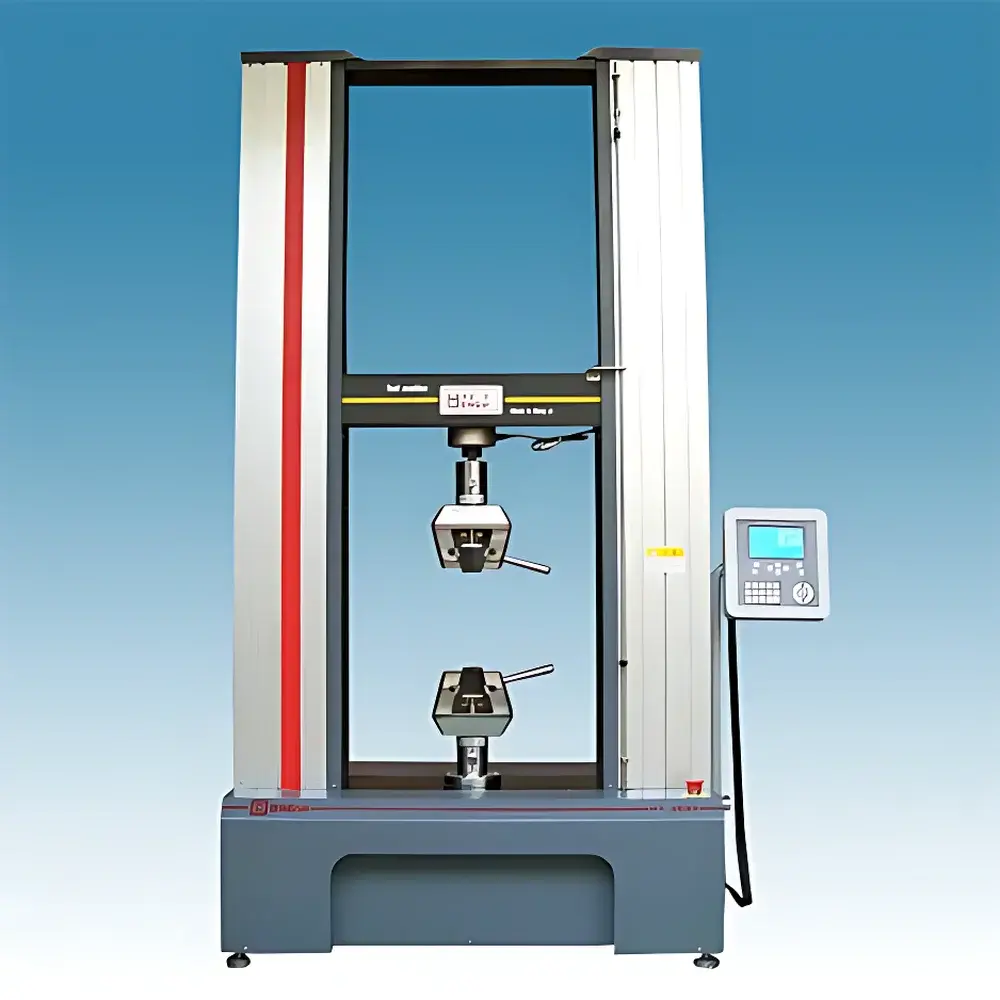
Hengyi HY-10080LOI Universal Testing Machine (UTM) – Electromechanical, Dual-Column, Microprocessor-Controlled for Tensile, Compression & Flexural Testing of Metals and Advanced Materials
| Key | Brand: Hengyi |
|---|---|
| Model | HY-10080LOI |
| Type | Electromechanical Universal Testing Machine |
| Load Capacity Options | 1 N to 100 kN (modular load cell configuration) |
| Accuracy Class | ≤0.5% of reading (per ISO 7500-1 / ASTM E4) |
| Effective Test Width | 600 mm (expandable) |
| Effective Test Height | 800 mm (extendable) |
| Speed Range | 0.001–500 mm/min (closed-loop controlled) |
| Speed Accuracy | ±0.5% of set value |
| Displacement Measurement Accuracy | ±0.5% of reading |
| Strain Measurement Accuracy | ±0.5% of reading |
| Stress Control Rate Range | 0.005–6 %FS/s |
| Strain Control Rate Range | 0.002–6 %FS/s |
| Load Resolution | 1 part in 500,000 full scale (no range switching required) |
| Power Supply | 220 V AC, single-phase, 2000 W |
| Host Dimensions | 1000 × 680 × 2200 mm |
| Weight | 1250 kg |
| Compliance | ISO 7500-1, ASTM E4, ASTM E8/E21, ISO 6892-1, GB/T 228.1 |
Overview
The Hengyi HY-10080LOI is a high-precision, dual-column electromechanical universal testing machine engineered for static mechanical characterization of metallic alloys, structural composites, automotive components, and advanced engineering materials. Built upon a rigid龙门 (gantry) frame architecture with reinforced crosshead guidance and precision-ground ball screws, the system delivers stable force application and sub-micron displacement resolution across its full operational envelope. Its measurement principle relies on closed-loop servo control of motor-driven actuation, synchronized with real-time acquisition from calibrated load cells, extensometers, and encoder-based position feedback—enabling traceable compliance with international standards including ISO 7500-1 (static calibration), ASTM E4 (verification of force-measuring instruments), and ISO 6892-1 (tensile testing of metallic materials). Designed for laboratory and industrial QA/QC environments, the HY-10080LOI supports both manual and automated test sequences, accommodating standardized procedures for yield strength (Rp0.2, Rp0.01), ultimate tensile strength (Rm), fracture elongation (A%), reduction of area (Z%), Young’s modulus (E), compressive yield strength, flexural modulus, and shear strength evaluation.
Key Features
- Modular load cell architecture supporting selectable capacities from 1 N to 100 kN—enabling seamless transition between micro-scale fastener testing and macro-scale structural component evaluation.
- High-resolution force measurement with 500,000-count A/D conversion and no internal range switching—ensuring consistent resolution and linearity across the entire force spectrum.
- Triple-control capability: stress rate, strain rate, and displacement rate modes—all independently programmable and switchable during active testing without interruption.
- Dual-speed crosshead movement (fast jog + precise fine positioning) with electronic limit protection and automatic return-to-start functionality post-test.
- Integrated safety logic: overload cutoff at 110% of selected capacity, real-time diagnostics for drive system anomalies (overvoltage, overcurrent, thermal fault), and emergency stop interlock compatibility.
- Robust mechanical design featuring hardened steel guide columns, preloaded linear bearings, and vibration-damped base assembly—optimized for long-term repeatability under cyclic loading conditions.
Sample Compatibility & Compliance
The HY-10080LOI accommodates specimens conforming to ASTM E8/E21 (metals), ISO 6892-1 (room temperature tensile), ISO 15630-1 (reinforcing steels), and EN 10002-1 (metallic materials—tensile testing). Standard grips include wedge-action tensile jaws (for flat/round bars), compression platens (100 mm diameter), and three-point bending fixtures (span adjustable up to 500 mm). Optional accessories include environmental chambers (−70 °C to +300 °C), video extensometry systems, and digital image correlation (DIC) integration kits. All hardware and firmware are designed to support audit-ready documentation per GLP and GMP frameworks; data integrity complies with FDA 21 CFR Part 11 requirements when paired with validated software modules—including electronic signatures, audit trails, and user access controls.
Software & Data Management
The system operates with Hengyi’s proprietary TestMaster Pro software—a Windows-based platform supporting multilingual UI (English, German, Japanese, Chinese), customizable test method templates, and real-time curve overlay (stress–strain, load–displacement, force–time). Raw data export is available in CSV, Excel (.xlsx), XML, and universal .UDF formats compatible with MATLAB, OriginLab, and Minitab. The software implements automatic calculation of standard mechanical properties per ISO 6892-1 Annex B and ASTM E8 Table X1.1, with configurable pass/fail thresholds, statistical batch reporting (mean, SD, CV%), and PDF report generation including header metadata (operator ID, sample ID, calibration certificate ID, timestamp). Optional cloud synchronization enables centralized fleet monitoring and remote diagnostic telemetry for multi-site laboratories.
Applications
- Metallic material qualification: tensile property mapping of aluminum alloys (e.g., 6061-T6, 7075-T73), stainless steels (304, 316), titanium grades (Ti-6Al-4V), and high-strength low-alloy (HSLA) steels per ASTM A370.
- Automotive component validation: tensile strength of spot welds, shear testing of riveted joints, compression testing of brake pads and bushings.
- Aerospace fastener certification: pull-out testing of threaded inserts, shear strength evaluation of blind bolts per NASM 1312-8.
- Academic research: constitutive modeling input generation, creep behavior screening (under sustained load), and fracture mechanics pre-crack specimen preparation verification.
- Quality assurance in foundries and rolling mills: routine batch verification against mill test reports (MTRs) and ISO 10474 compliance documentation.
FAQ
What international standards does the HY-10080LOI comply with for force calibration and test execution?
The system meets ISO 7500-1 Class 0.5 accuracy for static force measurement and supports test methods aligned with ASTM E8/E21, ISO 6892-1, EN 10002-1, and GB/T 228.1.
Can the machine perform closed-loop strain-controlled testing using an extensometer?
Yes—it accepts analog and digital extensometers (including clip-on, non-contact video, and laser types) with full integration into strain-rate control loops and automatic gauge length compensation.
Is the software compliant with FDA 21 CFR Part 11 for regulated pharmaceutical or medical device testing?
When deployed with validated TestMaster Pro configurations—including role-based access, electronic signatures, and immutable audit logs—the system satisfies core Part 11 requirements for electronic records and signatures.
What is the maximum specimen height accommodated without modification?
The standard vertical test space is 800 mm between upper and lower platens; extended-height columns are available for specimens up to 1500 mm.
Does the system support cyclic or fatigue testing?
While primarily optimized for quasi-static tests, the HY-10080LOI can execute low-cycle fatigue (LCF) protocols up to 5 Hz with optional high-speed controller firmware and dynamic load cell upgrades—subject to mechanical resonance analysis of the test setup.



