
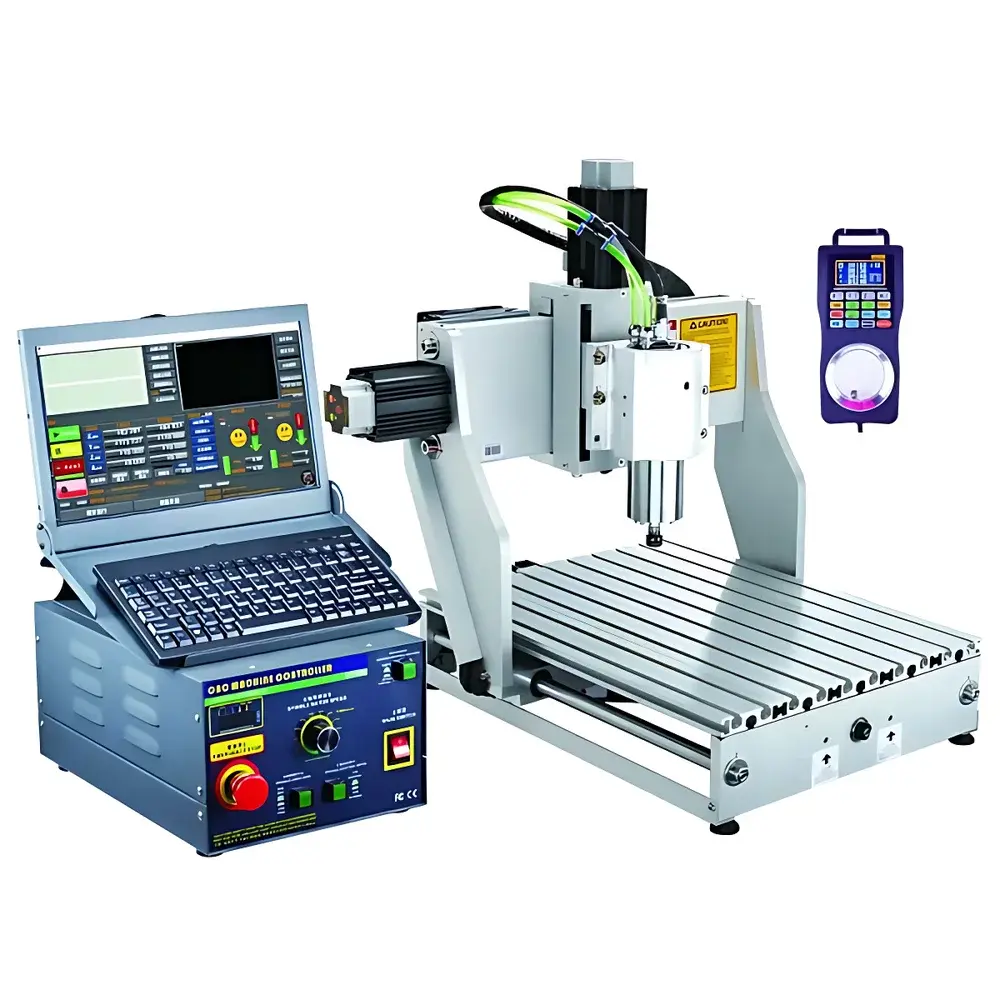
Hengyi HY(DK)YJ Tensile Test Dumbbell Specimen Cutting Machine
| Brand | Hengyi |
|---|---|
| Origin | Shanghai, China |
| Manufacturer Type | Manufacturer |
| Product Origin | Domestic (China) |
| Model | HY(DK)YJ |
| Quotation | Upon Request |
| Spindle Speed | 24,000 rpm |
| Feed Rate | 0–500 mm/min |
| Cut Thickness | 2–20 mm |
| Max. Pipe Diameter | 50–250 mm |
| Max. Workpiece Length (Pipe/Sheet) | 260 mm |
| X-Axis Travel | 280 mm |
| Y-Axis Travel | 310 mm |
| Z-Axis Travel | 70 mm |
| Frame Material | Aluminum Alloy |
| Stepper Motor & Driver Sets | 3 |
| High-Speed Variable-Frequency Spindle Motor | 1 |
| Precision Linear Guide Rods | 6 |
| Precision Ball Screws | 3 |
| Standard Vise | 1 set |
| Specimen Dimensional Accuracy | Compliant with GB/T 1040, GB/T 1043, GB/T 1843, GB/T 8804.2, ISO 179, and ISO 8004.2 |
| Tooling Options | Cylindrical end mills, 20° flat-bottom cutters, slitting cutters, 45° chamfer cutters |
| Tool Diameters | Φ3 mm, Φ4 mm, Φ6 mm |
| Max. Machining Envelope | 300 × 150 × 100 mm |
| Power Supply | AC 220 V |
| Total Power Consumption | 1500 W |
| Net Weight | 45 kg |
Overview
The Hengyi HY(DK)YJ Tensile Test Dumbbell Specimen Cutting Machine is a precision CNC-controlled specimen preparation system engineered for the reproducible fabrication of standardized dumbbell-shaped tensile specimens from thermoplastic, thermoset, composite, and fiber-reinforced polymer materials—including PVC, PE, PP, ABS, PMMA (organic glass), FRP, and non-metallic sheet or pipe stock. Unlike manual milling or die-cutting methods, this machine employs a rigid aluminum alloy frame, high-speed variable-frequency spindle (24,000 rpm), and synchronized three-axis motion control (X/Y/Z) to achieve micron-level repeatability in critical dimensions—particularly gauge length, width taper, and parallel section thickness—as required by ISO 527-2, ASTM D638, GB/T 1040.2, and related international standards for mechanical property evaluation. Its modular tooling configuration supports multi-step machining sequences (roughing, finishing, edge deburring, and chamfering) within a single clamping cycle, minimizing operator-induced variability and ensuring compliance-ready traceability in QA/QC laboratories and R&D environments.
Key Features
- Rigid aluminum alloy structural frame with vibration-damping design for dimensional stability during high-speed cutting
- Three-axis CNC motion system driven by stepper motors and precision ball screws (3 sets), supported by six high-accuracy linear guide rods
- 24,000 rpm high-frequency spindle motor enabling clean, burr-free cuts on heat-sensitive polymers without thermal degradation
- Adjustable feed rate (0–500 mm/min) and programmable cut depth (2–20 mm) for optimized material removal across diverse hardness levels
- Dedicated vise fixture and customizable jig options for secure clamping of pipes (Ø50–250 mm) and sheets up to 260 mm in length
- Tool library support for interchangeable cutters: cylindrical end mills (Φ3/Φ4/Φ6 mm), 20° flat-bottom profile cutters, slitting blades, and 45° chamfer tools
- Maximum work envelope of 300 × 150 × 100 mm, accommodating full-size ISO/ASTM-compliant specimen blanks
Sample Compatibility & Compliance
The HY(DK)YJ is validated for processing rigid and semi-crystalline polymeric materials used in piping systems, construction composites, automotive interior panels, and packaging films. It produces specimens meeting dimensional tolerances specified in GB/T 1040.2 (tensile), GB/T 1043 (impact), GB/T 1843 (notched impact), GB/T 8804.2 (polyethylene pipes), ISO 179 (Charpy impact), and ISO 8004.2 (plastic pipe tensile testing). All machined features—including parallel section width (±0.1 mm), gauge length (±0.2 mm), and thickness uniformity (< ±0.05 mm across 25 mm span)—are verified against reference gauges and optical measurement systems. The machine’s mechanical repeatability supports GLP-compliant documentation when integrated with lab management software.
Software & Data Management
The HY(DK)YJ operates via embedded CNC controller with G-code compatibility, allowing offline programming using standard CAM software (e.g., Fusion 360, Mastercam). Preloaded machining templates include ISO 527-2 Type 1A/1B, ASTM D638 Type I/IV, and GB/T 1040.2 Type I dumbbell geometries. Tool offset tables, feed/speed presets per material class, and job logging (date/time, operator ID, tool wear counter) are stored locally. Optional RS-232 or USB interface enables integration with LIMS platforms for audit-trail generation compliant with ISO/IEC 17025 and FDA 21 CFR Part 11 requirements.
Applications
- Preparation of tensile specimens from extruded plastic pipes (PE, PP-R, PVC-U) for hydrostatic pressure rating validation
- Manufacturing notched Charpy specimens (ISO 179) from FRP laminates in wind turbine blade R&D
- Generating standardized dumbbell blanks from injection-molded plaques for accelerated aging studies per ISO 188
- Quality control in cable sheathing production lines requiring rapid turnaround of ASTM D638 specimens
- Research-grade specimen fabrication in university polymer labs where inter-laboratory comparability depends on machining consistency
FAQ
What standards does the HY(DK)YJ directly support for specimen geometry?
It conforms to dimensional specifications in GB/T 1040.2, GB/T 1043, GB/T 1843, GB/T 8804.2, ISO 179, ISO 8004.2, and ISO 527-2.
Can it process both pipe and sheet materials in one setup?
Yes—adjustable vise and modular jigs accommodate round pipes (Ø50–250 mm) and flat sheets (up to 260 mm long) without reconfiguration.
Is tool calibration traceable to national metrology institutes?
While the machine itself does not include built-in calibration certification, all cutting tools are dimensionally certified per ISO 8402; users may implement periodic verification using NIST-traceable micrometers and surface roughness testers.
What maintenance intervals are recommended for sustained accuracy?
Lubrication of ball screws and guide rods every 200 operational hours; spindle bearing inspection every 1,000 hours; tool wear monitoring via surface finish assessment after each batch.
Does the system support automated batch processing for high-throughput labs?
Yes—G-code program queuing allows unattended sequential machining of up to 20 specimens per load, provided raw material blanks are pre-aligned and clamped.



