
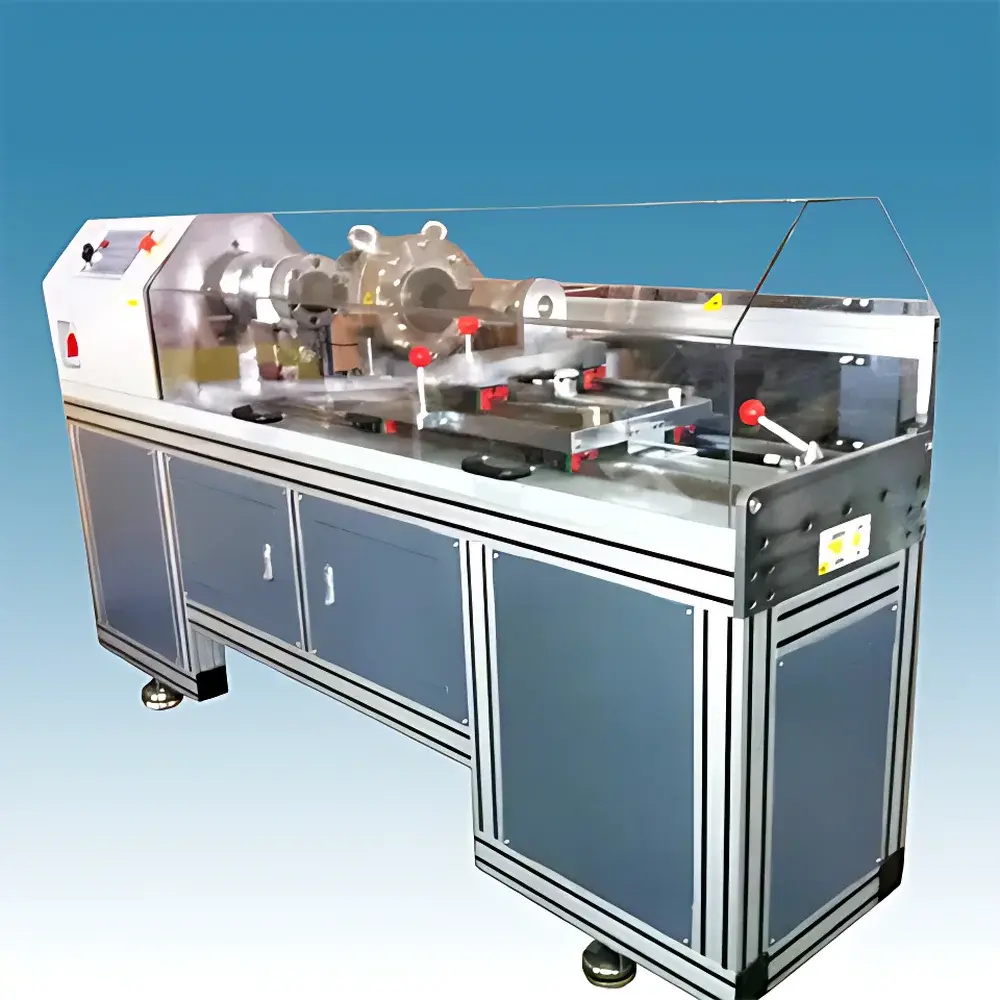
Hengyi HY-2000N·M Advanced Fastener Friction Coefficient & Torsion Testing System
| Brand | Hengyi / Hengyitest |
|---|---|
| Origin | Shanghai, China |
| Manufacturer Type | Direct Manufacturer |
| Product Origin | Domestic (China) |
| Model | HY-2000N·M UIN |
| Max Torque | 2000 N·m |
| Torque Measurement Range | 2–2000 N·m |
| Torque Resolution | 1/50000 |
| Torsion Angle Range | 0–100000° |
| Motor Power | 5 kW |
Overview
The Hengyi HY-2000N·M Advanced Fastener Friction Coefficient & Torsion Testing System is a high-precision, dual-sensor torsion testing platform engineered for quantitative mechanical characterization of threaded fasteners under controlled preload and rotational loading. It operates on the principle of simultaneous, real-time acquisition of axial clamping force (tensile load) and three distinct torque components—total torque, thread torque, and bearing surface torque—enabling calculation of frictional partitioning in accordance with internationally recognized tribomechanical models. This system implements the standardized “clamp force–torque” measurement methodology defined in ISO 16047:2019, GB/T 3098.9–2010, GB/T 16823.3–2010, ISO 2320, and EN 14399 series standards. Its architecture supports both static and dynamic torque-angle profiling, yield point detection, ultimate failure analysis, and K-factor derivation—making it suitable for R&D validation, production quality control, and metrological calibration in high-integrity fastening applications.
Key Features
- Integrated dual-load-path measurement: High-stiffness axial load cell (5–500 kN range) and coaxial torque transducer (2–2000 N·m) with synchronized sampling at ≥1 kHz.
- High-resolution torsion actuation: Servo-motor-driven system with speed control from 5 to 40 rpm (extendable to 200 rpm), delivering ±0.5% accuracy in torque, angle, and rotational speed.
- Modular gripping system: Adjustable jaw spacing up to 1000 mm; accommodates fasteners from M10 to M30 (customizable for larger diameters upon request).
- Robust mechanical frame: Heavy-duty welded steel construction (1800 kg mass) ensures minimal deflection during high-torque testing and long-term dimensional stability.
- Low-noise, zero-crawl drive: Precision planetary gearbox and vector-controlled 5 kW AC servo motor enable smooth low-speed operation (<1 rpm) without stick-slip artifacts.
- Dedicated HYtest controller and software suite: Fully modular firmware architecture compliant with deterministic real-time control requirements for closed-loop torque/angle/force regulation.
Sample Compatibility & Compliance
The HY-2000N·M system is validated for testing bolts, screws, studs, and nut-bolt assemblies per mechanical property classes up to 12.9 and A4-80. It supports both free-standing and fixture-mounted configurations, including washer-integrated setups for bearing surface friction evaluation. All test protocols align with ISO 16047 Annex A (direct measurement method) and Annex B (indirect calculation method), as well as ASTM F2329 for coating influence assessment. The system meets GLP documentation requirements through audit-trail-enabled software, supports 21 CFR Part 11-compliant electronic signatures (optional configuration), and provides traceable calibration certificates aligned with ISO/IEC 17025-accredited reference standards.
Software & Data Management
HYtest v5.x software provides a unified interface for test definition, real-time monitoring, post-test analysis, and report generation. It features automated parameter extraction—including total, thread, and bearing surface friction coefficients (µtot, µth, µb), K-factor, yield torque/axial force, ultimate torque/axial force, and angular displacement at critical events. Raw data export is supported in CSV, XML, and HDF5 formats; metadata embedding includes operator ID, environmental conditions (optional sensor integration), calibration status, and instrument configuration logs. Multi-user role management, password-protected method templates, and version-controlled test procedures ensure regulatory readiness for ISO 9001, AS9100, and IATF 16949 environments.
Applications
- Quantitative validation of lubricant efficacy and surface treatment performance (e.g., zinc flake, phosphate, PTFE coatings) on coefficient of friction stability.
- Development and verification of torque-tension relationships for aerospace-grade fasteners (e.g., NASM, MS, or SAE AS standards).
- Root-cause analysis of joint loosening in automotive powertrain and chassis assemblies.
- Calibration and verification of handheld torque tools against primary reference standards.
- Research into thread geometry effects (pitch, flank angle, lead error) on torque partitioning behavior.
- Support for Failure Modes and Effects Analysis (FMEA) of bolted joints in wind turbine nacelles and offshore structural connections.
FAQ
What standards does this system fully support for friction coefficient testing?
ISO 16047:2019, GB/T 3098.9–2010, GB/T 16823.3–2010, ISO 2320, EN 14399-1 & -3–6, and ASTM F2329.
Can the system measure both static and dynamic friction parameters?
Yes—it captures quasi-static friction coefficients during controlled ramped tightening and enables transient analysis during step-torque or dwell-phase tests.
Is third-party calibration certification included with delivery?
A factory calibration certificate traceable to CNAS-accredited national standards is provided; optional ISO/IEC 17025-certified field calibration is available upon request.
Does the software support automated report generation compliant with internal QA workflows?
Yes—customizable report templates include configurable pass/fail thresholds, statistical summaries (mean, SD, CV%), and embedded digital signatures meeting GLP/GMP documentation requirements.
What is the maximum recommended fastener length for accurate torsional measurement?
For optimal torsional stiffness and minimal bending interference, the standard configuration supports specimens up to 1000 mm between grips; extended-length fixtures are available for longer assemblies.



