
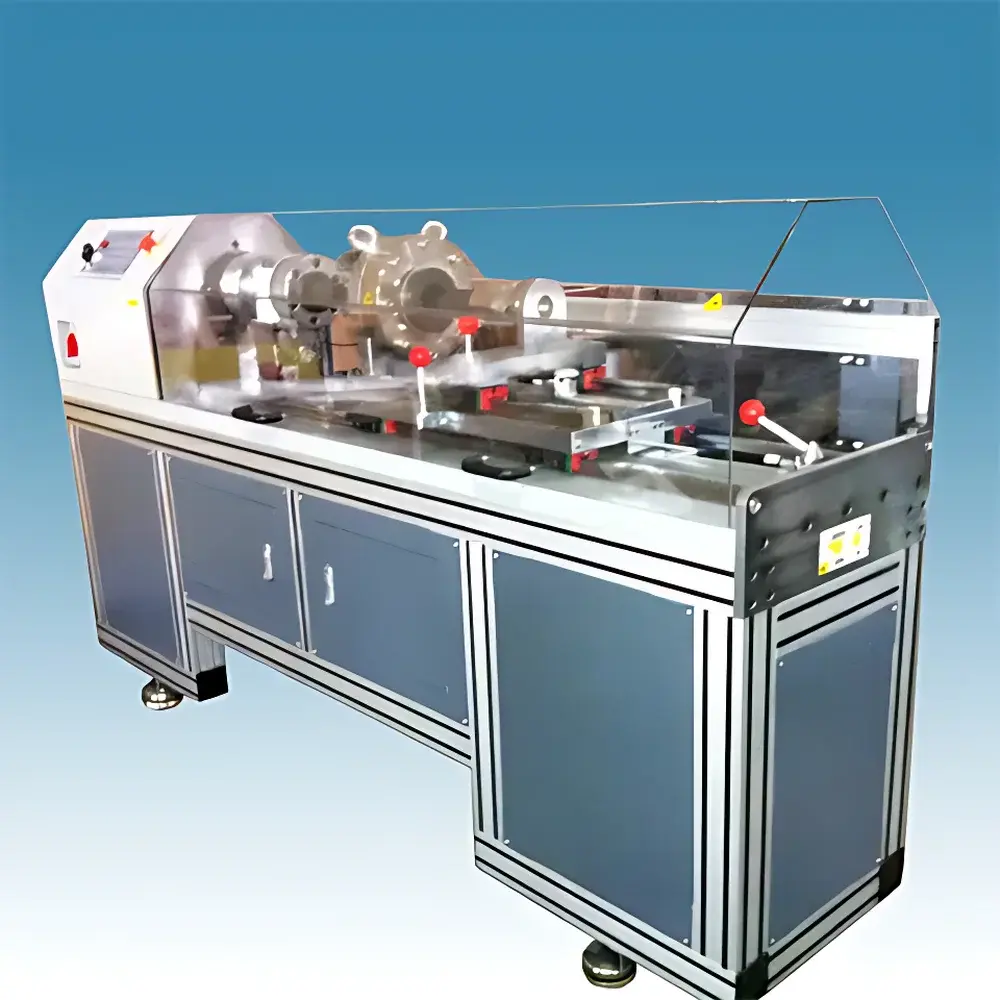
Hengyi HY-2000N·m Aerospace Fastener Thread Friction Coefficient Tester
| Brand | Hengyi / Hengyitest |
|---|---|
| Origin | Shanghai, China |
| Manufacturer Type | Direct Manufacturer |
| Product Category | Domestic |
| Model | HY-2000N·mTYU |
| Max Torque | 2000 N·m |
| Torque Measurement Range | 2–2000 N·m |
| Torque Resolution | 1/50,000 |
| Torsion Angle Range | 0–100,000° (or continuous) |
| Motor Power | 5 kW |
Overview
The Hengyi HY-2000N·m Aerospace Fastener Thread Friction Coefficient Tester is a high-precision torsion testing system engineered for quantitative mechanical characterization of threaded fasteners under controlled preload and rotational loading. It operates on the principle of simultaneous dual-sensor torque decomposition—measuring total input torque, thread torque, and bearing surface torque—while concurrently capturing axial clamping force and angular displacement. This enables direct calculation of critical fastener performance parameters including thread friction coefficient (μth), bearing surface friction coefficient (μb), total friction coefficient (μtot), K-factor, yield torque/clamping force, ultimate failure torque/force, and tightening angle. Designed specifically for aerospace-grade fasteners, the system complies with internationally recognized mechanical test standards governing bolted joint integrity, including ISO 16047, ISO 2320, GB/T 3098.9–2010, GB/T 16823.3–2010, EN 14399-1:2005, and EN 14399-3–6:2006. Its robust architecture supports full-cycle tensile-torsional coupling analysis essential for validating fastener behavior in high-reliability structural assemblies.
Key Features
- High-fidelity dual-torque sensing: Independent measurement of total torque, thread torque, and bearing surface torque using calibrated coaxial transducers with integrated axial load cells
- Precision torque control: Closed-loop servo-motor drive with 5 kW motor enabling stable low-speed operation (5–40 rpm, extendable to 200 rpm) and zero-crawl motion profile
- Ultra-high resolution: Torque resolution of 1/50,000 FS and angular resolution supporting up to 100,000° continuous rotation or infinite-angle mode
- Wide mechanical capacity: 2–2000 N·m torque range, 5–500 kN axial force range, and adjustable grip span up to 1000 mm
- Standardized specimen compatibility: Accommodates M10–M30 threaded fasteners; custom jaw configurations available for non-standard geometries
- Stable thermal and mechanical platform: Heavy-duty cast-iron frame (1800 kg mass) minimizing vibration and drift during high-torque static/dynamic tests
Sample Compatibility & Compliance
The tester is validated for bolts, screws, studs, and nut-bolt assemblies used in aviation, space launch systems, wind turbine nacelles, nuclear containment structures, and rail infrastructure. It supports standardized test specimens per ISO 898-1:1999 (mechanical properties of fasteners), ASTM F606 (mechanical testing of externally and internally threaded fasteners), and DIN 267-27 (torque-tension relationships). All measurement channels are traceably calibrated to national metrological standards (CNAS-accredited procedures), ensuring compliance with ISO/IEC 17025 requirements for testing laboratories. Data acquisition meets GLP/GMP documentation prerequisites, including audit-trail-enabled timestamping, user authentication, and electronic signature support.
Software & Data Management
The HYtest modular software suite provides real-time synchronized acquisition of torque, axial force, angle, and rotational speed across multiple channels. It features automated test sequencing (e.g., ramp-to-yield, constant-rate tightening, stepwise torque hold), customizable pass/fail criteria, and export-ready reporting in CSV, PDF, and XML formats. The system supports 21 CFR Part 11-compliant data integrity protocols—including role-based access control, electronic signatures, and immutable raw-data archiving—making it suitable for regulated environments such as FAA-certified manufacturing facilities and EASA Part 21G organizations. Calibration certificates, uncertainty budgets, and sensor linearity reports are embedded within the software metadata framework.
Applications
- Determination of μth and μb for specification validation of lubricated, coated, or dry-thread aerospace bolts (e.g., NASM21209, MS21208, ASTM A193 B16)
- Development and verification of torque-tension relationships for new fastener materials (e.g., Ti-6Al-4V, Inconel 718, composite-inserted threads)
- Quality assurance screening in high-volume production lines for automotive powertrain and aircraft engine mounting hardware
- Root-cause analysis of joint loosening, galling, or premature yielding in service-critical applications
- Support of DO-160 Section 22 (structural testing) and MIL-STD-1312 (fastener testing) qualification programs
- Research into tribological behavior of anti-seize compounds, phosphate coatings, and nanostructured thread finishes
FAQ
What standards does this tester fully support for aerospace fastener certification?
ISO 16047, ISO 2320, GB/T 3098.9–2010, GB/T 16823.3–2010, EN 14399-1:2005, and EN 14399-3–6:2006.
Can the system measure both static and dynamic friction coefficients during tightening?
Yes—it captures real-time torque and angle derivatives to compute instantaneous frictional behavior throughout the entire tightening curve, including yield transition and plastic deformation regions.
Is the software compliant with FDA 21 CFR Part 11 requirements?
Yes—the HYtest software includes full electronic signature capability, audit trail logging, and data immutability controls required for regulated life-science and aerospace manufacturing environments.
What is the maximum specimen length accommodated without modification?
The standard parallel jaw spacing is adjustable up to 1000 mm, supporting long-stud configurations typical in structural flange and landing gear applications.
Does the system provide uncertainty analysis for calculated friction coefficients?
Yes—uncertainty propagation is automatically computed per GUM (JCGM 100:2008) based on transducer calibration certificates, environmental conditions, and operator-defined measurement intervals.



