
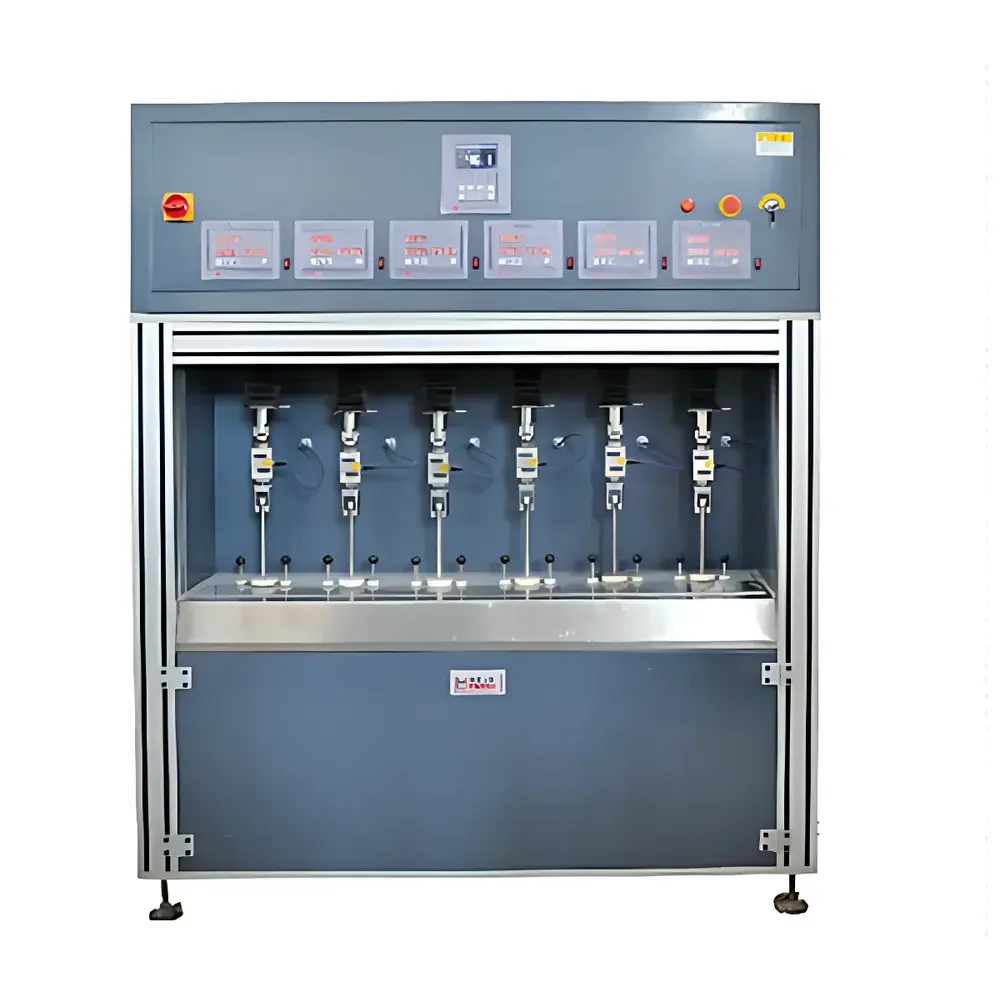
Hengyi HY-QKRB Six-Station Full-Notch Creep Testing Machine
| Brand | Hengyi / Hengyitest |
|---|---|
| Origin | Shanghai, China |
| Manufacturer Type | Direct Manufacturer |
| Regional Category | Domestic (China) |
| Model | HY-QKRBTYY |
| Pricing | Available Upon Request |
| Load Capacity | 2000 N (interchangeable load cells available below 2000 N) |
| Force Measurement Range | 0.4–99.999% of full scale |
| Effective Test Width | 120 mm |
| Effective Test Stroke | 200 mm |
| Test Speed | 0.001–100 mm/min (adjustable) |
| Speed Accuracy | ±1% of indicated value |
| Displacement & Strain Measurement Accuracy | ±1% of indicated value |
| Number of Test Stations | 6 independent stations |
| Temperature Control Range (Constant-Temp Bath) | Room temperature to 95 °C |
| Temperature Stability | ±0.5 °C |
| Control System | PC-based closed-loop control |
| Power Requirement | 220 V AC, 10 kW |
| Machine Dimensions (W×D×H) | 1620 × 850 × 1750 mm |
| Net Weight | 850 kg |
| Compliance Standards | GB/T 15820–1995, GB/T 11546, GB/T 32682–2016, ISO 899-1, ISO 16770, ISO 3501 |
Overview
The Hengyi HY-QKRB Six-Station Full-Notch Creep Testing Machine is a precision-engineered instrument designed for standardized evaluation of environmental stress cracking (ESC) and time-dependent mechanical failure in thermoplastic polymers—particularly polyethylene (PE) pipe materials, fittings, and high-performance composites. It operates on the principle of full-notch creep testing (FNCT), a widely accepted accelerated method that applies constant tensile load to pre-notched specimens immersed in a controlled thermal environment (e.g., detergent solution or water bath). Unlike conventional uniaxial creep tests, FNCT introduces a defined stress concentrator (full notch) to simulate localized flaw-driven crack initiation and propagation under sustained load, enabling quantification of failure time (tf) as a function of applied stress intensity and environmental aggressivity. This machine supports three primary test modes: uniaxial tensile creep, full-notch tensile creep (per ISO 16770 and GB/T 32682–2016), and pull-out testing for pipe joint integrity assessment (per GB/T 15820–1995).
Key Features
- Six fully independent test stations with individual load application, displacement sensing, and thermal immersion—eliminating cross-talk between specimens and ensuring statistical robustness in multi-sample studies.
- Modular high-precision load cell architecture: factory-calibrated 2000 N capacity sensor with optional lower-range transducers (e.g., 500 N, 100 N) for enhanced resolution in low-stress ESC regimes; all sensors conform to ISO 7500-1 Class 0.5 accuracy.
- Electromechanical actuation system delivering stable, programmable crosshead motion from 0.001 to 100 mm/min, with speed repeatability ≤ ±1% of setpoint across full range.
- Integrated constant-temperature liquid bath (water or surfactant solution) with PID-controlled heating and circulation, maintaining uniform ±0.5 °C stability over 20–95 °C operating range—critical for reproducible ESC kinetics.
- Robust structural frame (850 kg mass) with isolated elastic support per station minimizes vibrational coupling and ensures long-term dimensional stability during extended-duration tests (up to 10,000+ hours).
- Comprehensive hardware-level safety logic: automatic overload cutoff, bath-level monitoring, thermal runaway protection, and emergency stop interlock compliant with IEC 61000-6-2 EMC requirements.
Sample Compatibility & Compliance
The HY-QKRB accommodates standard FNCT specimens per ISO 16770 (10 × 4 × 4 mm rectangular bars with 0.4 mm full-thickness notch) and ASTM D1693-type geometries. It also supports custom configurations for pipe pull-out testing (e.g., PE100 spigot-and-socket joints) using fixture adapters. All test protocols align with internationally recognized regulatory frameworks: GB/T 11546 (plastic creep behavior), ISO 899-1 (tensile creep), and ISO 3501 (ESC screening). Data traceability meets GLP audit requirements through timestamped raw data logging, user-access controls, and electronic signature capability in software. The system is suitable for laboratories seeking ISO/IEC 17025 accreditation or preparing submissions to regulatory bodies requiring documented adherence to GB/T 32682–2016 and ISO 16770 test execution standards.
Software & Data Management
Control and analysis are executed via Hengyi’s Windows-based software suite, supporting both English and Chinese UI localization. The application provides real-time visualization of force–time, displacement–time, and stress–time curves for each station independently. Automated calculation modules compute critical parameters including time-to-failure (tf), creep strain rate (dε/dt), and normalized stress intensity factor (KI). All raw data (100 Hz sampling rate) are stored in vendor-neutral CSV format with embedded metadata (operator ID, calibration certificate ID, ambient conditions, bath temperature log). Audit trail functionality records all parameter changes, test starts/stops, and manual interventions—fully compliant with FDA 21 CFR Part 11 requirements for electronic records and signatures when configured with user authentication and role-based permissions.
Applications
- Quality assurance of PE pressure pipe systems (e.g., PE80, PE100) for municipal water and gas distribution networks.
- Comparative ESC resistance ranking of polymer formulations exposed to surfactants, alcohols, or hydrocarbon media.
- Accelerated lifetime prediction modeling for plastic components in aggressive chemical environments.
- Validation of joining methods (electrofusion, butt fusion) per ISO 13953 and GB/T 15820–1995 pull-out performance criteria.
- Research into fracture mechanics of semi-crystalline thermoplastics under combined thermal–mechanical–chemical loading.
FAQ
What standards does the HY-QKRB comply with for full-notch creep testing?
It fully supports ISO 16770, GB/T 32682–2016, ISO 899-1, GB/T 11546, and GB/T 15820–1995 for FNCT, tensile creep, and pipe joint pull-out testing.
Can the system operate unattended for multi-day or multi-week tests?
Yes—the six-station architecture, thermal bath redundancy, and built-in diagnostics enable continuous operation up to 10,000 hours with minimal intervention.
Is calibration documentation provided with the instrument?
Each unit ships with NIST-traceable calibration certificates for load cells and temperature sensors, plus a full metrological validation report per ISO/IEC 17025 guidelines.
How is data integrity ensured during long-term testing?
The software implements cyclic buffering, automatic backup to network drives, and checksum-verified data export—preventing loss due to power interruption or system crash.
Does the system support custom test profiles beyond standard FNCT?
Yes—users may define multi-step load ramps, dwell periods, and conditional termination triggers (e.g., strain threshold, time limit) via script-based test sequencing.



