
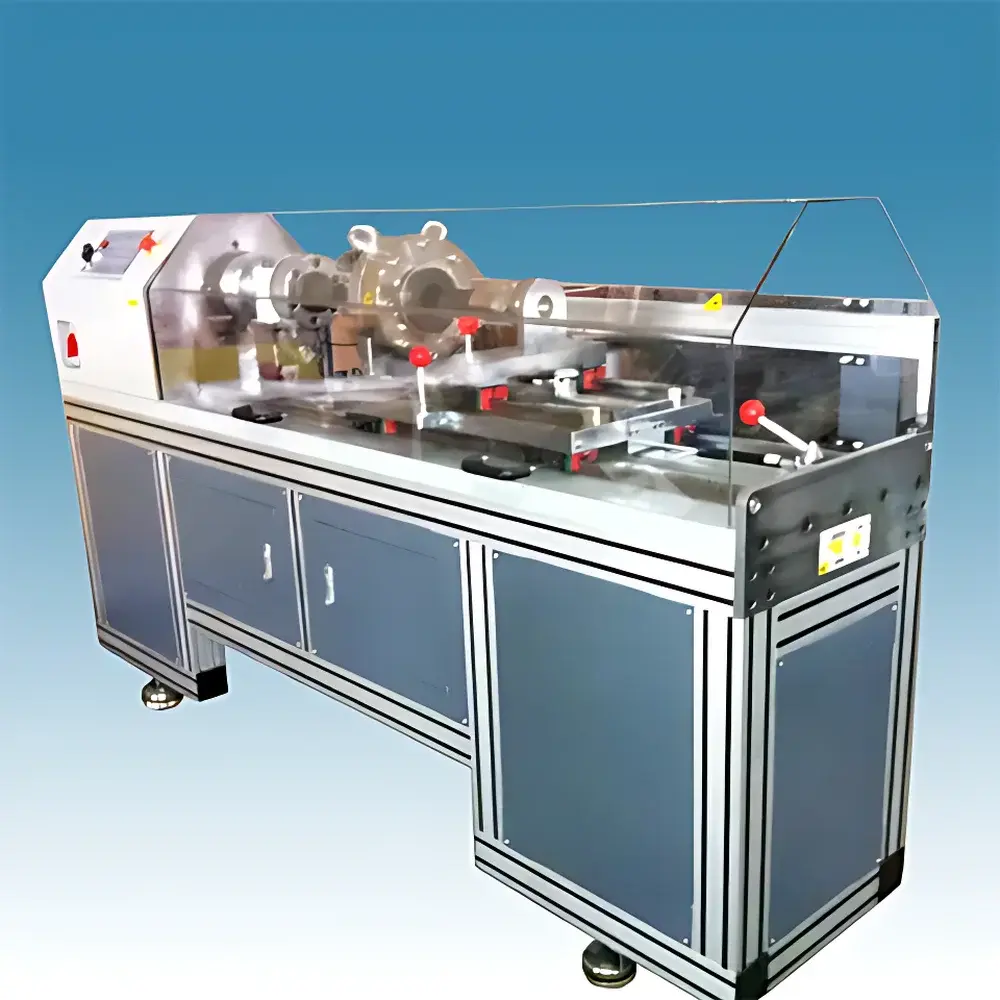
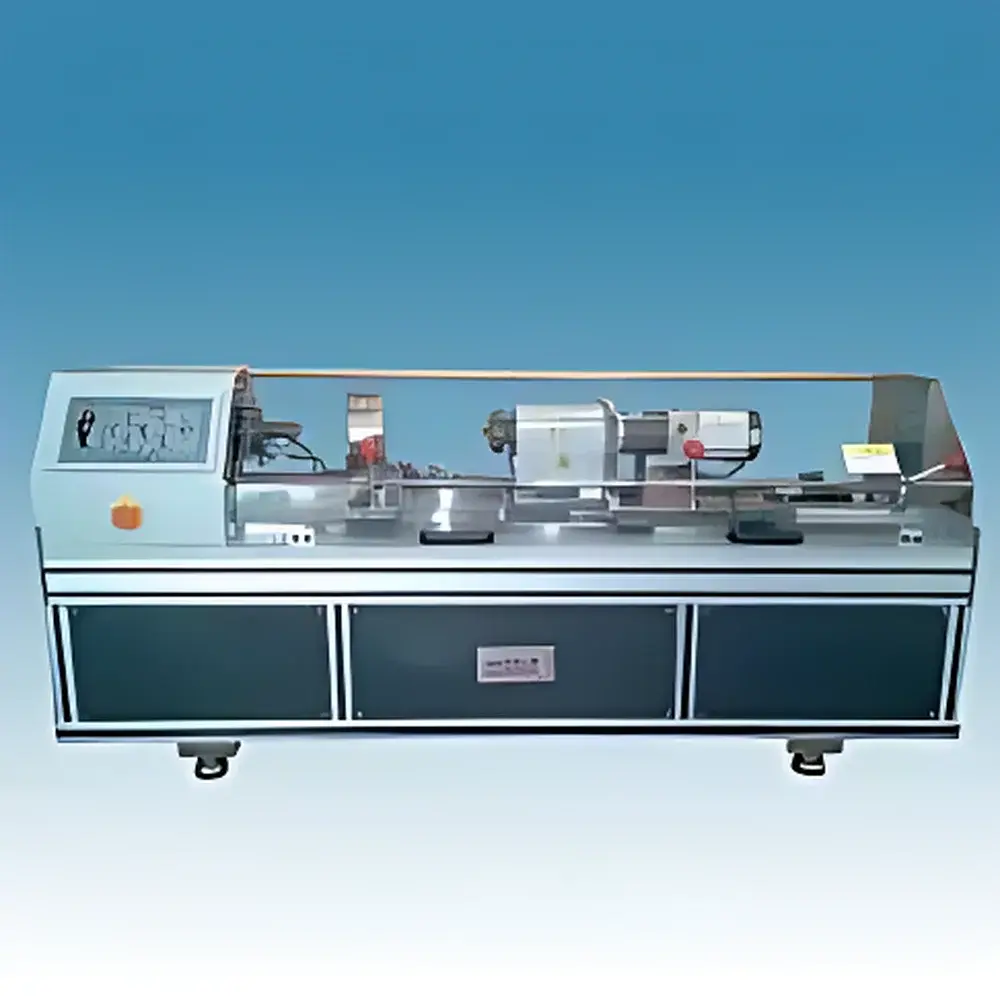
Hengyi HY(NJ)-2000N·m High-Strength Bolt Torque Coefficient Testing Machine
| Brand | Hengyi |
|---|---|
| Origin | Shanghai, China |
| Manufacturer Type | Direct Manufacturer |
| Country of Origin | China |
| Model | HY(NJ)-2000N·mGHH |
| Max Torque | 2000 N·m |
| Torque Measurement Range | 2–2000 N·m |
| Torque Resolution | 1/50000 |
| Torsion Angle Measurement Range | 0–100000° (or continuous) |
| Motor Power | 3 kW |
| Axial Force Range | 5–500 kN |
| Torque Measurement Accuracy | ±0.5% FS (typical) |
| Torsion Angle Accuracy | ±0.5% FS (typical) |
| Rotational Speed Range | 0–1000°/min |
| Gauge Length Adjustment | 1000 mm |
| Specimen Clamping Range | M10–M27 (customizable) |
| Dimensions (L×W×H) | ≈2800×540×1250 mm |
| Weight | 2200 kg |
Overview
The Hengyi HY(NJ)-2000N·m High-Strength Bolt Torque Coefficient Testing Machine is a precision-engineered torsion testing system designed for the standardized evaluation of torque-tension behavior in high-strength structural fasteners. Based on the Couette-type torsional loading principle, it simultaneously measures axial preload force and applied torque under controlled angular displacement or rotational speed, enabling calculation of the critical torque coefficient (K-value) per ISO 16047 and ASTM F2281. The machine adopts a robust horizontal floor-standing architecture with high-rigidity load frame, imported high-precision torque transducers and axial load cells, and a servo-motor-driven actuation system—ensuring long-term mechanical stability, minimal hysteresis, and repeatability better than ±0.5% full scale across its operational range.
Key Features
- Integrated dual-axis measurement: Simultaneous real-time acquisition of torque (2–2000 N·m) and axial force (5–500 kN) with synchronized angular position feedback (0–100000°, resolution ≤0.01°)
- High-fidelity control architecture: Closed-loop servo control with adjustable rotational speed (0–1000°/min) and programmable ramp-hold profiles for stepwise torque application or constant-rate twisting
- Advanced torque resolution: 1/50000 internal resolution supports accurate K-value derivation even at low-torque preloading stages
- Modular clamping system: Standardized jaw sets for M10–M27 fasteners; optional custom fixtures available for non-standard geometries including double-nut assemblies and washer-integrated configurations
- Structural integrity: Load frame fabricated from stress-relieved steel with static rigidity >2×10⁶ N/mm, minimizing deflection-induced measurement drift during high-load testing
- Thermal and mechanical stability: Precision-machined base plate with vibration-dampening mounts; ambient temperature operating range: 10–35°C, RH ≤80% non-condensing
Sample Compatibility & Compliance
This system is validated for testing high-strength bolt assemblies conforming to GB/T 1231–2006 (high-strength hex bolts for steel structures), GB/T 3632–2008 (torque-shear type bolts), ISO 898-1, ASTM A325/A490, and EN 14399 series. It supports full-cycle testing protocols—including proof loading, yield point detection, ultimate twist-to-failure, and repeated tightening cycles—to assess scatter in K-values, relaxation behavior, and thread friction contribution. All measurement subsystems comply with GB/T 2611–2007 (General Technical Requirements for Testing Machines) and GB/T 16823.3–2010 (Testing Methods for Threaded Fasteners). Traceable calibration certificates are provided per ISO/IEC 17025 requirements, with annual verification intervals aligned to GLP and ISO 9001 quality management systems.
Software & Data Management
Controlled by the proprietary HYtest V5.2 test platform, the system delivers comprehensive data acquisition, visualization, and reporting capabilities. The software supports multi-curve overlay (torque vs. angle, axial force vs. angle, torque vs. axial force), automatic K-value computation per ISO 16047 Annex A, statistical summary (mean, SD, CV%), and export to CSV, PDF, or XML formats. Audit trails record operator ID, test parameters, calibration history, and timestamped raw data—fully compliant with FDA 21 CFR Part 11 for electronic records and signatures when configured with user authentication and digital signature modules. Data archiving adheres to ISO/IEC 27001 information security standards, with optional network integration into LIMS environments via OPC UA or TCP/IP protocols.
Applications
Primary use cases include quality assurance of high-strength bolting systems in wind turbine tower flange connections, photovoltaic mounting structures, bridge cable anchorages, transmission tower foundations, offshore platform modules, and heavy-duty construction machinery. It is routinely deployed by national metrology institutes (e.g., CNAS-accredited labs), third-party certification bodies (e.g., TÜV, SGS), R&D departments in fastener OEMs, and QC laboratories within EPC contractors. Secondary applications encompass comparative friction studies (lubricated vs. dry threads), coating performance validation (e.g., zinc flake, Geomet), and qualification of alternative materials (e.g., stainless steel, duplex alloys) under elevated temperature or corrosive exposure conditions—when paired with environmental chamber integration options.
FAQ
What standards does this machine directly support for torque coefficient testing?
It fully implements GB/T 16823.3–2010, ISO 16047:2019, and ASTM F2281–22, with built-in test templates and pass/fail logic for K-value acceptance criteria.
Can the system perform cyclic tightening tests for evaluating scatter and relaxation?
Yes—programmable multi-step torque-angle sequences enable up to 99 repeat cycles with variable dwell times, axial force hold, and real-time deviation logging.
Is third-party calibration and traceability documentation included?
Each unit ships with a factory calibration report traceable to NIM (National Institute of Metrology, China) and optional CNAS-accredited calibration upon request.
What maintenance intervals are recommended for long-term accuracy?
Torque and load sensors require biannual verification; servo motor and gearbox lubrication is scheduled every 2000 operational hours; full system recalibration advised annually or after major mechanical impact.



