
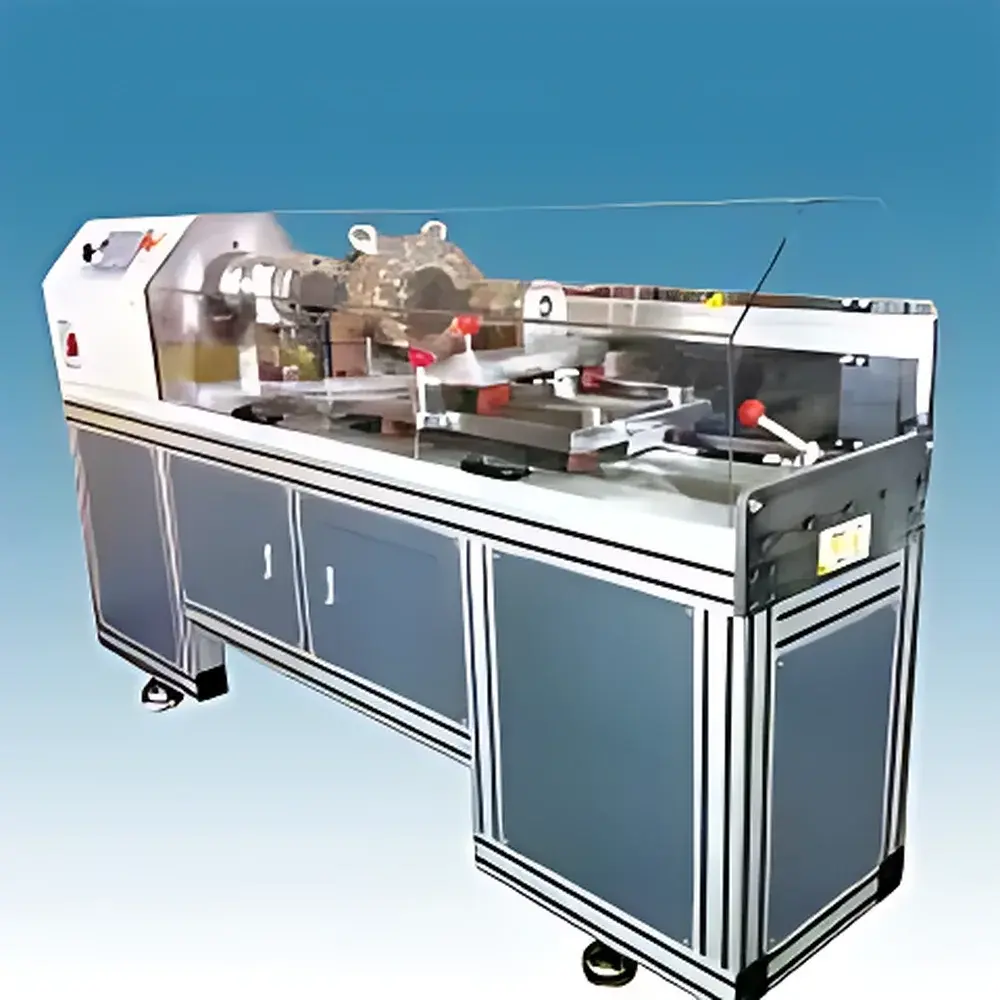
Hengyi HY-2000N·m Microcomputer-Controlled Bolt Friction Coefficient Tester
| Brand | Hengyi |
|---|---|
| Origin | Shanghai, China |
| Manufacturer Type | Direct Manufacturer |
| Model | HY-2000N·m (LM) |
| Torque Measurement Range (Primary Sensor) | 2000 N·m |
| Torque Measurement Range (Secondary Sensor) | 1000 N·m |
| Axial Force Range | 5–500 kN |
| Torque Measurement Accuracy | ±0.5% FS (typical) |
| Torsion Angle Range | 0–100,000° (or continuous) |
| Angular Position Accuracy | ±0.5% FS |
| Torsion Speed Range | 0–30 rpm |
| Speed Control Accuracy | ±0.5% |
| Maximum Gauge Length | 1000 mm |
| Specimen Clamping Range | M10–M30 (customizable) |
| Power Supply | Single-phase 3 kW |
| Dimensions (L×W×H) | ≈2200×540×1250 mm |
| Weight | 1200 kg |
Overview
The Hengyi HY-2000N·m Microcomputer-Controlled Bolt Friction Coefficient Tester is a precision torsion testing system engineered for quantitative evaluation of thread and bearing surface friction behavior in fastener assemblies under controlled axial preload and rotational loading. It operates on the principle of simultaneous dual-axis measurement—capturing real-time torque (T), axial force (F), and angular displacement (θ) during tightening or loosening cycles—to compute fundamental tribological parameters including thread friction coefficient (μt), bearing surface friction coefficient (μb), total coefficient of friction (μtot), torque coefficient (K), yield torque, proof load, and effective torque. Designed to ISO 16047, ASTM F568M, DIN 946, and GB/T 16823.3 compliance frameworks, this instrument supports traceable, repeatable fastener qualification in R&D, quality assurance, and production validation environments.
Key Features
- High-fidelity dual-sensor architecture: 2000 N·m primary torque transducer with ±0.5% full-scale accuracy and 1000 N·m secondary sensor for extended dynamic range and cross-verification.
- Integrated 500 kN high-precision axial load cell enabling synchronized force-torque-angle acquisition at up to 100 Hz sampling rate.
- Robust horizontal frame with reinforced steel base, CNC-machined fixture mounts, and M10–M30 interchangeable clamping modules (standardized per ISO 898-1).
- Japanese Panasonic AC servo drive system coupled with a high-ratio planetary gearbox (1:2,000,000 speed resolution) ensuring stable low-speed control down to 0.01 rpm and precise positioning repeatability.
- Imported optical encoder with 0.01° angular resolution and <0.02° linearity error over full 0–100,000° range.
- Dedicated 32-bit ARM-based embedded controller delivering deterministic real-time closed-loop control, 115.2 kbps serial communication bandwidth, and onboard data buffering for transient event capture.
Sample Compatibility & Compliance
The HY-2000N·m accommodates standard and custom fasteners ranging from M10 to M30 metric threads, with optional adapters available for non-standard geometries (e.g., flange bolts, lock nuts, wedge-lock washers). Test specimens include but are not limited to structural bolts, automotive wheel studs, aerospace shear bolts, and medical implant screws. All test protocols adhere to internationally recognized standards—including ISO 16047 (determination of torque–tension characteristics), ASTM F1470 (fastener testing guide), DIN 946 (friction coefficients of bolt/nut assemblies), and GB/T 16823.3 (Chinese national standard for bolted joint analysis). The system supports GLP-compliant audit trails, user-level access control, and electronic signature functionality when configured with validated software modules meeting FDA 21 CFR Part 11 requirements.
Software & Data Management
The Windows-based Hengyi TestSuite v4.x software provides ISO/IEC 17025-aligned test configuration, real-time multi-channel visualization (T–F–θ plots), automated parameter derivation (μt, μb, K, τy, θplastic), and customizable report generation in PDF/XLS formats. Raw data export includes timestamped ASCII files compatible with MATLAB, Python (NumPy/Pandas), and third-party statistical analysis platforms. Calibration certificates are digitally linked to sensor IDs; firmware updates preserve metrological integrity through cryptographic checksum verification. Optional cloud synchronization enables centralized fleet monitoring across distributed QA labs.
Applications
- Quantification of friction variability across lubricant types (molybdenum disulfide, zinc flake, PTFE coatings) and surface treatments (phosphating, galvanizing, black oxide).
- Validation of torque–tension relationships for critical bolting applications in wind turbine nacelles, railcar suspension systems, and pressure vessel flanges.
- Development of statistical process control (SPC) baselines for production-line fastener acceptance testing.
- Failure mode analysis of self-loosening mechanisms under vibration or thermal cycling (per ISO 10545-13 or VDI 2230 Part 1).
- Supporting design-for-assembly (DFA) initiatives by correlating thread geometry (pitch, flank angle, root radius) with measured μt values.
FAQ
What standards does the HY-2000N·m support for friction coefficient calculation?
It implements ISO 16047 Annex A methodology for calculating μt and μb using measured torque, axial force, and pitch diameter, with configurable input for thread geometry per ISO 68-1.
Can the system perform both tightening and loosening friction analysis?
Yes—bidirectional torque control allows hysteresis loop acquisition, enabling differentiation between static and kinetic friction coefficients.
Is calibration traceability provided to national metrology institutes?
All torque and force sensors ship with UKAS-accredited calibration certificates (NPL or CNAS-equivalent), valid for 12 months under normal operating conditions.
Does the software support automated pass/fail decision logic based on specification limits?
Yes—user-defined tolerance bands trigger visual alerts and auto-flag outliers in accordance with ISO 2768-1 general tolerances for linear and angular dimensions.
What maintenance intervals are recommended for long-term measurement stability?
Biannual verification of sensor zero drift and encoder alignment is advised; annual recalibration of torque and axial load channels is required for ISO/IEC 17025 compliance.



