
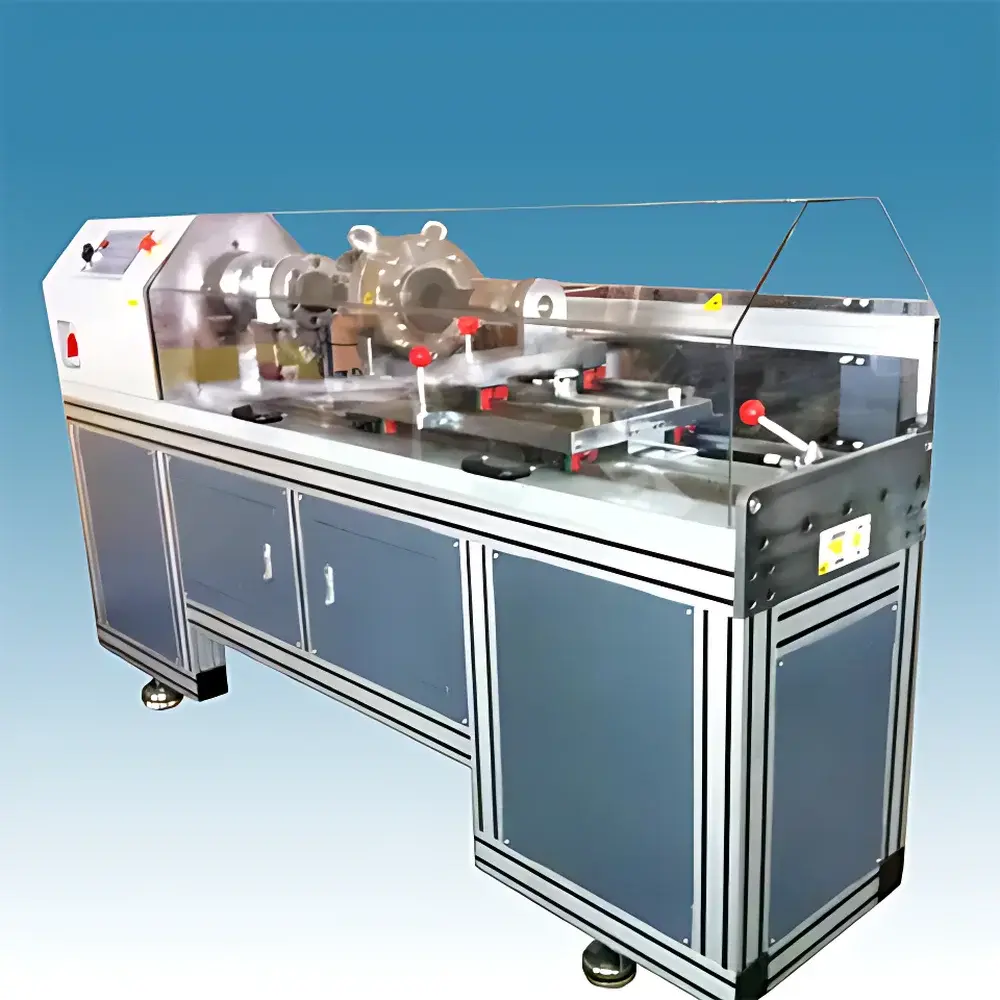
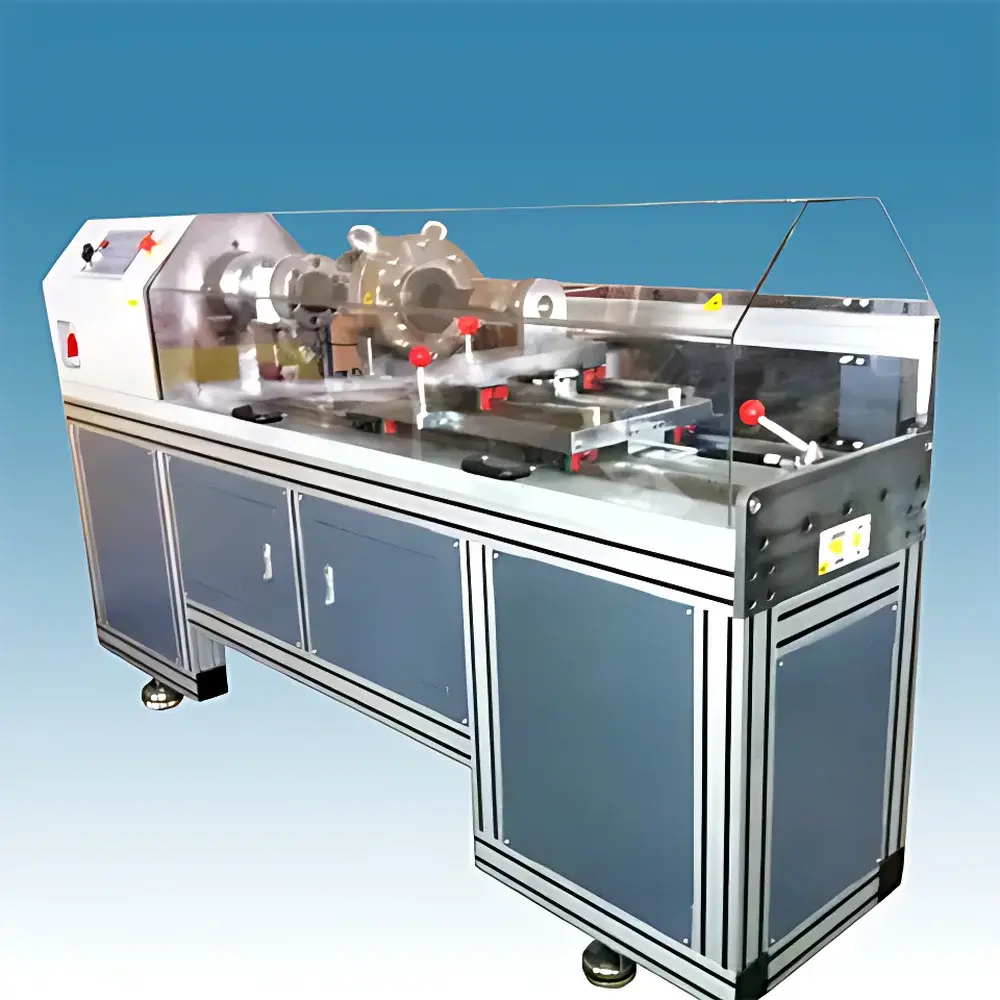
Hengyi HY-2000N·m Microcomputer-Controlled Fastener Friction Coefficient Tester
| Brand | Hengyi |
|---|---|
| Origin | Shanghai, China |
| Manufacturer Type | Direct Manufacturer |
| Model | HY-2000N·m |
| Torque Measurement Range (Total) | 2000 N·m |
| Thread Torque Range | 1000 N·m |
| Axial Force Range | 5–500 kN |
| Torque Measurement Accuracy | ±0.5% FS |
| Twist Angle Range | 0–100,000° (or continuous) |
| Angular Position Accuracy | ±0.5% FS |
| Torsion Speed Range | 0–30 rpm |
| Specimen Clamping Diameter | M10–M30 |
| Maximum Spacing Between Chucks | 1000 mm |
| Power Supply | Single-phase 5 kW |
| Weight | 1800 kg |
| Compliance Standards | GB/T 16823.3, ISO 16047, ASTM F568M, DIN 946, JIS B1083 |
Overview
The Hengyi HY-2000N·m Microcomputer-Controlled Fastener Friction Coefficient Tester is a precision torsion testing system engineered for quantitative characterization of frictional behavior in threaded fasteners under controlled axial preload and rotational loading. Based on the principle of simultaneous dual-sensor torque measurement—separating total applied torque into thread torque and bearing surface (under-head) torque—the instrument enables calculation of three critical friction coefficients: thread friction coefficient (µth), bearing surface friction coefficient (µb), and total coefficient of friction (µtot). This methodology aligns with internationally recognized mechanical test standards including ISO 16047 (Fasteners — Torque/clamp force testing), ASTM F568M (Standard Specification for Carbon and Alloy Steel Externally Threaded Metric Fasteners), and GB/T 16823.3 (Mechanical properties of fasteners — Part 3: Torque/clamp force testing). The system employs a rigid horizontal frame architecture with high-stiffness load train, ensuring minimal parasitic bending and high reproducibility in multi-cycle friction mapping.
Key Features
- Dual high-precision torque sensing: Independent 2000 N·m total torque transducer (Messtechnik, Germany) and 1000 N·m thread-specific torque transducer enable real-time decomposition of torque components with ≤0.5% full-scale accuracy.
- Integrated axial force measurement: 500 kN load cell (domestic high-accuracy grade) provides synchronized clamp force data, essential for K-factor (torque coefficient) derivation per ISO 16047 Annex A.
- High-resolution angular metrology: Imported optical encoder delivers ≤0.5% angular position error over 0–100,000° range, supporting precise determination of yield point, plastic deformation onset, and breakaway torque.
- Real-time closed-loop control: ARM32-based embedded controller (56 MIPS processing capability) executes servo regulation at 100 Hz sampling rate, enabling stable low-speed torsion (0.01–30 rpm) with ≤0.5% speed deviation.
- Modular fixture compatibility: Standard M10–M30 socket sets (11 pairs included) accommodate common structural bolts; custom jaw configurations available for non-standard geometries or embedded assemblies.
- Robust mechanical design: 1800 kg mass, reinforced steel frame, and industrial-grade planetary gearbox (Hubei brand) ensure vibration damping and long-term dimensional stability during high-load cyclic testing.
Sample Compatibility & Compliance
The HY-2000N·m tester supports standardized test specimens per ISO 16047 Clause 6, including property class 8.8 to 12.9 hex bolts, flange bolts, and shear-resistant assemblies. It accommodates both bare and coated fasteners (e.g., zinc-flake, phosphate, PTFE-lubricated), provided surface finish and coating thickness remain within specification limits defined in ASTM D7819. All hardware and firmware comply with GLP documentation requirements: audit-trail-enabled software logs operator ID, timestamp, calibration status, and raw sensor outputs. Data export formats (CSV, XML) meet FDA 21 CFR Part 11 readiness when paired with validated user access controls and electronic signature modules. Test reports include traceable references to ISO 16047:2019, DIN 946-1:2021, and GB/T 16823.3–2010.
Software & Data Management
The proprietary Hengyi TestMaster v4.2 software—developed on an ARM32 real-time OS platform—supports fully automated test sequences, including preload ramping, dwell phases, and dynamic torque-angle sweeps. Users define multi-step protocols with conditional logic (e.g., “hold at 80% yield torque for 30 s, then increase at 2 N·m/s until fracture”). Raw data streams (torque, axial force, angle, time) are acquired synchronously at 100 Hz and stored with 16-bit resolution. Post-processing tools compute K-value, µth, µb, τy (yield torque), and θp (plastic twist angle) per ISO 16047 Annex B algorithms. Export options include PDF test certificates with digital signatures, CSV for statistical process control (SPC) integration, and XML for LIMS ingestion. Calibration records are version-controlled and linked to NIST-traceable certificate numbers.
Applications
- Quality assurance of automotive chassis fasteners subjected to thermal cycling and vibration-induced loosening.
- R&D validation of anti-seize coatings and solid-film lubricants under simulated service loads.
- Production line verification of torque-tension relationships for aerospace-grade titanium alloy bolts (e.g., Ti-6Al-4V per AMS 4928).
- Failure analysis of galling-prone stainless steel assemblies (A2/A4, ASTM A193 B8M) via friction coefficient trend monitoring across tightening cycles.
- Material certification per EN 15048 (non-preloaded assemblies) and ISO 898-1 (mechanical properties of bolts).
- Calibration traceability support for ISO/IEC 17025-accredited laboratories performing fastener certification testing.
FAQ
What standards does this tester directly support for friction coefficient reporting?
ISO 16047:2019, ASTM F568M–2022, DIN 946–1:2021, GB/T 16823.3–2010, and JIS B1083:2018.
Can the system measure friction coefficients for non-hexagonal fasteners such as Torx or spline drives?
Yes—custom tooling adapters (e.g., Torx bit holders, internal spline chucks) are available upon request and maintain measurement traceability when calibrated per ISO 16047 Annex C.
Is the software compliant with FDA 21 CFR Part 11 for regulated environments?
Out-of-the-box functionality meets technical prerequisites; full compliance requires site-specific validation, including role-based access control configuration, electronic signature implementation, and audit trail review procedures.
What maintenance intervals are recommended for torque sensor recalibration?
Annual recalibration against NIST-traceable reference standards is advised; in high-volume production use (>500 tests/week), semi-annual verification is recommended.
Does the system support real-time torque-angle curve overlay for comparative analysis?
Yes—up to 16 concurrent test curves can be overlaid with adjustable scaling, differential highlighting, and statistical banding (±1σ) for batch consistency assessment.



