
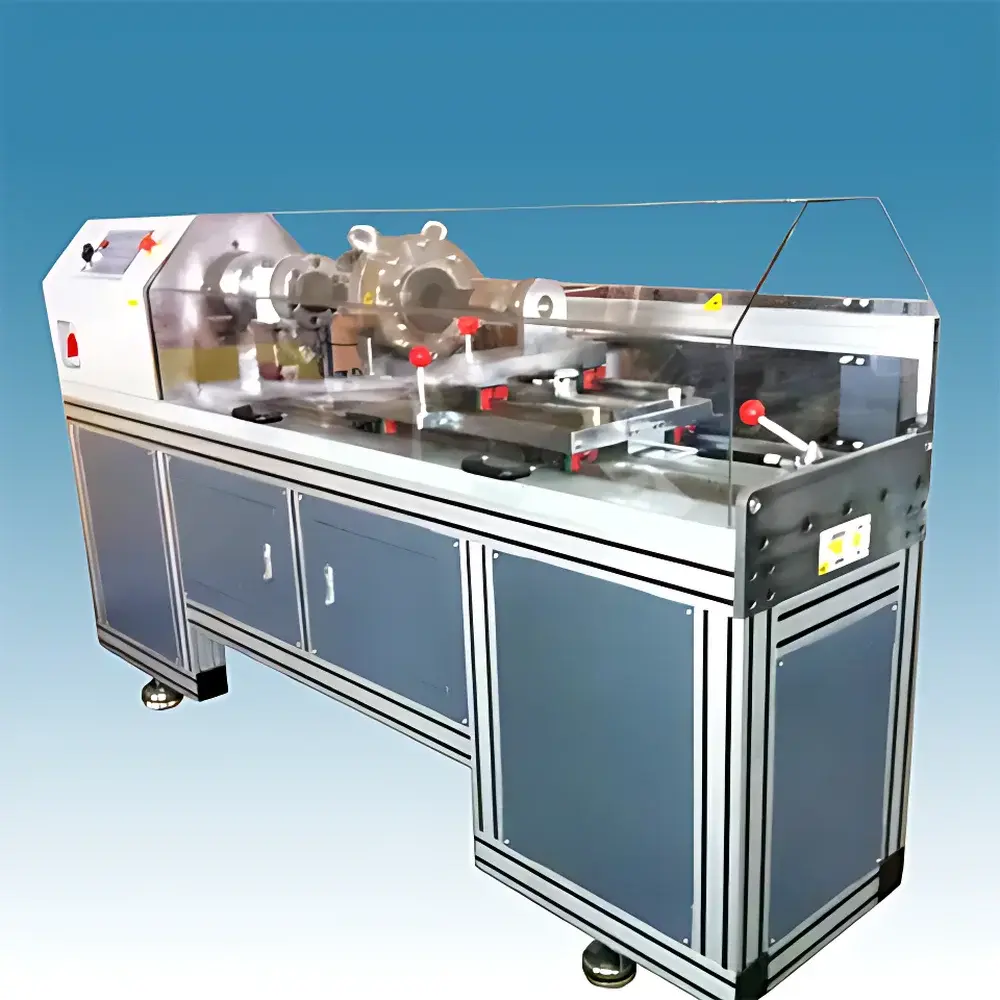
Hengyi HY-2000N·m Threaded Fastener Friction Coefficient Tester
| Brand | Hengyi (Hengyitest) |
|---|---|
| Origin | Shanghai, China |
| Manufacturer Type | OEM Manufacturer |
| Product Category | Domestic |
| Model | HY-2000N·m |
| Max Torque | 2000 N·m |
| Torque Measurement Range | 2–2000 N·m |
| Torque Resolution | 1/50000 |
| Torsion Angle Range | 0–100000° |
| Motor Power | 5 kW |
Overview
The Hengyi HY-2000N·m Threaded Fastener Friction Coefficient Tester is a precision torsion testing system engineered for quantitative mechanical characterization of bolt-nut assemblies under controlled tightening and loosening cycles. It operates on the principle of simultaneous, synchronized measurement of axial preload (clamping force) and multi-component torque—total torque, thread torque, and bearing surface torque—enabling decomposition of frictional contributions across functional interfaces. This architecture conforms to the fundamental physical model defined in ISO 16047:2015 (“Fasteners — Mechanical properties of fasteners made of carbon steel and alloy steel — Part 2: Nuts”), which establishes standardized methodology for determining torque coefficients (K), total coefficient of friction (μtot), thread coefficient of friction (μth), and bearing surface coefficient of friction (μb). Designed specifically for high-strength fasteners used in aerospace, wind turbine assembly, rail infrastructure, and automotive powertrain applications, the system delivers traceable, repeatable data essential for GD&T validation, statistical process control (SPC), and failure mode analysis.
Key Features
- Integrated dual-sensor architecture: High-accuracy load cell (5–500 kN axial force range) coupled with a coaxial torque transducer (2–2000 N·m), both calibrated to ISO 376 and ISO 3779 standards
- Real-time decoupling of torque components: Independent acquisition of thread torque and bearing surface torque via proprietary mechanical isolation and signal conditioning
- Programmable multi-cycle testing: Automated execution of standardized sequences per ISO 16047 Annex A—including first tightening, first loosening, fifth loosening, and fifteenth loosening—to assess wear-induced friction degradation
- High-resolution angular measurement: Absolute encoder with 0–100,000° range and ±0.5% relative error, supporting both incremental angle control and full-turn tracking
- Robust mechanical frame: Cast-iron base with 1000 mm maximum jaw spacing and M10–M30 specimen compatibility; total mass 1800 kg ensures vibration damping and long-term stability
- Industrial-grade drive system: 5 kW AC servo motor with speed regulation from 5–40 rpm (extendable to 200 rpm), enabling controlled ramp rates compliant with ASTM F2329 and EN 14399 series
Sample Compatibility & Compliance
The HY-2000N·m tester accommodates threaded fasteners ranging from M10 to M30, including but not limited to hex bolts, flange bolts, lock nuts (e.g., prevailing-torque and free-spinning types), and structural bolting assemblies per ASTM A325/A490 and EN 14399-1:2005. It supports standardized test specimens as specified in GB/T 3098.9–2010 (equivalent to ISO 898-2), GB/T 16823.3–2010 (identical to ISO 16047), and ISO 2320:2008 (for zinc-coated fasteners). All measurement outputs—including K-factor, μtot, μth, μb, yield clamping force, ultimate tensile force, and breakaway torque—are traceable to national metrological standards and support GLP-compliant audit trails when paired with validated software.
Software & Data Management
The embedded control and analysis platform provides ISO/IEC 17025-aligned data acquisition with timestamped metadata, digital signature support, and configurable report templates exportable to PDF, CSV, and XML. Raw sensor streams are sampled at ≥1 kHz, enabling dynamic analysis of transient phenomena such as stick-slip behavior and yield onset detection. The software enforces user role-based access control (RBAC), electronic signatures per FDA 21 CFR Part 11, and automatic backup to network-attached storage (NAS). Calibration certificates, uncertainty budgets, and verification logs are stored within the database with immutable revision history. Exported datasets comply with ASTM E2917 and ISO/IEC 17025:2017 requirements for measurement traceability.
Applications
- Validation of lubricant performance on coated fasteners (e.g., yellow-zinc, Geomet®, Dacromet®)
- Quantification of friction scatter in production lots for SPC implementation
- Development and qualification of anti-loosening mechanisms (e.g., nylon inserts, distorted threads, wedge-lock washers)
- Correlation studies between lab-scale friction data and field failure reports in rotating machinery
- Supporting root cause analysis in bolted joint fatigue investigations per VDI 2230
- Third-party certification testing for ISO 898-1, ISO 898-2, and EN 15048 compliance
FAQ
What international standards does this tester fully support?
It complies with ISO 16047:2015, ISO 2320:2008, GB/T 16823.3–2010, GB/T 3098.9–2010, EN 14399-1:2005, EN 14399-3/6:2006, and ISO 898-1:1999.
Can it measure both static and dynamic friction coefficients?
Yes—the system captures quasi-static friction during controlled tightening and dynamic breakaway friction during loosening cycles, with independent resolution of thread and bearing surface contributions.
Is the torque resolution verified per ISO 376?
Yes—torque transducers are factory-calibrated and certified to ISO 376 Class 0.5, with documented uncertainty budgets available upon request.
Does the system support automated pass/fail evaluation against specification limits?
Yes—user-defined acceptance criteria (e.g., μth ≤ 0.14 ± 0.02) can be embedded into test methods, triggering real-time alerts and auto-generated non-conformance reports.
What is the typical calibration interval recommended for routine use?
Annual calibration is recommended per ISO/IEC 17025; however, intermediate verification using traceable reference standards is advised before each shift in high-volume QA environments.



