
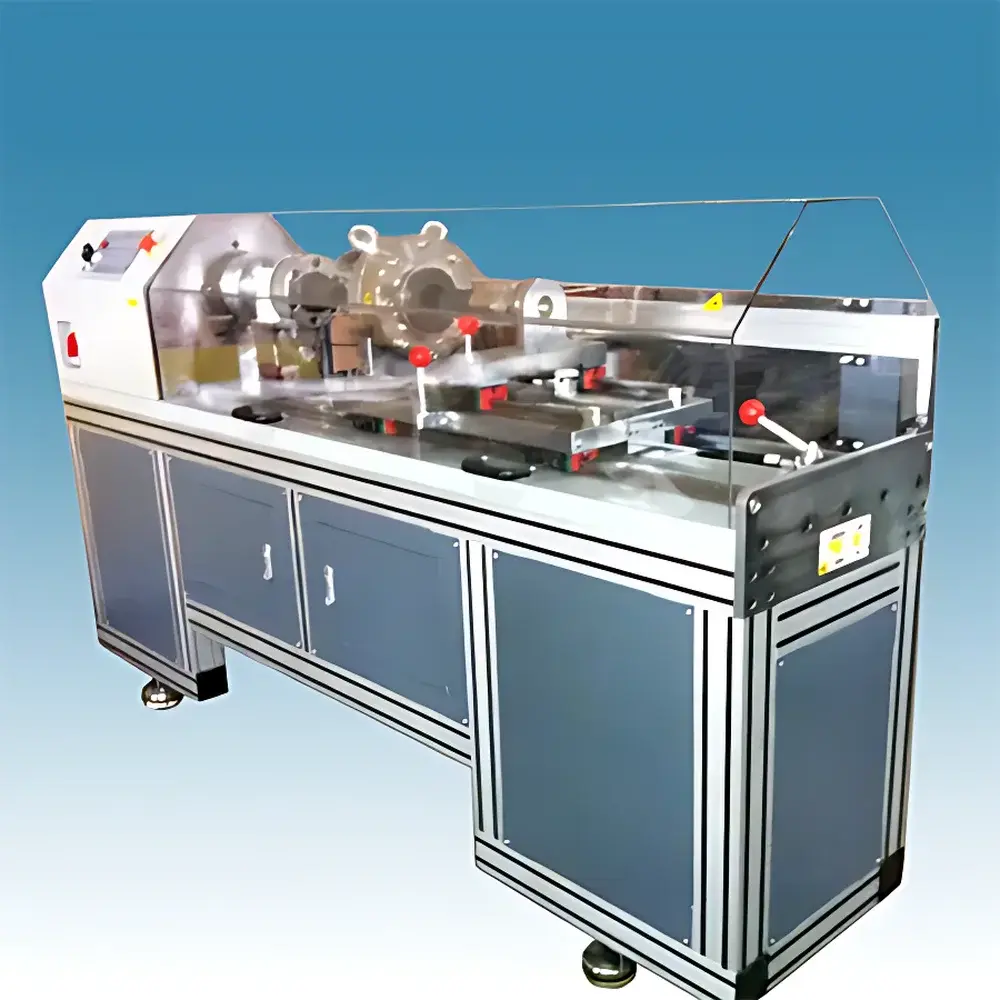
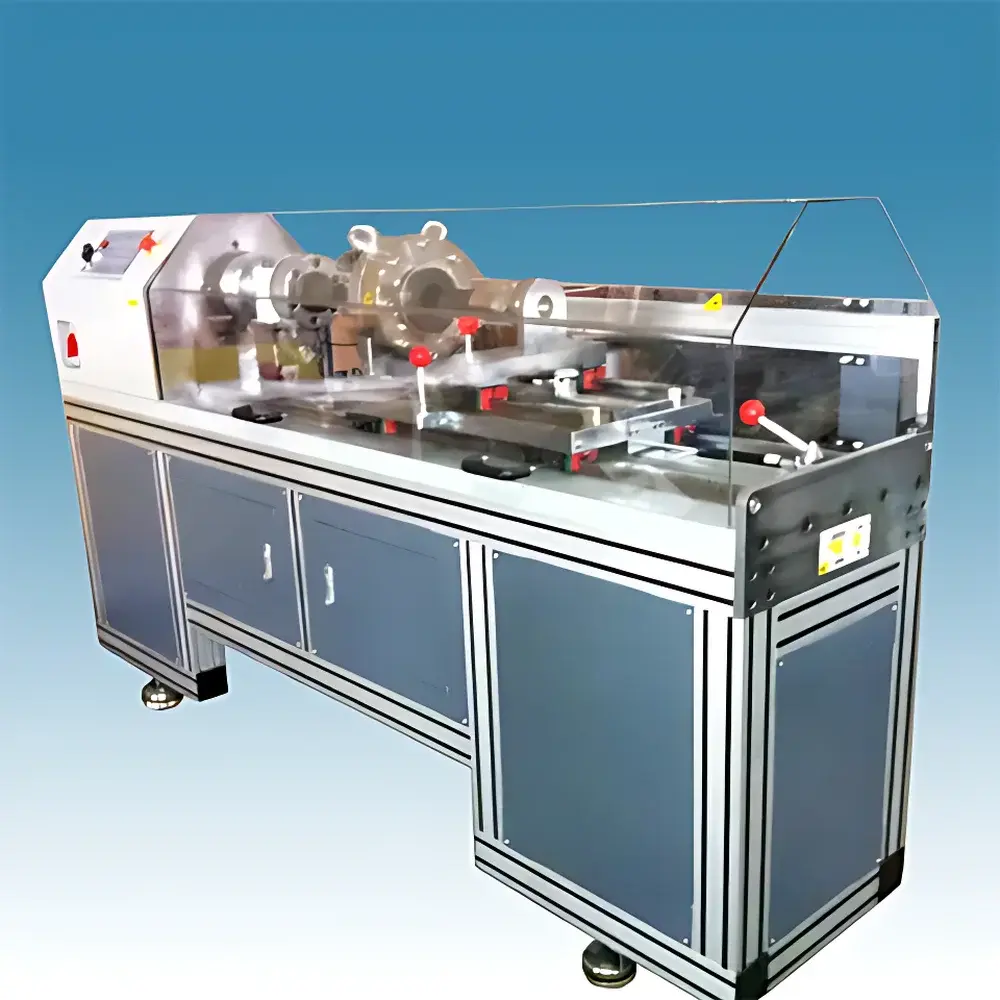
Hengyi HY-2000NM Threaded Fastener Friction Coefficient Testing System
| Brand | Hengyi / Hengyitest |
|---|---|
| Origin | Shanghai, China |
| Manufacturer Type | Direct Manufacturer |
| Region Classification | Domestic (China) |
| Model | HY-2000NMRTG |
| Pricing | Upon Request |
Overview
The Hengyi HY-2000NM Threaded Fastener Friction Coefficient Testing System is a high-capacity, dual-sensor torsional testing platform engineered for precise quantification of frictional and mechanical behavior in bolt-nut assemblies under controlled preload conditions. It operates on the principle of simultaneous axial force and torque measurement during controlled tightening—enabling separation and calculation of total coefficient of friction (µtot), thread coefficient of friction (µth), and bearing surface coefficient of friction (µb) in accordance with ISO 16047, ASTM F568M, and DIN EN ISO 898-1 standards. Designed for industrial metrology labs, fastener OEM quality control departments, and R&D centers in wind energy, steel construction, rail infrastructure, and aerospace supply chains, the system delivers traceable, repeatable data essential for validating tightening protocols, verifying lubricant performance, and supporting statistical process control (SPC) initiatives.
Key Features
- Integrated dual-load measurement architecture: independent high-accuracy load cell (5–500 kN axial force range) and coaxial torque transducers (2000 N·m total torque; 1000 N·m thread torque) enable real-time decoupling of friction components.
- High-resolution angular displacement sensing with ±0.5% relative error across 0–100,000° range, supporting both incremental step-torque and continuous ramp-to-failure test modes.
- Motor-driven precision drive system with speed control from 5–40 rpm (extendable to 200 rpm), ensuring smooth low-speed tightening without stick-slip artifacts or torque ripple.
- Rigid C-frame structural design (2200 × 540 × 1250 mm; 1800 kg mass) minimizes frame compliance and enhances measurement stability during high-load testing.
- Modular specimen grip system accommodates threaded fasteners from M10 to M30; custom adapters available for non-standard geometries including weld studs, anchor bolts, and double-end rods.
- Compliance-ready control electronics: HYtest controller meets EMC Class B requirements and supports audit-trail logging per GLP/GMP guidelines when paired with validated software configurations.
Sample Compatibility & Compliance
The HY-2000NM is validated for testing high-strength threaded fasteners including ASTM A193 B7/B16, A320 L7/L43, ISO 898-1 Class 10.9/12.9, and EN 15048 non-preloaded structural bolts. It supports standardized test configurations for hex head bolts, torque-shear bolts, wind turbine tower anchor bolts, foundation anchor rods, and shear connectors per EN 14399 and IEC 61400-1. All measurement outputs—including K-factor (torque coefficient), µtot, µth, µb, yield clamping force, ultimate tensile torque, and rotation angle at yield—are reported in units and formats fully compatible with ISO 16047 Annex A and VDI 2230 Part 1 documentation requirements. Calibration certificates are traceable to CNAS-accredited national standards.
Software & Data Management
The HYtest universal testing software provides ISO 16047-compliant test sequence templates, real-time multi-curve overlay (T-θ, F-θ, T-F), and automated calculation of friction coefficients using the standard formulae: µtot = T / (K × F × d), µth = (Tth) / (0.16 × F × d), and µb = (Tb) / (0.58 × F × d). Raw data export is supported in CSV, XML, and PDF report formats with embedded metadata (operator ID, calibration date, environmental conditions). Optional 21 CFR Part 11 add-on module enables electronic signatures, role-based access control, and immutable audit trails for regulated environments. Software validation documentation (IQ/OQ/PQ protocols) is available upon request.
Applications
- Verification of lubricant efficacy and consistency across production batches of high-strength bolts used in wind turbine nacelles and tower flanges.
- Root-cause analysis of joint slippage or bolt fracture in steel bridge connections through correlation of µb variation with surface finish and coating thickness.
- Development and qualification of new anti-seize compounds, phosphate coatings, and nano-ceramic dry film lubricants per ASTM D2670 and ISO 20623.
- Supporting PPAP submissions for automotive Tier-1 suppliers by generating full friction characteristic datasets compliant with VW PV 1003 and GMW 14872.
- Calibration and verification of torque-controlled assembly tools in manufacturing cells using reference fastener datasets generated on the HY-2000NM.
FAQ
What international standards does the HY-2000NM support for friction coefficient testing?
It fully complies with ISO 16047, ASTM F568M, DIN EN ISO 898-1, VDI 2230, and EN 14399 for both methodology and reporting format.
Can the system measure friction coefficients for non-standard fasteners such as weld studs or anchor rods?
Yes—custom fixture kits and adapter spindles are available for stud welding anchors, J-bolts, L-bolts, and other non-hex geometries; dimensional limits apply per maximum clamping length (1000 mm) and diameter range (M10–M30).
Is the software qualified for use in FDA-regulated or GMP environments?
With the optional 21 CFR Part 11 compliance package, the HYtest software supports electronic records, signature authentication, and audit trail generation meeting ALCOA+ principles.
What maintenance and calibration intervals are recommended?
Annual system-level calibration is advised; torque and force sensors require recalibration every 12 months or after 10,000 test cycles—certificates traceable to CNAS-accredited labs are provided.
Does the system support automated pass/fail evaluation against user-defined specification limits?
Yes—threshold-based go/no-go logic can be configured per parameter (e.g., µtot ∈ [0.08–0.14], K-factor ≤ 0.135), with visual alerts and automatic report flagging.



