
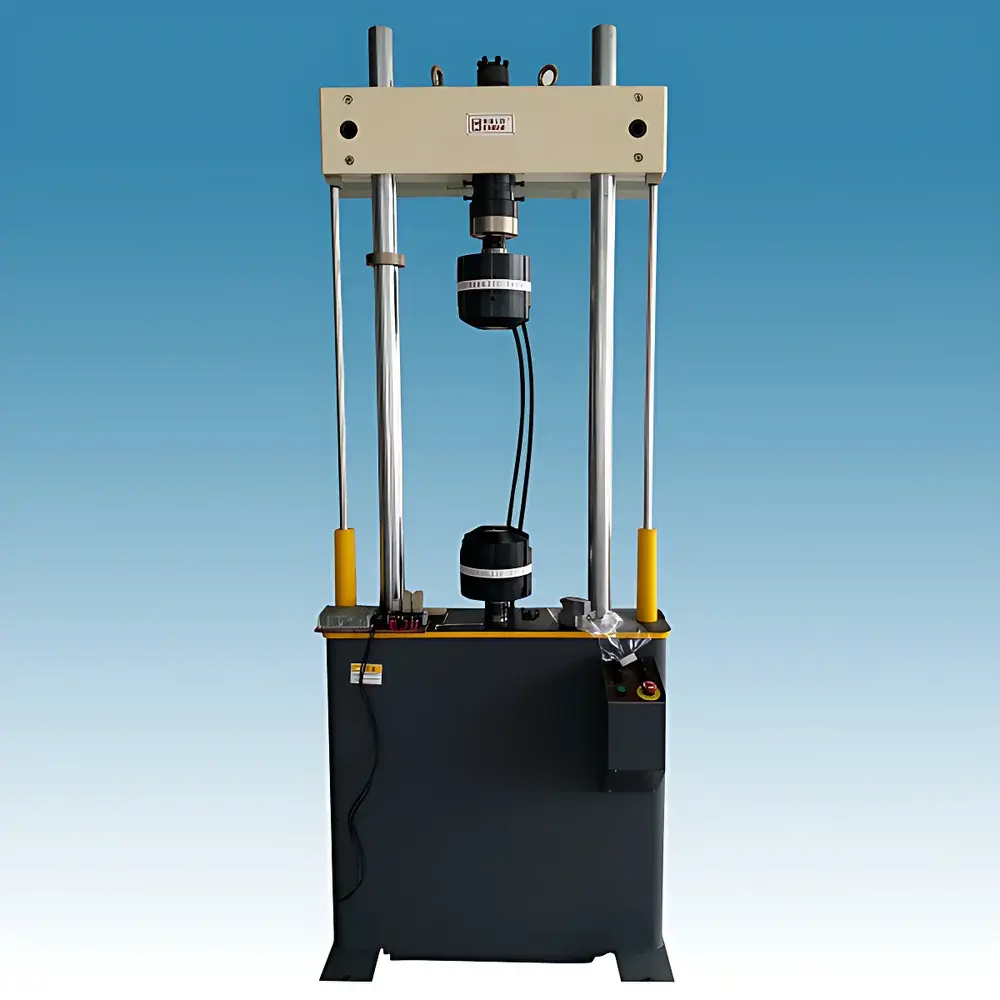
Hengyi HY(DLY)-100KN Electro-Hydraulic Servo Dynamic Fatigue Testing Machine
| Brand | Hengyi / Hengyitest |
|---|---|
| Origin | Shanghai, China |
| Manufacturer Type | Direct Manufacturer |
| Product Category | Domestic |
| Model | HY(DLY)-100KN |
| Instrument Type | Electro-Hydraulic Servo Fatigue Testing Machine |
| Maximum Test Load | ±100 kN (Dynamic), 100 kN (Static) |
| Frequency Range | 0.01–50 Hz |
| Host Weight | 95 kg |
Overview
The Hengyi HY(DLY)-100KN Electro-Hydraulic Servo Dynamic Fatigue Testing Machine is a high-precision, closed-loop controlled system engineered for rigorous mechanical characterization of structural materials and components under cyclic loading conditions. Based on the fundamental principles of servo-hydraulic actuation and real-time feedback control, it delivers stable, repeatable dynamic force application across a broad frequency spectrum—from quasi-static (0.01 Hz) to high-frequency fatigue regimes (up to 50 Hz). The machine employs a rigid two-column monolithic frame architecture with electroplated hard-chrome surface treatment on vertical columns, ensuring minimal deflection, zero backlash, and long-term dimensional stability during extended testing campaigns. Its lower-mounted bidirectional servo actuator—integrated with high-fidelity Moog or AOTOS servo valves—enables precise stroke control and rapid load reversal, essential for low-cycle fatigue (LCF), high-cycle fatigue (HCF), crack propagation (da/dN), and fracture mechanics (KIc, J-integral) evaluations per ASTM E647, E399, and ISO 12108.
Key Features
- Rigid two-column closed-frame structure with high-stiffness base and crosshead; column surface treated with electroplated hard chromium for wear resistance and dimensional consistency
- Lower-positioned bidirectional hydraulic actuator with ±75 mm piston stroke (standard), optimized for uniform stress distribution and simplified specimen alignment
- Electro-hydraulic servo pump station featuring ultra-low-noise operation, pressure ripple suppression, integrated thermal overload protection, and high-efficiency filtration (≤5 µm absolute)
- Multi-sensor fusion architecture: high-accuracy S-type load cell (Transcell/Interface grade, ±0.5% FS static / ±1.0% FS dynamic), magnetostrictive displacement transducer (NOVO or MTS, ±1.0% FS), and optional extensometry for strain-controlled testing
- Full-digital controller supporting simultaneous force, displacement, and strain closed-loop control with PID tuning; seamless, disturbance-free mode switching between control variables
- Comprehensive hardware safety layer including oil temperature monitoring, low fluid level detection, overpressure cutoff, motor thermal shutdown, and automatic halt upon specimen rupture or preset cycle completion
Sample Compatibility & Compliance
The HY(DLY)-100KN accommodates metallic specimens (steel, aluminum, titanium alloys), elastomeric components (rubber isolators, bushings), composite laminates, welded joints, and additively manufactured parts—provided within its 600 mm column spacing and 750 mm vertical test space (excluding grips). Standard wedge-action, hydraulic wedge, or custom-designed fixtures support tensile, compressive, flexural, and push-pull configurations. The system conforms to multiple international and national standards including GB/T 2611 (General Requirements for Testing Machines), GB/T 16826 (Electro-Hydraulic Servo Universal Testing Machines), GB/T 3075 (Axial Fatigue Testing of Metallic Materials), JB/T 9397 (Tension-Compression Fatigue Testing Machines), and GB/T 228.1 (Tensile Testing at Ambient Temperature). While not inherently 21 CFR Part 11 compliant, audit-ready data logging—including full traceability of calibration records, operator ID, environmental timestamps, and raw sensor streams—is supported via optional software modules aligned with GLP/GMP documentation workflows.
Software & Data Management
The proprietary Windows-based test software operates natively on Windows 2000/XP platforms (with compatibility extensions for modern virtualized environments). It provides real-time graphical display of force-displacement, stress-strain, hysteresis loops, and S–N curves; supports waveform synthesis for sinusoidal, triangular, square, trapezoidal, ramp, and user-defined arbitrary functions; and enables automated sequence programming for multi-step tests (e.g., preload → hold → cyclic loading → unloading). All raw acquisition data (1 kHz sampling standard, upgradable to 10 kHz) are stored in binary-indexed format with embedded metadata (test parameters, calibration coefficients, environmental notes). Export options include CSV, Excel-compatible XML, and PDF report generation with customizable templates meeting institutional QA requirements. Data integrity is preserved through write-once archival protocols and optional digital signature integration.
Applications
- Metallic material fatigue life assessment under variable amplitude loading (e.g., automotive crankshafts, aerospace fasteners)
- Dynamic stiffness and damping characterization of viscoelastic polymers and rubber mounts
- Crack growth rate measurement (da/dN) in compact tension (CT) and single-edge notched bend (SENB) specimens
- Low-cycle fatigue behavior of weldments and heat-affected zones (HAZ)
- Validation of finite element models using experimentally derived hysteresis and energy dissipation data
- Quality assurance testing of structural components in rail, wind turbine, and defense sectors per MIL-STD-810 or EN 15662
FAQ
What is the maximum achievable test frequency at full ±100 kN dynamic load?
At rated capacity, the system maintains stable performance up to 25 Hz; 50 Hz operation is validated at reduced amplitudes (typically ≤±30 kN), subject to hydraulic power supply configuration and cooling capacity.
Does the system support strain-controlled fatigue testing?
Yes—when equipped with clip-on or non-contact extensometers (e.g., laser interferometer or video extensometer), the controller executes closed-loop strain control with sub-micron resolution and real-time derivative-based cycle counting.
Can test data be exported for third-party analysis in MATLAB or Python?
Absolutely—raw time-series data are saved in ASCII-delimited format with header metadata, enabling direct ingestion into scientific computing environments without proprietary codec dependencies.
Is remote diagnostics and firmware update capability available?
Standard Ethernet interface supports remote monitoring via secure VNC or SSH tunneling; firmware updates require local administrator access and validated checksum verification prior to installation.
What maintenance intervals are recommended for the hydraulic system?
Oil analysis and filter replacement every 1,500 operational hours or annually (whichever occurs first); servo valve recalibration recommended biannually under continuous use conditions.



