
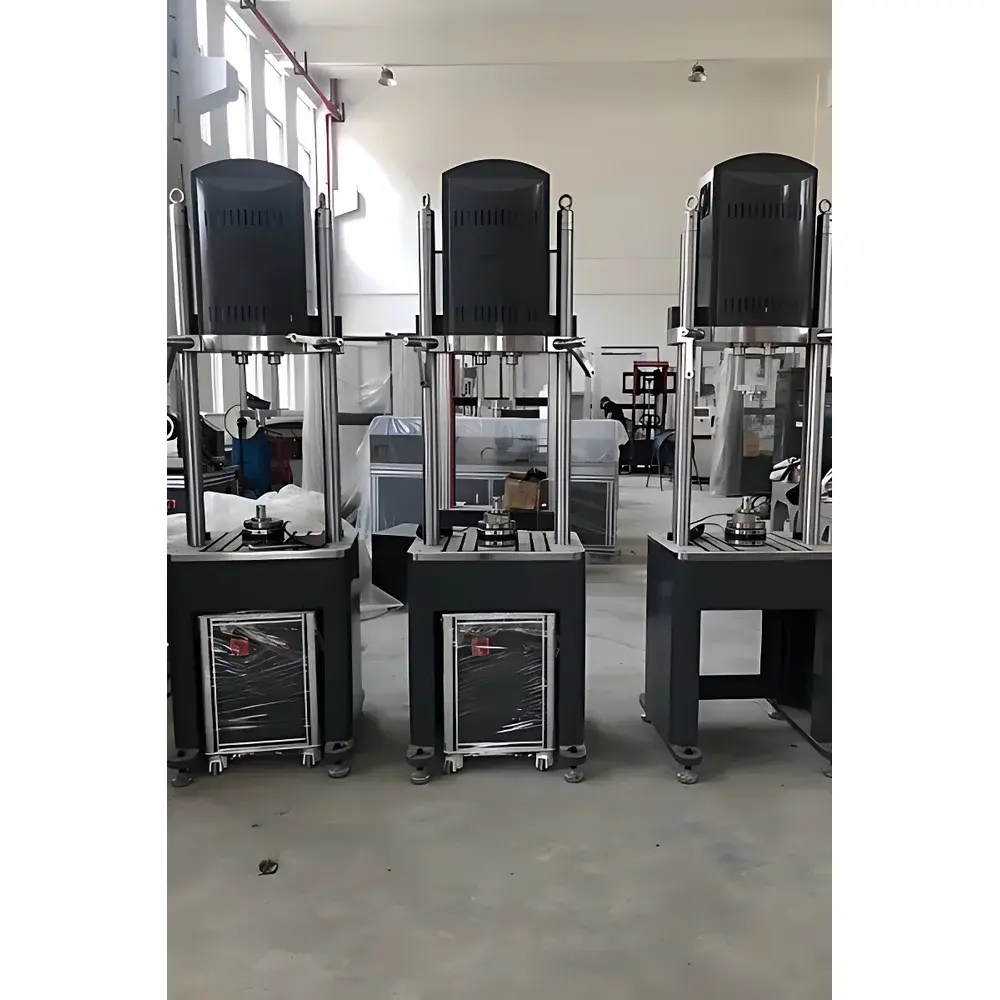
Hengyi HY(DP)5020YUIII Bone and Orthopedic Biomaterials Universal Testing System
| Brand | Hengyi |
|---|---|
| Origin | Shanghai, China |
| Manufacturer Type | Direct Manufacturer |
| Country of Origin | China |
| Model | HY(DP)5020YUIII |
| Instrument Type | Electromechanical Universal Testing Machine |
| Force Range | ±5000 N |
| Force Accuracy | Class 1 (e.g., ±1 N at 100 N reading) |
| Force Resolution | 0.01 N |
| Usable Force Range | 50–5000 N |
| Displacement Accuracy | Class 1 |
| Relative Indication Error | ≤1% |
| Control Accuracy | ±1% |
| Test Frequency | 0.1–15 Hz |
| Waveforms | Sine, Cosine, Square, Triangle, Sawtooth |
| Actuator Stroke | 0–200 mm (or ±100 mm) |
| Stroke Accuracy | ±1% |
| Resolution | 0.01 mm |
| Horizontal Clearance (Left–Right) | 450 mm |
| Vertical Test Height | 500 mm |
| Tensile Test Space | 300 mm |
| Compressive Test Space | 500 mm |
| Dimensions (L×W×H) | ~680 × 700 × 2500 mm |
| Power Supply | 380 V AC, 5 kW |
| Weight | 600 kg |
Overview
The Hengyi HY(DP)5020YUIII Bone and Orthopedic Biomaterials Universal Testing System is an electromechanical universal testing machine engineered for high-fidelity static and dynamic mechanical characterization of orthopedic implants, biomaterials, and load-bearing biological tissues. Designed around a closed-loop servo-controlled actuation architecture, the system employs precision ball-screw-driven linear motion and high-stability load cell feedback to deliver repeatable force and displacement control across low-frequency cyclic regimes (0.1–15 Hz). Its core measurement principle relies on calibrated strain-gauge-based load transduction and optical or potentiometric displacement sensing—both traceable to national metrological standards—enabling compliance with biomechanical test protocols defined in ASTM F2077 (interbody fusion devices), ISO 14879 (spinal implant fatigue), ASTM F1717 (spinal fixation systems), ASTM F1160 (composite bone cements), ISO 7206-4/6/8 (hip/knee joint replacements), ASTM F1264 (intramedullary nails), ASTM F382 (bone plates), and ISO 9585 (dental implants). The system operates within a rigid C-frame structure optimized for minimal deflection under axial loading, supporting both uniaxial tension/compression and multi-axis coupled loading modes including torsion–tension and torsion–compression via optional modular fixtures.
Key Features
- Class 1 force accuracy (±1% full scale) with 0.01 N resolution over a usable range of 50–5000 N, ensuring sensitivity for small-diameter screws, porous coatings, and thin tissue specimens.
- High-resolution displacement measurement (0.01 mm resolution, ±1% stroke accuracy) across a ±100 mm actuator stroke, compatible with both tensile (300 mm clearance) and compressive (500 mm clearance) configurations.
- Programmable waveform generation—including sine, cosine, square, triangle, and sawtooth—enabling simulation of physiological loading profiles such as gait-cycle–derived stress histories.
- Modular fixture interface compliant with standardized orthopedic test geometries per ASTM and ISO specifications, including intervertebral spacer compression, vertebral body screw pullout, and four-point bending of spinal rods.
- Robust mechanical architecture: 600 kg mass, reinforced C-frame design, and 450 mm lateral clearance accommodate large-format spinal constructs and custom test assemblies.
- Integrated safety logic with hardware-limited emergency stop, overload cut-off, and position-limit switches aligned with ISO 13850 and IEC 61800-5-2 functional safety requirements.
Sample Compatibility & Compliance
The HY(DP)5020YUIII supports mechanical evaluation of a broad spectrum of orthopedic substrates, including metallic (Ti-6Al-4V, CoCr alloys), polymer (UHMWPE, PEEK), ceramic (hydroxyapatite-coated surfaces), composite (PMMA bone cement), and biological tissues (cortical bone, cortical–cancellous composites, tendon–bone units). Its mechanical envelope—500 mm vertical test height, 450 mm horizontal clearance, and configurable grips—allows direct mounting of ASTM F2077-compliant interbody cages, ISO 7206-4 hip stem constructs, and ASTM F1160 bone plate–screw assemblies without disassembly. All standard fixtures are designed to meet dimensional tolerances specified in relevant standards, and calibration certificates for load cells and displacement sensors are provided with NIST-traceable documentation. The system architecture supports GLP-aligned operation through audit-trail–enabled software logging (see Software section), and its mechanical performance has been verified against ISO 7500-1 (static calibration) and ISO 4965 (dynamic verification) protocols.
Software & Data Management
The system is operated via a Windows-based control and acquisition platform featuring real-time PID loop tuning, multi-channel synchronized data streaming (force, displacement, time, cycle count), and automated test sequencing. Raw data are stored in vendor-neutral CSV and HDF5 formats, with metadata tags indicating operator ID, test standard reference, environmental conditions (if integrated with optional temperature/humidity sensors), and calibration status. The software includes built-in modules for calculating stiffness, yield strength, ultimate load, energy absorption, hysteresis area, and fatigue life (S–N curve derivation). Audit trail functionality records all parameter changes, test starts/stops, and user logins in tamper-evident logs compliant with FDA 21 CFR Part 11 requirements for electronic records and signatures. Exported datasets integrate seamlessly with MATLAB, Python (via pandas/h5py), and commercial statistical analysis tools for post-test regression modeling and Weibull reliability analysis.
Applications
- Fatigue testing of intervertebral fusion devices per ASTM F2077 and ISO 14879 under compressive sinusoidal loading (e.g., 1–5 Hz, R = 0.1).
- Pullout strength assessment of pedicle screws in synthetic bone blocks or cadaveric vertebrae per ASTM F543 and ISO 14801.
- Bending stiffness and failure moment evaluation of spinal rods and connectors under three- or four-point bending per ASTM F1717.
- Cyclic torsional loading of intramedullary nails per ASTM F1264, including torque–angle hysteresis and permanent set quantification.
- Compression testing of knee tibial trays and acetabular cups per ISO 7206-6 and ISO 7206-8, including creep and relaxation behavior at physiological temperatures.
- Mechanical characterization of osteointegration interfaces, including shear push-out tests of coated dental or orthopedic implants per ISO 9585.
FAQ
What orthopedic standards does the HY(DP)5020YUIII natively support?
The system’s mechanical configuration, control firmware, and standard fixture set comply with ASTM F2077, ISO 14879, ASTM F1717, ASTM F1160, ISO 7206-4/6/8, ASTM F1264, ASTM F382, and ISO 9585. Custom fixture adapters can be supplied for additional standards upon request.
Can the system perform combined loading (e.g., axial + torsion)?
Yes—when equipped with optional torsion actuation modules and dual-axis controllers, the HY(DP)5020YUIII supports synchronized tension–torsion and compression–torsion protocols per ASTM F2346 and ISO 14879 Annex B.
Is the software validated for regulated environments (e.g., ISO 13485, FDA submissions)?
The control software includes 21 CFR Part 11-compliant audit trails, electronic signature workflows, and change-control documentation packages available upon validation support agreement.
What is the recommended maintenance interval for calibration and mechanical inspection?
Annual recalibration of load cells and displacement sensors is recommended; biannual mechanical inspection of guide rails, ball screws, and coupling integrity is advised per ISO 7500-1 and manufacturer service bulletins.
Does the system support third-party environmental chambers?
Yes—the controller features analog and digital I/O ports compatible with commercially available temperature–humidity chambers (e.g., ESPEC, Weiss) for in situ biomechanical testing at –20 °C to +60 °C.



