
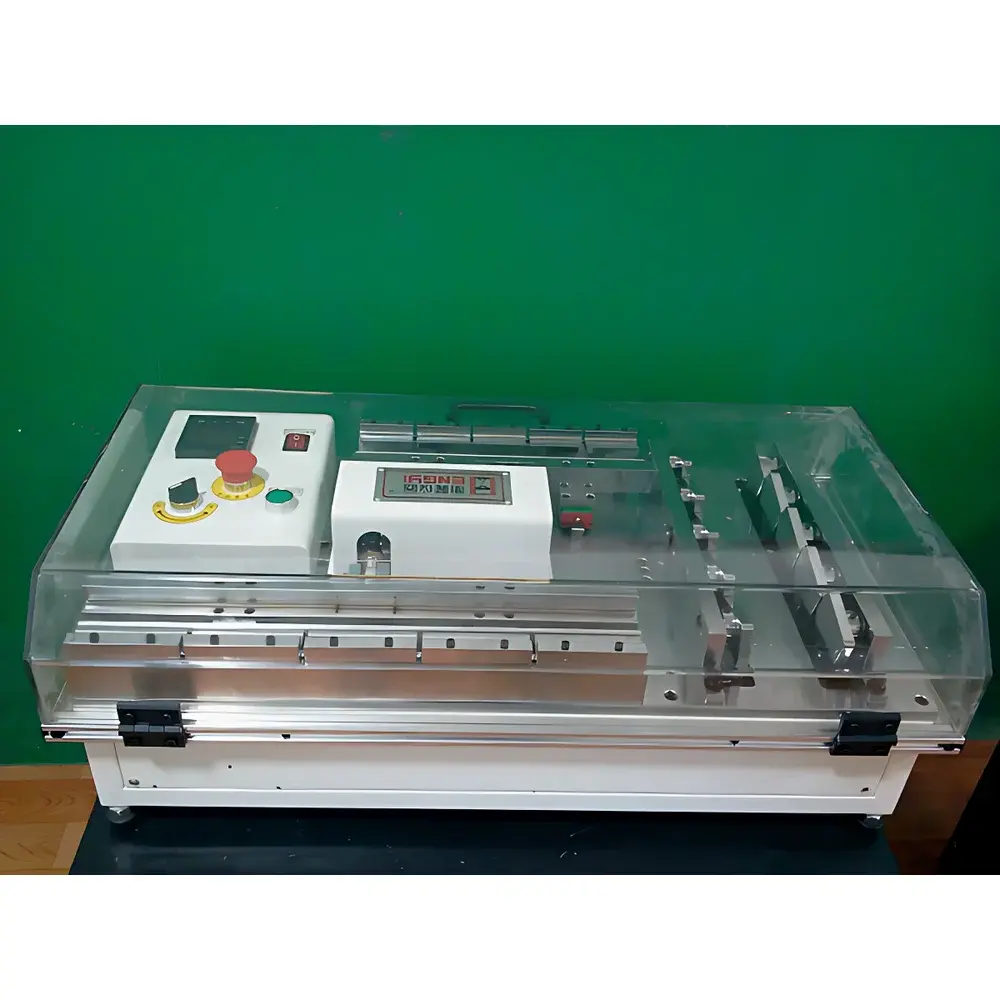
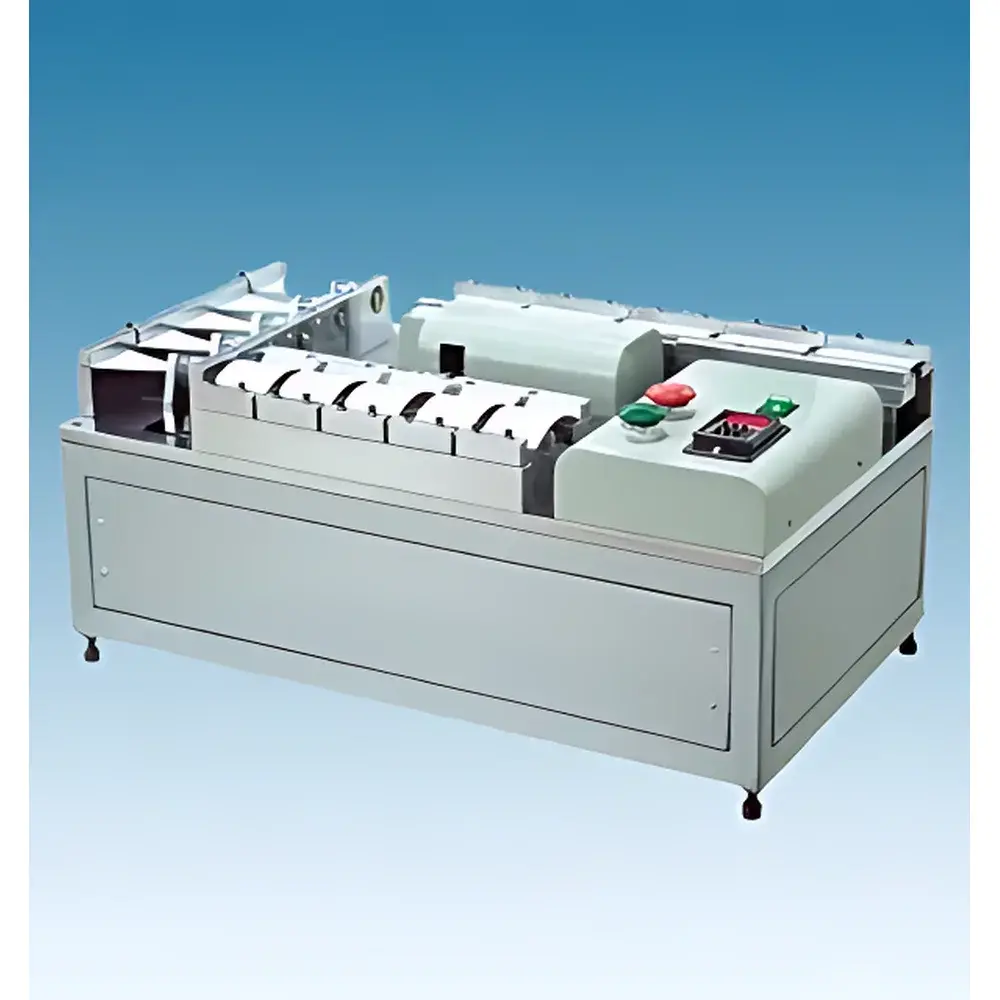
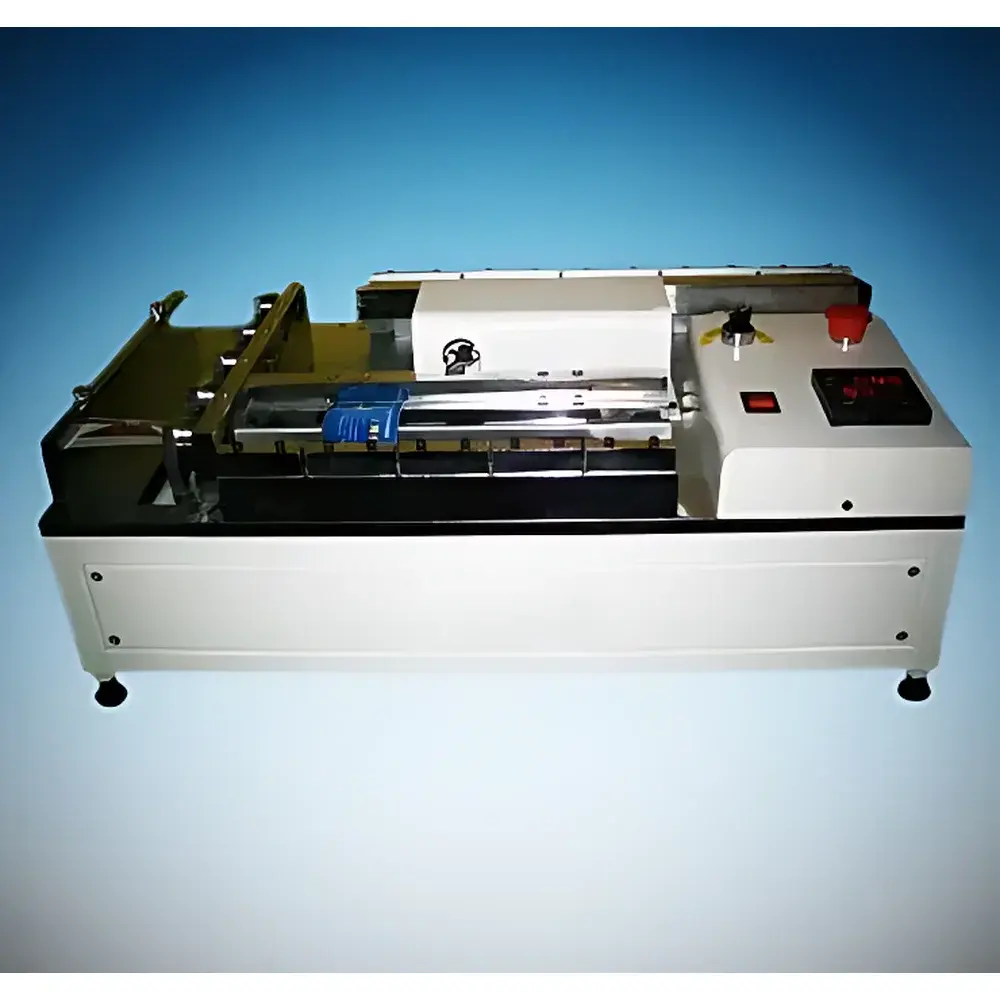
Hengyi HY(IC)B Dynamic Bending and Torsion Tester for Smart Cards
| Brand | Hengyi |
|---|---|
| Origin | Shanghai, China |
| Manufacturer Type | Direct Manufacturer |
| Country of Origin | China |
| Model | HY(IC)B |
| Price Range | USD 1,400 – 2,800 (FOB Shanghai) |
| Max Torque | 1 N·m |
| Torque Measurement Range | 0–1 N·m |
| Torque Resolution | 0.001 N·m |
| Torsion Angle Range | ±15° (±1° accuracy) |
| Total Angular Displacement | 30° (bidirectional, ±15° per direction) |
| Bending Displacement (Long Edge) | 20 mm (−1.0 mm / 0 mm tolerance), 2 mm (±0.5 mm) |
| Bending Displacement (Short Edge) | 10 mm (−1.0 mm / 0 mm), 1 mm (±0.5 mm) |
| Motor Power | 35 W |
| Drive System | STK AC Speed-Controlled Motor + Precision Gear Reducer |
| Counting System | High-Accuracy Photoelectric Encoder with Dual-Channel Counter |
| Test Speed | 30 rpm (bending/torsion), 0.5 Hz cyclic frequency |
| Cycle Count Range | 1–9999 cycles |
| Fixture Mounting | Fully compliant with GB/T 16649.1, GB/T 17554.1–2006, ISO/IEC 7816-1998, and ISO/IEC 10373 test geometry specifications |
| Dimensions (L×W×H) | 670 × 380 × 220 mm |
| Net Weight | 70 kg |
| Input Voltage | AC 220 V ±5%, 50/60 Hz |
Overview
The Hengyi HY(IC)B Dynamic Bending and Torsion Tester is a purpose-built mechanical endurance testing instrument engineered to evaluate the structural integrity and fatigue resistance of contact and contactless integrated circuit (IC) cards, magnetic stripe cards, and other ISO/IEC 7816-compliant smart cards under standardized cyclic mechanical stress. It operates on the principle of controlled, repeatable angular displacement and linear deflection—simulating real-world handling conditions such as card insertion, bending in wallets, and torsional strain during improper handling. The system applies precisely defined bending moments along the long and short edges of the card specimen while simultaneously executing bidirectional torsional rotation about its central axis. All motion profiles—including angular amplitude, displacement limits, cycle count, and dwell timing—are programmable within the constraints of internationally recognized test standards. Its rigid aluminum-alloy frame, low-inertia drive train, and high-fidelity position feedback ensure measurement repeatability across thousands of cycles, making it suitable for quality assurance labs, certification bodies, and R&D departments engaged in smart card material development and compliance validation.
Key Features
- Full compliance with GB/T 16649.1, GB/T 17554.1–2006, ISO/IEC 7816-1998, and ISO/IEC 10373 mechanical test requirements for smart cards
- Dual-mode actuation: independent control of bending (linear displacement) and torsion (angular rotation) with synchronized or sequential execution
- Precision STK AC servo motor coupled with a high-ratio gear reducer ensures stable low-speed operation at 0.5 Hz (30 rpm) with minimal torque ripple
- Optical encoder-based counting system provides traceable, non-contact cycle monitoring with dual-channel redundancy for fail-safe termination
- Standardized fixture geometry—including 86 mm center-to-center mounting distance and ISO-defined clamping zones—guarantees interchangeability with accredited test laboratories
- Robust mechanical architecture: 70 kg mass, vibration-damped base, and CNC-machined load path minimize parasitic deflection during high-cycle testing
- Front-panel digital interface with LED indicators for real-time status display (cycle count, direction, error flags)
Sample Compatibility & Compliance
The HY(IC)B accommodates standard ID-1 format cards (85.6 × 53.98 × 0.76 mm) as defined in ISO/IEC 7810. It supports both laminated PVC and polycarbonate substrates, embedded copper or aluminum antenna coils, and multi-layer IC modules. The bending fixtures apply calibrated force via hardened steel rollers with radius-matched contact surfaces to prevent localized plastic deformation outside the specified test zone. Torsion is delivered through a pair of opposing pneumatic grippers that grip the card’s lateral edges without slippage, maintaining constant moment arm length throughout ±15° rotation. All mechanical tolerances—including ±1° angular accuracy, ±0.5 mm linear displacement repeatability, and <0.1% torque hysteresis over 1000 cycles—are verified against NIST-traceable calibration artifacts. The system meets GLP documentation requirements when operated with external data logging; full audit trails (operator ID, timestamp, parameter set, pass/fail flag) can be exported via RS-232.
Software & Data Management
While the HY(IC)B operates in standalone mode via its embedded microcontroller, optional PC-based software (Hengyi TestSuite v3.2) enables advanced test sequencing, parameter scripting, and automated report generation in PDF or CSV format. The software supports user-defined test profiles—including variable-speed ramping, conditional branching based on cycle count or failure detection, and statistical analysis of failure thresholds across batch samples. Data export complies with ASTM E2916-21 for electronic records in regulated environments. When paired with a validated USB-to-RS232 adapter, the system satisfies FDA 21 CFR Part 11 requirements for electronic signatures and audit trail retention, provided local IT policies enforce role-based access control and password complexity rules.
Applications
- Pre-certification mechanical validation of EMV-compliant payment cards prior to Common Criteria or PCI PTS evaluation
- Comparative fatigue analysis of alternative substrate materials (e.g., PET-G vs. polycarbonate) under identical bending/torsion loads
- Reliability screening of chip module adhesion strength during thermal cycling qualification
- Root cause investigation of delamination or conductor fracture in failed field-return cards
- Supporting ISO/IEC 17025-accredited testing services for third-party certification agencies
- Teaching laboratory use for mechanical engineering courses covering fatigue life prediction and polymer viscoelasticity
FAQ
Does the HY(IC)B support automatic pass/fail judgment based on cycle count?
Yes—the built-in counter triggers a hardware interrupt upon reaching the preset cycle limit, halting motion and illuminating a dedicated status LED. Optional software adds configurable failure criteria (e.g., open-circuit detection via external continuity probe integration).
Can the bending and torsion motions be executed independently?
Yes—test modes include pure bending, pure torsion, and combined simultaneous loading. Each axis is driven by separate kinematic chains with independent position feedback.
Is calibration documentation included with shipment?
A factory calibration certificate (traceable to CNAS-accredited reference standards) is supplied, covering torque linearity, angular encoder resolution, and displacement repeatability across the full operational range.
What maintenance intervals are recommended for long-term reliability?
Motor and gearbox lubrication every 12 months; optical encoder window cleaning every 3 months; annual verification of roller surface flatness and grip pad wear using supplied gauge blocks.
Are custom fixtures available for non-ID-1 card formats?
Yes—Hengyi offers OEM fixture design services for proprietary card geometries, subject to minimum order quantity and mechanical feasibility review.



