
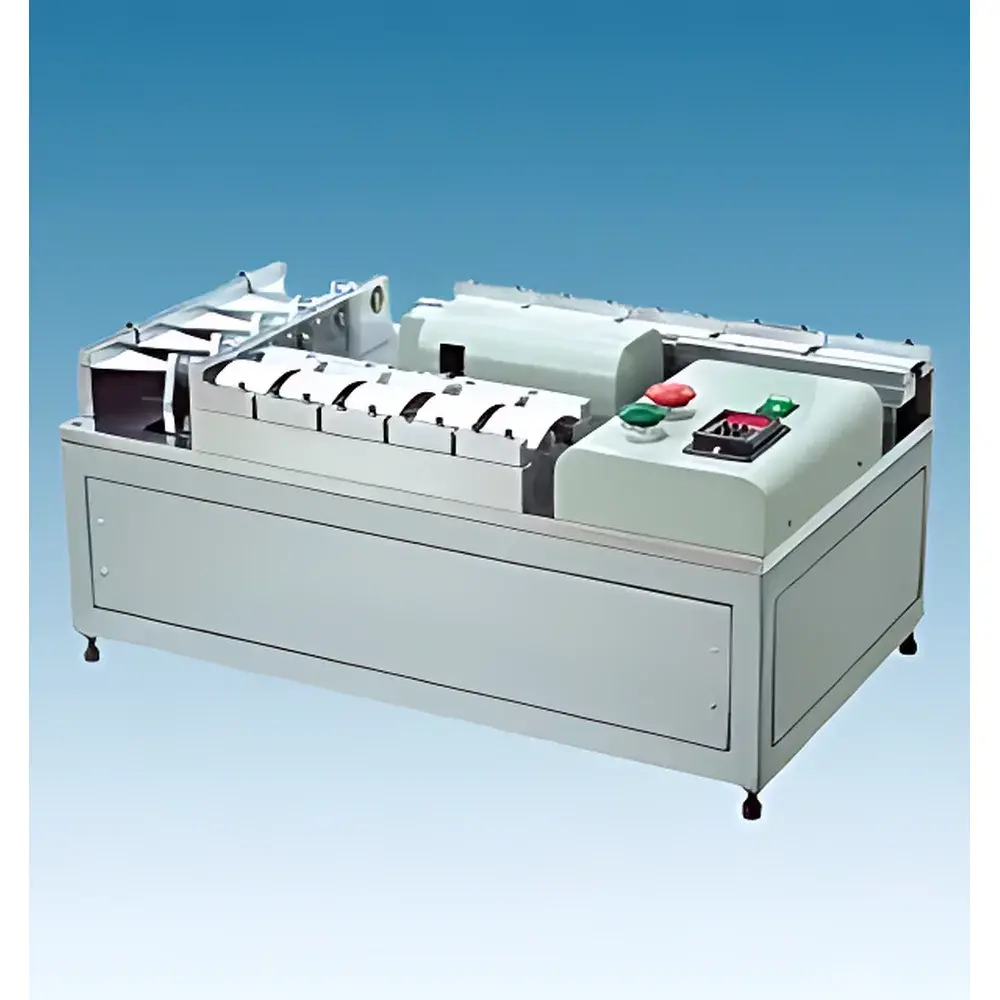
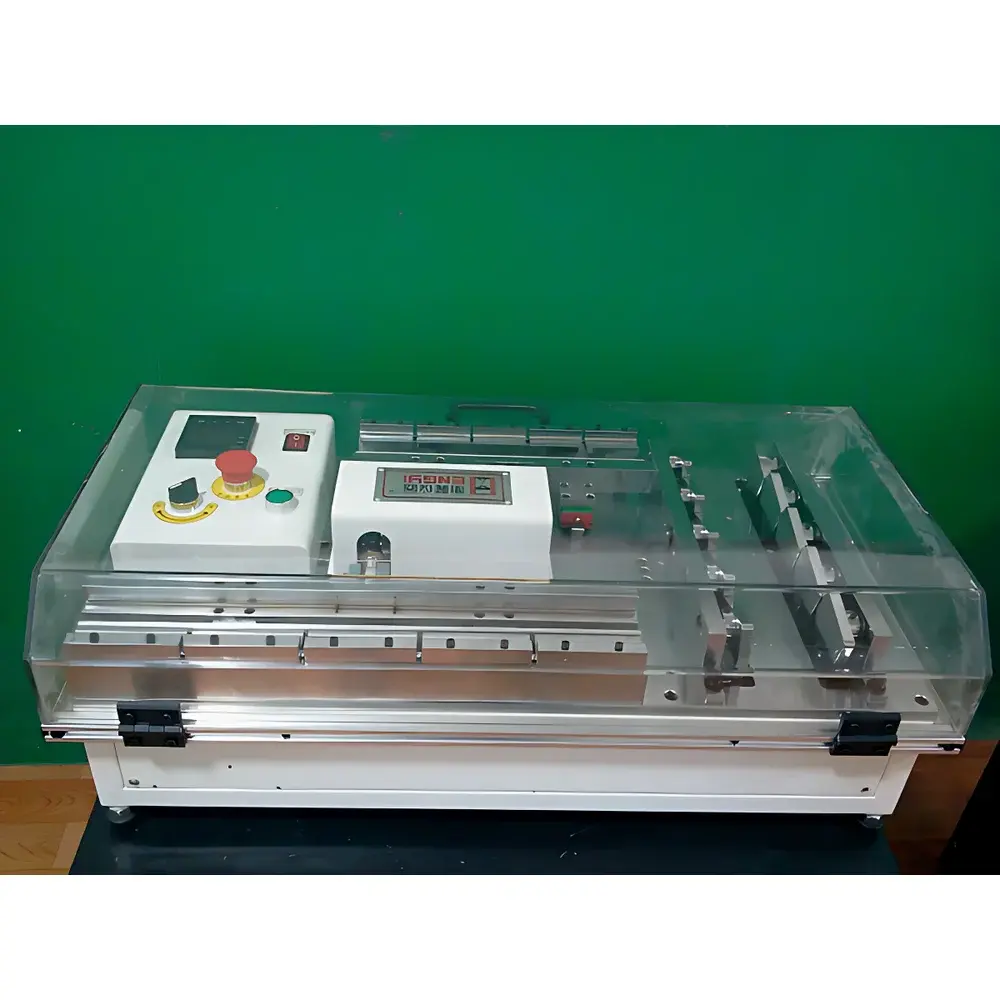
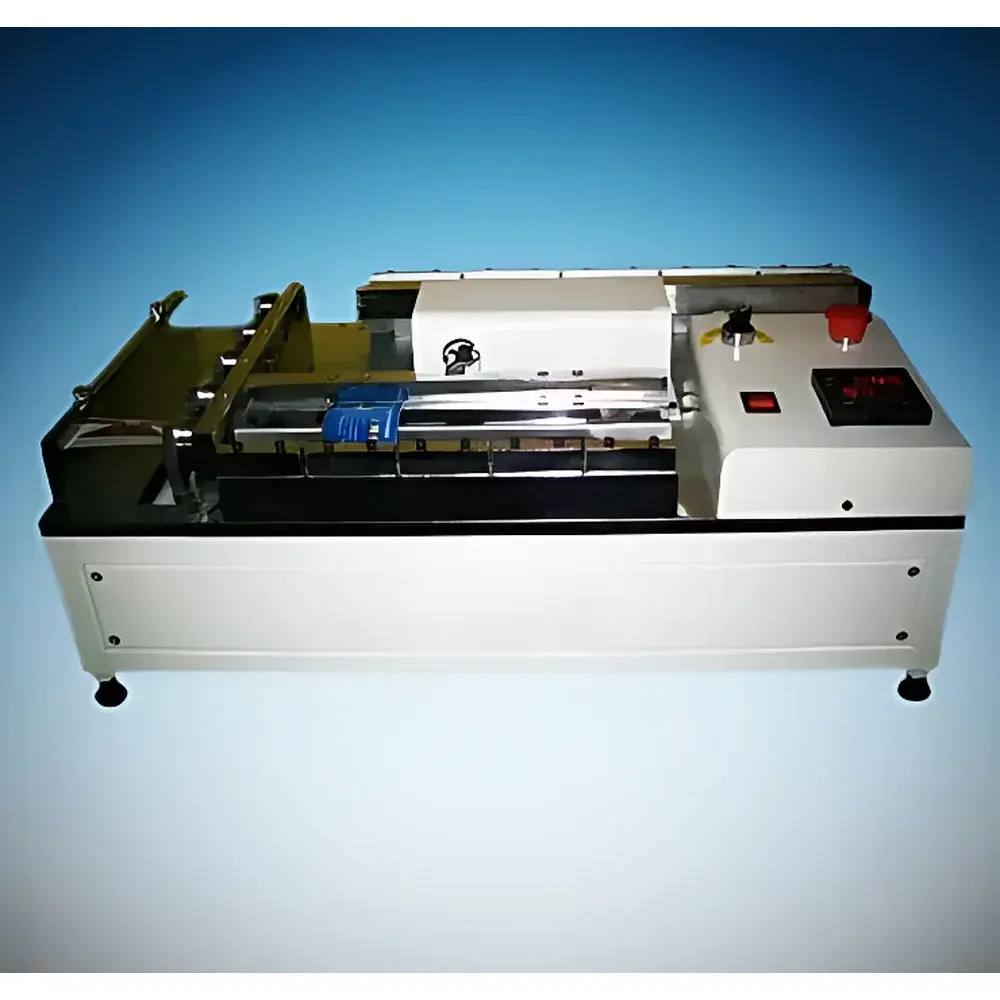
Hengyi HY(IC)YUB Dual-Directional Dynamic Bending and Torsion Tester for Smart Cards
| Brand | Hengyi / Hengyitest |
|---|---|
| Origin | Shanghai, China |
| Manufacturer Type | Direct Manufacturer |
| Country of Origin | China |
| Model | HY(IC)YUB |
| Quotation | Upon Request |
| Test Stations | 15 (5 long-edge bending, 5 short-edge bending, 5 torsion) |
| Cycle Count Range | 1–9999 (non-contact optical counting) |
| Bending Displacement | Long-edge max 20 mm (−1.0 mm tolerance), min 2 mm ±0.5 mm |
| Torsion Angle | ±15° ±1° (bidirectional, total 30°, d = 86 mm) |
| Test Speed | 30 rpm / 0.5 Hz |
| Dimensions (L×W×H) | 670 × 380 × 220 mm |
| Weight | 70 kg |
| Power Supply | AC 220 V ±5% |
| Power Consumption | 35 W |
| Compliance | GB/T 16649.1, GB/T 17554.1–2006, ISO/IEC 10373, ISO/IEC 7816–1998 |
Overview
The Hengyi HY(IC)YUB Dual-Directional Dynamic Bending and Torsion Tester is a purpose-built mechanical endurance testing system engineered for the standardized evaluation of physical durability in contact and contactless smart cards—including EMV-compliant IC cards, magnetic stripe cards, and integrated circuit cards. Designed in strict accordance with international and national standards—namely ISO/IEC 7816–1998 (Identification cards — Integrated circuit cards), ISO/IEC 10373 (Test methods for identification cards), GB/T 16649.1 (Identification cards — Integrated circuit cards — Part 1: Physical characteristics), and GB/T 17554.1–2006 (Identification cards — Test methods — Part 1: Mechanical characteristics)—this instrument applies controlled, repeatable cyclic mechanical stress to simulate real-world handling conditions such as wallet flexing, insertion/removal forces, and angular twisting during card usage. Its core architecture employs Couette-type dual-axis actuation: independent servo-controlled motion paths drive simultaneous or sequential long-edge bending, short-edge bending, and bidirectional torsional deformation—each precisely synchronized and traceable via non-contact optical encoders.
Key Features
- Fifteen independent test stations: five configured for long-edge bending, five for short-edge bending, and five dedicated to bidirectional torsion—enabling parallel, statistically robust multi-sample evaluation.
- Non-contact optical counting system replaces legacy mechanical switch-based counters, eliminating wear-related failure modes and ensuring >99.99% counting reliability over 9999 cycles.
- Adjustable displacement and angular parameters: long-edge bending displacement range 2–20 mm (±0.5 mm resolution); short-edge 1–10 mm; torsional amplitude ±15° ±1°, with center-to-center distance fixed at 86 mm per ISO/IEC 7816 mechanical fixture specifications.
- High-fidelity motion control: STK AC variable-speed motor coupled with precision gear reduction delivers stable 0.5 Hz (30 rpm) sinusoidal or stepwise motion profiles, programmable for dwell time, acceleration ramp, and direction reversal.
- Standardized fixture geometry: all clamping interfaces comply with ISO/IEC 7816–1 Annex A dimensional tolerances, ensuring interchangeability with certified reference cards and third-party validation hardware.
- Low-power, laboratory-grade design: 35 W nominal consumption, compact footprint (670 × 380 × 220 mm), and 70 kg mass optimized for benchtop deployment in QA labs and metrology centers.
Sample Compatibility & Compliance
The HY(IC)YUB accommodates standard ID-1 format cards (85.6 × 53.98 × 0.76 mm) with embedded silicon die, antenna coils, or magnetic stripes. It supports both rigid PVC and flexible polymer substrates used in modern dual-interface (contact + contactless) cards. All test protocols align with mandatory conformance requirements for certification under EMVCo Level 1, Common Criteria EAL4+, and national payment system approvals (e.g., China UnionPay, State Grid Smart Card Certification). The system satisfies traceability requirements under ISO/IEC 17025 for accredited testing laboratories and provides full audit trails compatible with GLP/GMP documentation workflows.
Software & Data Management
While the base configuration operates via front-panel digital controls and LED cycle counters, optional PC-based software (Hengyi TestSuite v3.x) enables remote parameter programming, real-time waveform monitoring, cycle-log export (CSV/Excel), and automated pass/fail flagging per ISO-defined failure thresholds (e.g., electrical continuity loss, delamination, or chip detachment detected via external continuity tester integration). Data files include timestamped metadata, operator ID, environmental ambient logging (via optional sensor input), and are structured to support FDA 21 CFR Part 11-compliant electronic signatures when deployed in regulated environments.
Applications
- Endurance validation of smart cards prior to mass production release.
- Comparative fatigue analysis across substrate materials (e.g., PET vs. PVC vs. polycarbonate).
- Design verification of embedded antenna geometry under torsional strain.
- Root-cause investigation of field failures linked to mechanical overstress.
- Supporting R&D for next-generation flexible hybrid cards and wearable NFC devices.
- Third-party certification testing for banking, telecom, transportation, and government ID programs.
FAQ
Does the HY(IC)YUB support automated data export to LIMS systems?
Yes—when equipped with Hengyi TestSuite software and optional RS-232/Ethernet interface, test logs can be pushed directly to LIMS via TCP/IP or scheduled file transfer.
Can the torsion angle be calibrated in-house?
Yes—the ±15° angular range is mechanically fixed but verifiable using NIST-traceable optical goniometers; calibration certificates are provided with each unit.
Is firmware upgradable post-purchase?
Yes—firmware updates are distributed via secure USB key and include backward-compatible enhancements to timing resolution and error logging.
What maintenance intervals are recommended?
Optical sensor cleaning every 500 cycles; gear lubrication annually or after 10,000 cycles—full service manual and spare parts list included.
Does the system meet CE or UKCA marking requirements?
It complies with IEC 61000-6-2 (immunity) and IEC 61000-6-4 (emissions); CE marking is available upon request with EU Representative documentation.



