
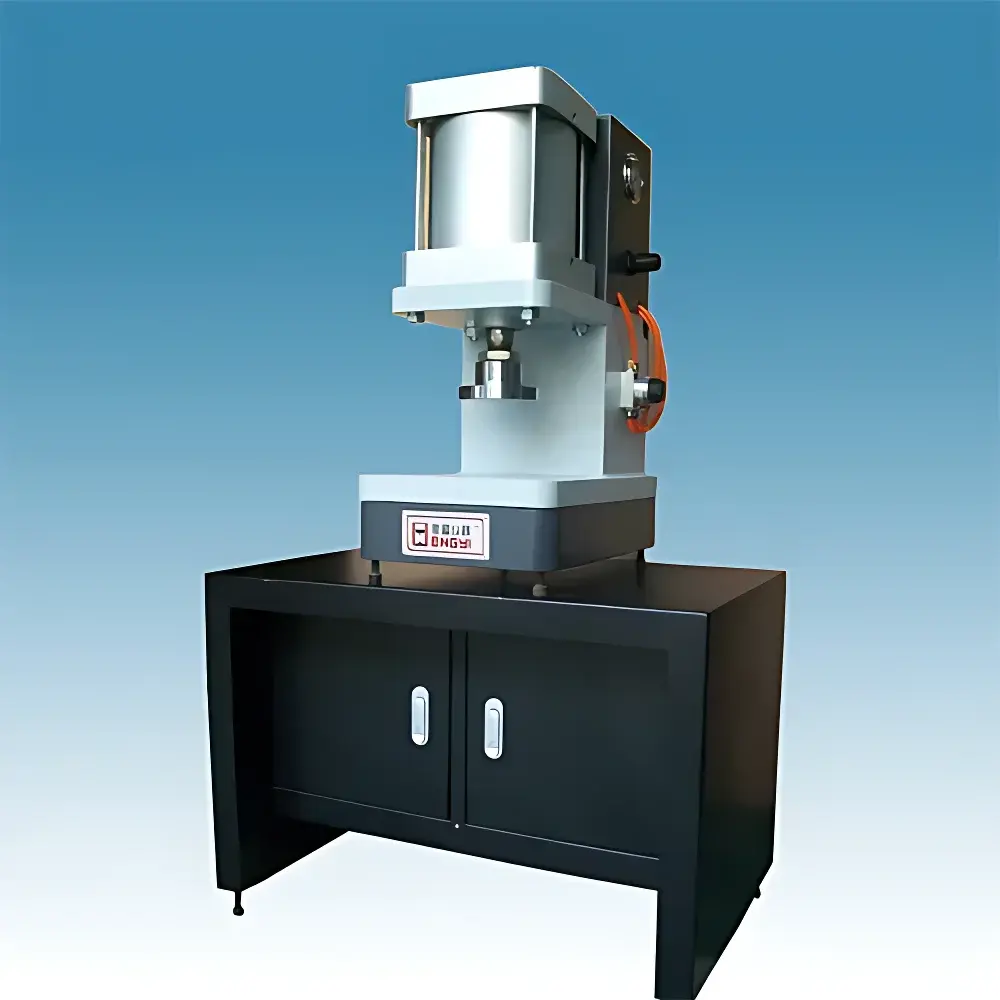
Hengyi HY(QDCP) Pneumatic Dumbbell Specimen Cutter
| Brand | Hengyi |
|---|---|
| Origin | Shanghai, China |
| Manufacturer Type | Manufacturer |
| Country of Origin | Domestic (China) |
| Model | HY(QDCP) |
| Quotation | Upon Request |
| Stroke | >50 mm |
| Worktable Dimensions | 300 × 200 mm |
| Die Width | 6 mm |
| Overall Dimensions | 520 × 450 × 520 mm |
| Air Supply Pressure | 0.6 MPa |
| Punching Force | 20 kN |
| Net Weight | 85 kg |
Overview
The Hengyi HY(QDCP) Pneumatic Dumbbell Specimen Cutter is an engineered precision tool designed for the standardized preparation of tensile test specimens from elastomeric, thermoplastic, thermoset, and composite sheet materials. Operating on a controlled pneumatic actuation principle, it delivers consistent, repeatable cutting force without manual variability—ensuring specimen geometry conforms strictly to international test standards including ASTM D412, ISO 37, GB/T 528, and ISO 527-2. Unlike hydraulic or manually operated cutters, this system eliminates operator-dependent force modulation, thereby reducing inter-specimen dimensional variance and improving test data reproducibility in mechanical property evaluation workflows.
Key Features
- Pneumatic drive system delivering a stable, calibrated punching force of 20 kN at 0.6 MPa regulated air pressure—optimized for high-cycle durability and minimal maintenance.
- Robust cast-iron frame with reinforced base and vertical guide columns ensuring rigidity during operation and long-term alignment stability of the die head.
- Adjustable stroke mechanism (>50 mm travel) accommodating varying material thicknesses and enabling precise control over die penetration depth.
- Standardized 300 × 200 mm flat worktable with T-slot configuration for secure clamping of sample sheets using optional fixtures or vacuum hold-down plates.
- Interchangeable dumbbell-shaped cutting dies (standard width: 6 mm) compliant with Type I, II, and IV geometries per ASTM D412; custom die sets available upon request for specialized standards (e.g., ISO 37 Type A, GB/T 528 rectangular variants).
- Integrated safety interlock system requiring both hands to engage dual palm buttons before actuation—meeting CE machinery directive requirements (EN ISO 13857) and supporting OSHA-compliant lab environments.
Sample Compatibility & Compliance
The HY(QDCP) accommodates a broad range of sheet-form polymeric and elastomeric materials up to 12 mm thick, including natural rubber, SBR, EPDM, silicone, PVC, ABS, PC, PET, and PU foams. It is routinely deployed in QC laboratories for incoming raw material verification, R&D formulation screening, and production lot release testing. All mechanical dimensions, force calibration, and operational parameters are traceable to national metrological standards (CNAS-accredited calibration protocols). The cutter supports GLP-compliant documentation when integrated into validated laboratory workflows, and its mechanical design permits audit readiness for ISO/IEC 17025 accreditation requirements related to specimen preparation traceability.
Software & Data Management
As a standalone mechanical instrument, the HY(QDCP) does not incorporate embedded software or digital interfaces. However, its deterministic pneumatic operation enables seamless integration into automated lab systems via external PLC-triggered I/O signals (24 V DC dry contact input/output). Users may log usage cycles, die change timestamps, and maintenance intervals using LIMS-compatible spreadsheets or enterprise quality management platforms (e.g., TrackWise, LabVantage). Calibration records—including air pressure verification, force transducer validation (per ISO 376), and die edge wear inspection—are maintained per internal SOPs aligned with ISO 9001 clause 7.1.5 and FDA 21 CFR Part 11 Annex 11 principles for non-electronic equipment.
Applications
- Tensile property characterization of vulcanized rubber compounds in tire, sealant, and automotive component manufacturing.
- Preparation of standardized specimens for elongation at break, tensile strength, and modulus measurements per ASTM D412 and ISO 37.
- Quality control of polymer film and sheet products in packaging, medical device, and aerospace composite supply chains.
- Research-grade specimen fabrication where geometric fidelity directly impacts stress-strain curve linearity and fracture behavior interpretation.
- Secondary use as a low-tonnage pneumatic press for embossing, perforating, or cold-forming thin metallic foils or laminated substrates.
FAQ
What standards does the HY(QDCP) support for dumbbell specimen geometry?
It complies with ASTM D412 Types I–IV, ISO 37 Type A, GB/T 528, and ISO 527-2 Type 1A geometries using standard 6 mm width dies; custom dies can be supplied for non-standard configurations.
Is compressed air supply included with the unit?
No—users must provide a clean, oil-free, and moisture-filtered compressed air source regulated to 0.6 MPa (±0.02 MPa) with minimum flow capacity of 120 L/min at peak demand.
Can the machine accommodate thicker materials beyond 12 mm?
Not recommended—exceeding specified thickness compromises die life, cutting edge integrity, and dimensional accuracy; alternative hydraulic presses or CNC milling are advised for such applications.
How often does the cutting die require sharpening or replacement?
Under typical usage (≤500 cuts/day), tungsten-carbide-coated dies maintain dimensional tolerance for ≥10,000 cycles; visual inspection and micrometer verification every 2,000 cycles are recommended.
Does Hengyi provide calibration certificates or installation qualification (IQ) documentation?
Yes—factory calibration reports (force verification, stroke repeatability, and parallelism checks) are provided; IQ/OQ protocols and templates are available upon request for GMP-regulated environments.



