
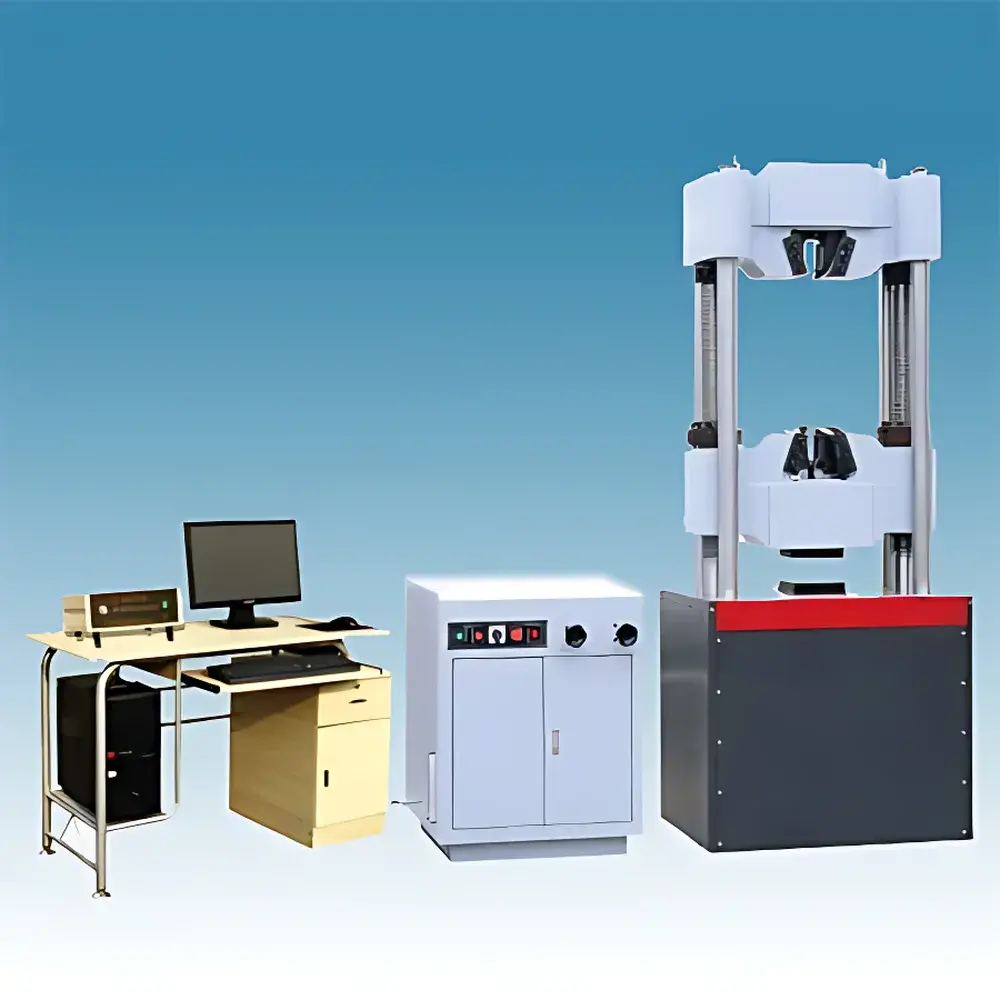
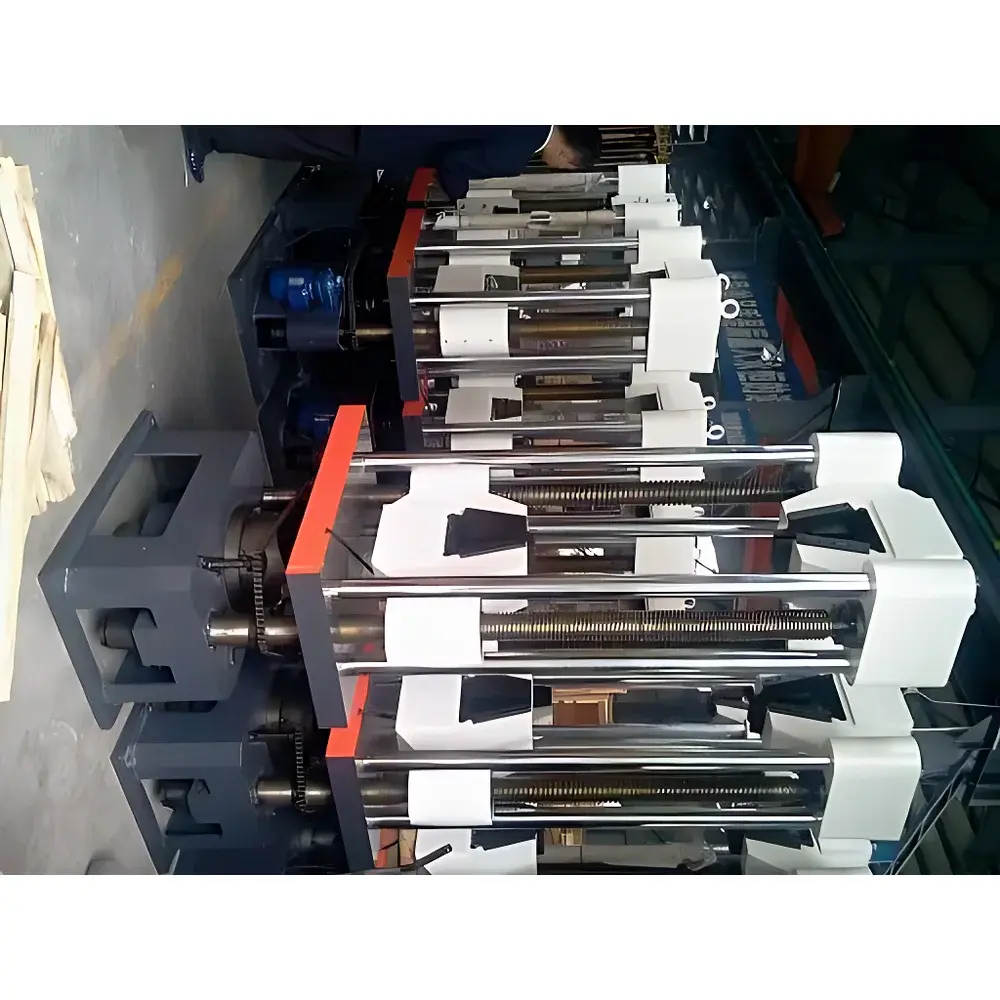
Hengyi HY(WE)100060ERT Electro-Hydraulic Servo Universal Testing Machine
| Brand | Hengyi |
|---|---|
| Origin | Shanghai, China |
| Manufacturer Type | Direct Manufacturer |
| Regional Category | Domestic (China) |
| Model | HY(WE)100060ERT |
| Instrument Type | Electro-Hydraulic Servo Testing Machine |
| Maximum Load Capacity | 1000 kN |
| Load Accuracy | ±0.5% of reading |
| Displacement Accuracy | ±0.5% of reading |
| Deformation Accuracy | ±0.5% of reading |
| Compression Space | 600 mm |
| Tensile Space | 600 mm |
| Round Specimen Clamping Range | Φ20–Φ60 mm |
| Flat Specimen Clamping Thickness | 0–40 mm |
| Piston Stroke | 150 mm |
| Bend Support Span Adjustment | 100–600 mm |
| Shear Specimen Diameter | Φ10 mm |
| Stress Rate Control Range | 1–60 N/mm²/s |
| Strain Rate Control Range | 0.00025–0.0025 s⁻¹ |
| Closed-Loop Control Accuracy (Force/Displacement/Deformation) | ±1% of setpoint |
| Overall Dimensions (W×D×H) | 880 × 580 × 2860 mm |
| Motor Power | 1.5 kW, 3-phase |
| Weight | 3500 kg |
Overview
The Hengyi HY(WE)100060ERT is a high-capacity electro-hydraulic servo universal testing machine engineered for precision mechanical property evaluation of metallic and non-metallic materials under static loading conditions. It operates on the principle of closed-loop hydraulic force generation controlled via proportional electro-hydraulic valves, enabling accurate, repeatable application of tensile, compressive, bending, and shear loads up to 1000 kN. The system integrates a lower-platen oil cylinder architecture with a rigid dual-column frame, optimized for stability during high-force testing and minimal deflection under load. Designed for compliance with international mechanical testing standards—including ASTM E4, ASTM E8/E8M, ASTM E9, ISO 6892-1, ISO 7500-1, and GB/T 228.1—the HY(WE)100060ERT supports full traceability and audit-ready data acquisition for quality control laboratories, R&D centers, and third-party certification facilities operating under GLP or ISO/IEC 17025 frameworks.
Key Features
- Electro-hydraulic servo control architecture with proportional valve regulation for smooth, programmable load application and high dynamic response
- Integrated high-precision load cell (±0.5% accuracy), optical encoder-based displacement measurement (±0.5% relative error), and extensometer-compatible deformation sensing
- Automated range switching and auto-calibration of force and deformation channels to maintain metrological integrity across full scale
- Dual-mode operation: manual hydraulic control for setup and emergency override; fully automated computer control for standardized test protocols
- Robust mechanical design featuring hardened steel columns, precision-ground丝杠 (lead screws), and reinforced crosshead assembly for long-term dimensional stability
- Modular clamping system supporting round specimens (Φ20–Φ60 mm), flat specimens (up to 40 mm thick), and dedicated shear fixtures (Φ10 mm)
- Real-time closed-loop control of stress rate (1–60 N/mm²/s), strain rate (0.00025–0.0025 s⁻¹), or displacement rate with ±1% setpoint accuracy
Sample Compatibility & Compliance
The HY(WE)100060ERT accommodates standard and custom specimens per ASTM, ISO, and GB geometries—including tensile bars, compression cylinders, beam flexure specimens, and shear coupons. Its 600 mm vertical test space (tension/compression) and adjustable bend span (100–600 mm) enable full compliance with ISO 178 (flexural testing), ISO 604 (compression of plastics), and GB/T 7314 (metal compression). All hardware and firmware comply with CE machinery directive requirements (2006/42/EC) and electromagnetic compatibility standards (2014/30/EU). Data acquisition meets ALCOA+ principles (Attributable, Legible, Contemporaneous, Original, Accurate, Complete, Consistent, Enduring, Available) and supports 21 CFR Part 11-compliant user authentication, electronic signatures, and audit trail generation when deployed with validated software configurations.
Software & Data Management
The system is operated via Hengyi’s native Windows-based testing software—fully localized in English and Chinese—with intuitive GUI for test method definition, real-time curve monitoring, and post-test analysis. Software modules support automatic calculation of key mechanical parameters including ultimate tensile strength (Rm), yield strength (ReH, ReL, RP0.2), Young’s modulus (E), fracture elongation (A), and reduction in area (Z). Raw data is stored in binary and CSV formats with embedded metadata (operator ID, timestamp, environmental conditions, calibration status). Curve overlay, local zoom, derivative analysis, and hysteresis loop extraction are available. Export options include PDF reports compliant with ISO 14289-1 (PDF/A-2u) for archival integrity, as well as XML exports compatible with LIMS integration.
Applications
- Mechanical characterization of structural steels, aluminum alloys, titanium, and high-strength composites in metallurgical QA/QC labs
- Compression testing of concrete cylinders, mortar prisms, and cementitious materials per ASTM C39 and EN 12390-3
- Flexural strength assessment of ceramic tiles, refractory bricks, and polymer matrix composites
- Shear strength validation of welded joints, riveted assemblies, and adhesive bonds
- Calibration verification of secondary force standards in national metrology institutes and accredited calibration labs
- Teaching and demonstration of fundamental mechanics-of-materials concepts in university engineering laboratories
FAQ
What standards does the HY(WE)100060ERT support for tensile testing?
It complies with ASTM E8/E8M, ISO 6892-1, and GB/T 228.1 for metallic materials, with configurable test profiles for non-metals per ISO 527 and ASTM D638.
Is the system suitable for cyclic or fatigue testing?
No—this is a static-load electro-hydraulic servo machine; it does not support high-frequency dynamic or low-cycle fatigue testing. For such applications, a dedicated servo-hydraulic fatigue testing system is recommended.
Can the software generate 21 CFR Part 11-compliant audit trails?
Yes—when configured with role-based user accounts, electronic signatures, and immutable log archiving, the software satisfies core Part 11 requirements for regulated pharmaceutical and medical device environments.
What maintenance intervals are recommended for the hydraulic system?
Oil filtration and replacement every 2,000 operating hours or annually (whichever occurs first); periodic calibration of load cell and displacement sensors per ISO/IEC 17025 schedule.
Does the machine support extensometer integration?
Yes—standard RS-422 and analog voltage inputs accommodate clip-on, video, or laser extensometers for high-accuracy strain measurement independent of crosshead movement.



