
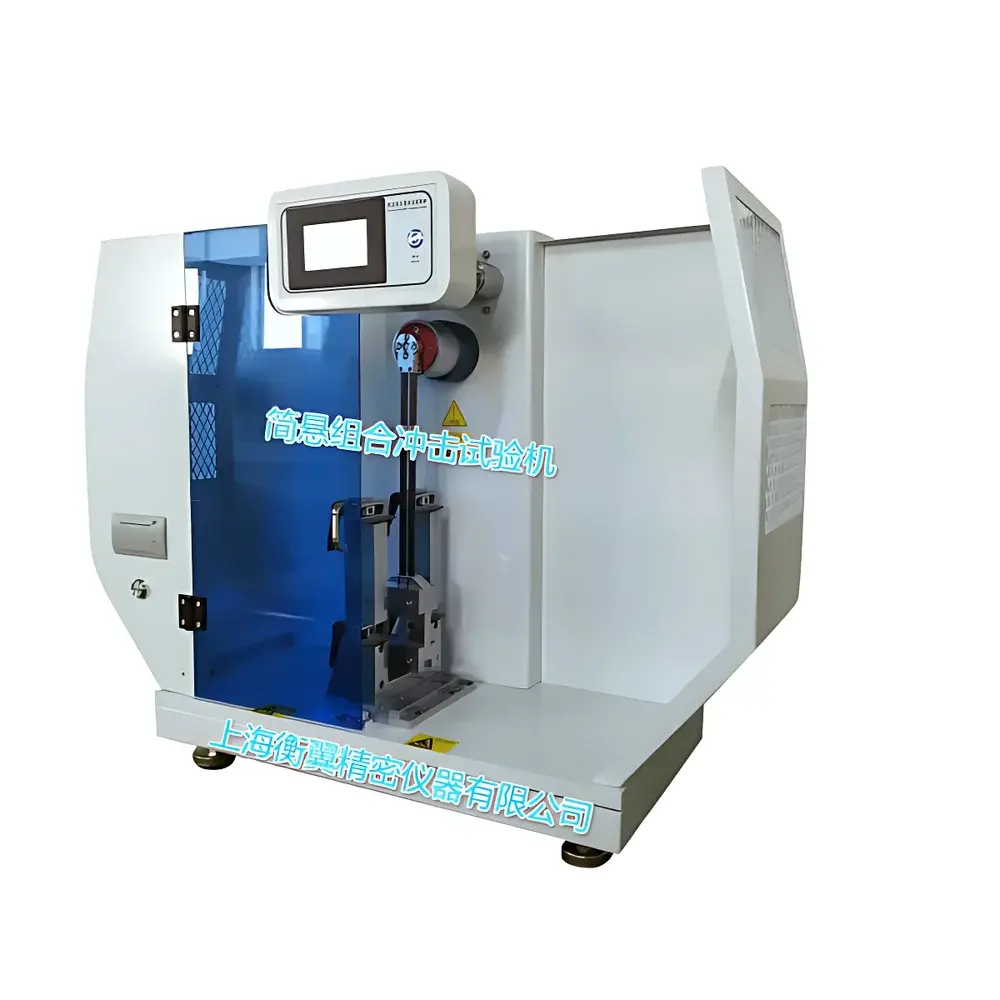
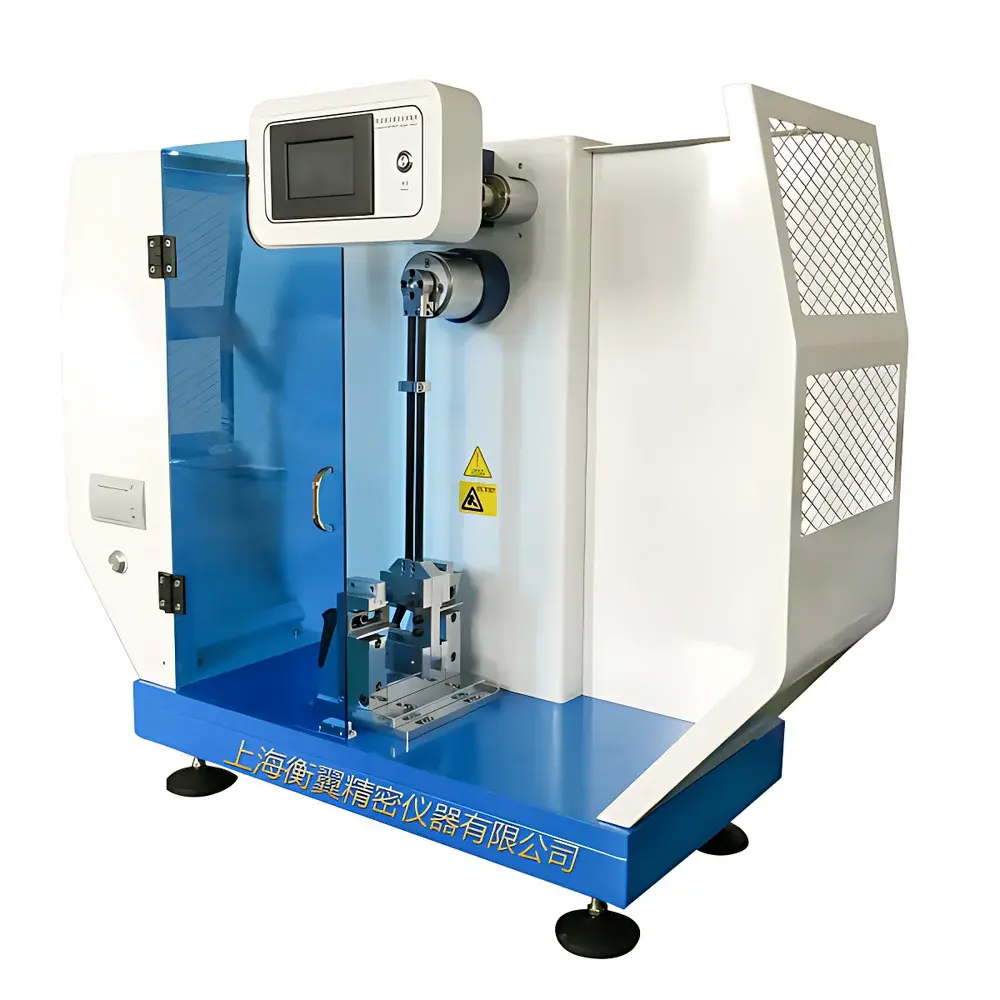
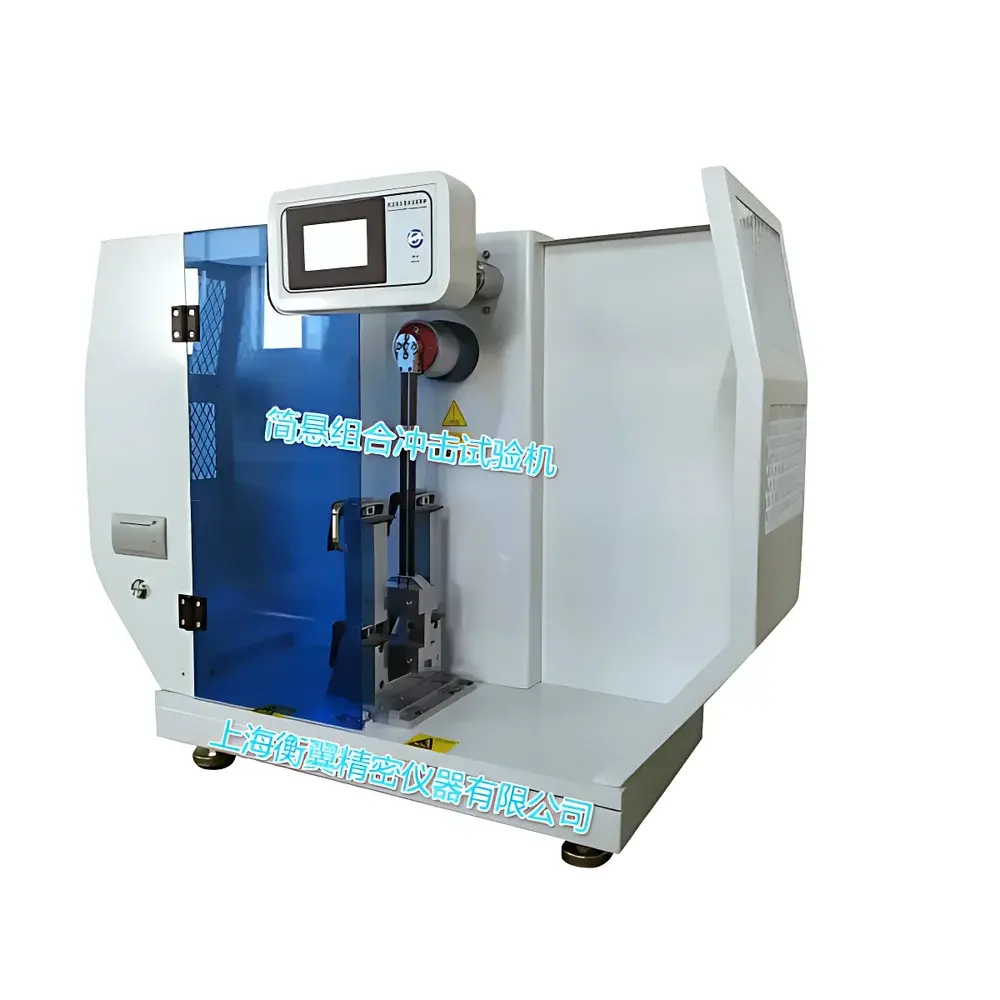
Hengyi HY(XB)-22JFB Cantilever Beam Impact Testing Machine with Color Touchscreen Control
| Brand | Hengyi |
|---|---|
| Origin | Shanghai, China |
| Manufacturer Type | Direct Manufacturer |
| Country of Origin | China |
| Model | HY(XB)-22JFB |
| Instrument Type | Pendulum Impact Tester |
| Nominal Impact Energy | 22 J |
| Impact Velocity | 3.5 m/s |
| Pendulum Constant (Torque) | 0.01 J/deg |
| Load Cell Range | 22 J |
| Maximum Pendulum Lifting Height | 0 mm |
| Display | Full-color TFT touchscreen (bilingual: English & Chinese) |
| Angle Sensor | Omron rotary encoder, resolution 0.01° |
| Energy Resolution | 0.01 J |
| Pendulum Raise Angle | 150° |
| Distance from Pendulum Pivot to Impact Blade | 335 mm |
| Distance from Impact Blade to Clamp Upper Surface | 22 mm |
| Blade Tip Radius | R = 0.8 ± 0.2 mm |
| Machine Weight | 85 kg |
| Power Supply | AC 220 V ± 10%, 50 Hz |
Overview
The Hengyi HY(XB)-22JFB Cantilever Beam Impact Testing Machine is a precision-engineered pendulum-type impact tester designed in strict accordance with ISO 179-1, ASTM D256, and GB/T 1043.1 standards for determining the notched and unnotched impact strength of rigid plastics and non-metallic materials. It operates on the principle of gravitational potential energy conversion: a calibrated pendulum is raised to a defined angular position (150°), released, and allowed to strike a standardized specimen clamped in cantilever configuration. The residual energy—measured via high-resolution optical encoding and load cell feedback—is subtracted from the initial potential energy to yield absorbed impact energy (in joules). This machine delivers traceable, repeatable results for quality control, material development, and regulatory compliance testing across polymer science, composites engineering, and electrical insulation manufacturing.
Key Features
- Full-color 7-inch TFT touchscreen interface with bilingual (English/Chinese) menu navigation and real-time graphical display of pendulum trajectory, energy absorption curve, and test status.
- High-accuracy Omron rotary encoder (0.01° angular resolution) ensures precise determination of pendulum displacement and kinetic energy calculation.
- Dual-range pendulum configuration supporting nominal impact energies of 11 J and 22 J, optimized for standard ISO/ASTM specimen geometries (e.g., 80 × 10 × 4 mm bars).
- Integrated load cell with 22 J full-scale range and automatic zero-drift compensation, synchronized with encoder data for redundant energy validation.
- Automated energy loss correction algorithm compliant with ISO 179 Annex B, compensating for bearing friction and air resistance based on no-load swing calibration.
- Rigid cast-iron base and hardened steel pendulum shaft ensure mechanical stability, minimizing vibration-induced measurement uncertainty during high-speed impact events (3.5 m/s nominal blade velocity).
Sample Compatibility & Compliance
The HY(XB)-22JFB accommodates standardized rectangular specimens per ISO 179-1 (Type 1A, 1B) and ASTM D256 (Type A, B). Compatible materials include thermoplastics (e.g., ABS, PC, PP), thermosets (epoxy, phenolic), fiber-reinforced composites (GFRP, CFRP), ceramics, and insulating polymers used in electrical enclosures. Specimen mounting employs a precision-machined anvil and adjustable clamp system ensuring consistent 22 mm support span and controlled notch geometry alignment. All mechanical and metrological performance parameters conform to ISO/IEC 17025 requirements for testing laboratories; the instrument supports GLP-compliant audit trails when paired with optional reporting software.
Software & Data Management
The embedded firmware enables local storage of ≥500 test records with timestamp, operator ID, specimen ID, energy absorption (J), impact strength (kJ/m²), and pass/fail flagging against user-defined limits. Data export is supported via USB 2.0 to CSV or PDF report formats—including calibrated energy values, statistical summaries (mean, SD, CV%), and ISO-aligned test certificates. Optional PC-based Hengyi TestSuite™ software (v3.2+) provides advanced features: multi-user role management, electronic signature support per FDA 21 CFR Part 11, automated trend analysis across batches, and integration with LIMS via HL7 or ODBC protocols.
Applications
- Quality assurance of injection-molded plastic components in automotive and consumer electronics supply chains.
- Evaluation of toughness degradation in aged or UV-exposed polymeric insulators per IEC 60695-10-2.
- Comparative screening of bio-based polymer blends during R&D phase under controlled humidity and temperature preconditioning.
- Verification of batch-to-batch consistency for glass-fiber-reinforced nylon (PA66-GF30) used in structural connectors.
- Supporting ASTM D790 flexural property correlation studies where impact resistance serves as secondary mechanical indicator.
FAQ
What standards does the HY(XB)-22JFB comply with for impact testing?
It meets ISO 179-1 (2010), ASTM D256 (2022), GB/T 1043.1 (2018), and ISO 8256 for tensile impact—validated through third-party calibration certificates traceable to NIM (China National Institute of Metrology).
Can the machine test both notched and unnotched specimens?
Yes—it supports ISO 179 Type 1A (notched) and Type 1U (unnotched) configurations using interchangeable anvils and standardized notching tools (not included but available as accessory kit).
Is calibration verification required before each test series?
Per ISO 179-2, a no-load pendulum swing verification must be performed daily or after relocation; certified reference specimens (e.g., PMMA calibration bars) are recommended for quarterly accuracy checks.
Does the system support network connectivity for centralized lab data management?
The base unit includes USB host port only; Ethernet or Wi-Fi connectivity requires optional Hengyi Network Interface Module (NIM-01), enabling remote diagnostics and secure cloud sync via TLS 1.2-encrypted API.
What maintenance intervals are recommended for long-term accuracy?
Lubrication of pivot bearings every 6 months, annual verification of encoder linearity and load cell drift, and biannual inspection of impact blade radius (R = 0.8 ± 0.2 mm) using optical profilometry per ISO 13802 Annex C.
Related Products



