
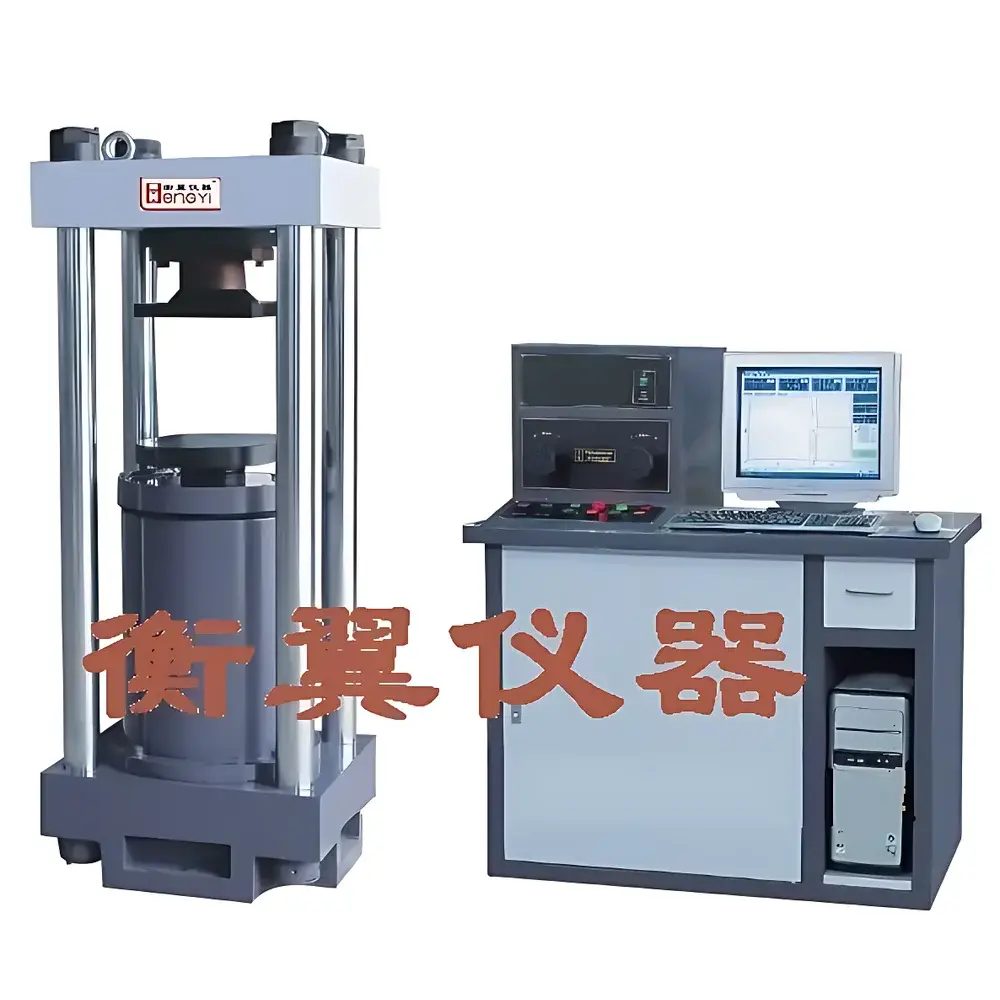
Hengyi HY(YE)-200008 Microcomputer-Controlled Hydraulic Compression Testing Machine
| Brand | Hengyi |
|---|---|
| Origin | Shanghai, China |
| Manufacturer Type | Direct Manufacturer |
| Model | HY(YE)-200008 |
| Max Load Capacity | 2000 kN |
| Accuracy Class | Class 1 (per GB/T 3159 & ISO 7500-1) |
| Force Measurement Range | 200–2000 kN |
| Relative Indication Error | ±1% |
| Internal Clear Distance | 450 mm |
| Upper/Lower Platen Dimensions | 240 × 240 mm |
| Piston Stroke | 80 mm |
| Motor Power | 0.75 kW |
| Net Weight | ~800 kg |
| Overall Dimensions (W×D×H) | 850 × 500 × 1480 mm |
| Deformation Measurement Accuracy | ±0.5% of reading |
| Displacement Measurement Error | ±0.5% of reading |
| Stress Rate Control Range | 1–60 N/mm²/s |
| Strain Rate Control Range | 0.00025–0.0025 s⁻¹ |
| Closed-Loop Control Accuracy (Force/Displacement/Deformation) | ±1% of setpoint |
| Key Components | High-Precision Electro-Hydraulic Proportional Valve, Dual High-Accuracy Load & Displacement Sensors, Microcomputer-Based Electro-Hydraulic Proportional Control System, Full-Closed-Loop Test Software with A4 Color Report Generation and Data Archiving |
Overview
The Hengyi HY(YE)-200008 Microcomputer-Controlled Hydraulic Compression Testing Machine is a Class 1-compliant static compression testing system engineered for high-reproducibility mechanical characterization of rigid construction materials under uniaxial compressive loading. It operates on the principle of electro-hydraulic servo-controlled force application, where a high-precision proportional valve regulates hydraulic oil flow to maintain programmed stress or strain rates in real time. Designed specifically for structural integrity assessment of concrete, masonry units, natural stone, and cementitious composites, the machine conforms to core international standards including ISO 7500-1 (static calibration of force-proving instruments), GB/T 3159 (hydraulic universal testing machines), and ASTM C39/C109 for compressive strength evaluation of concrete and mortar. Its rigid four-column frame, precision-ground platens, and integrated closed-loop control architecture ensure minimal deflection and long-term dimensional stability during sustained load application—critical for compliance with GLP-aligned quality assurance protocols in third-party certification labs and precast manufacturing QA environments.
Key Features
- Class 1 force measurement accuracy (±1% relative error) validated per ISO 7500-1 and GB/T 3159, supported by dual high-stability load cells and temperature-compensated signal conditioning
- Electro-hydraulic proportional control system enabling precise stress-rate (1–60 N/mm²/s) and strain-rate (0.00025–0.0025 s⁻¹) regulation with ±1% setpoint fidelity
- Motor-driven vertical adjustment mechanism with 80 mm piston stroke and 450 mm internal clear distance—optimized for standard and oversized civil engineering specimens
- 240 × 240 mm hardened steel platens with parallelism tolerance ≤0.02 mm/m, ensuring uniform load distribution across ASTM C39-specified specimen geometries
- Integrated microcomputer controller with real-time load-displacement-deformation acquisition at ≥100 Hz sampling rate and automatic zero-point drift compensation
- Full-closed-loop software supporting multi-step test profiles (preload → ramp → hold → unload), automatic report generation in A4 color PDF format, and secure local database storage with timestamped audit trails
Sample Compatibility & Compliance
The HY(YE)-200008 accommodates cylindrical (e.g., Ø150 × 300 mm concrete cores) and cubic (e.g., 150 × 150 × 150 mm mortar blocks) specimens per ASTM C39, EN 12390-3, and GB/T 50081. Its 200–2000 kN operational range covers standard compressive strength testing for M15–C100 grade concretes, fired clay bricks (GB/T 5101), autoclaved aerated concrete (GB/T 11968), and natural dimension stone (ASTM C170). All hardware and firmware comply with electromagnetic compatibility (EMC) requirements per IEC 61326-1 and safety standards per ISO 12100. The system supports traceable calibration via NIST-traceable force standards and includes built-in diagnostics for sensor linearity, valve hysteresis, and platen alignment verification—essential for ISO/IEC 17025-accredited laboratories.
Software & Data Management
The proprietary closed-loop test software provides role-based user access control, electronic signature capability, and full 21 CFR Part 11-compliant audit trail functionality—including operator ID, parameter changes, test initiation/termination timestamps, and raw data modification history. Raw force-displacement curves are stored in .csv and binary formats with metadata embedding (test standard, specimen ID, environmental conditions). Reporting modules auto-populate standardized templates aligned with ASTM C39 Annex A1 and GB/T 50081-2019, exporting results with statistical summaries (mean, SD, COV), pass/fail flags against specification limits, and embedded calibration certificate references. Data export supports integration with LIMS platforms via ODBC and RESTful API endpoints.
Applications
- Compressive strength validation of ready-mix and precast concrete per ASTM C39, EN 12390-3, and JGJ/T 70
- Quality conformance testing of load-bearing masonry units (clay bricks, concrete blocks) per ASTM C62/C140 and GB/T 5101/21144
- Mechanical property benchmarking of geopolymer binders, fiber-reinforced cement composites, and ultra-high-performance concrete (UHPC)
- Routine QA/QC in asphalt pavement material labs for stabilized base course evaluation (ASTM D1633)
- Research-grade monotonic compression tests for constitutive modeling of brittle geomaterials under controlled strain rates
FAQ
What standards does this machine support for calibration and operation?
It complies with ISO 7500-1 (force calibration), GB/T 3159 (machine classification), ASTM E4 (force verification), and supports test execution per ASTM C39, C109, EN 12390-3, and GB/T 50081.
Can the system perform multi-stage loading protocols (e.g., preload + ramp + dwell)?
Yes—the software enables up to 16 programmable steps per test sequence, including preloading, linear/ramp loading, constant-force holding, and controlled unloading, all with independent rate and duration parameters.
Is the data archive compliant with regulatory audit requirements?
Yes. All test data, configuration logs, and operator actions are immutably recorded with digital signatures, time stamps, and version-controlled backups—fully aligned with 21 CFR Part 11 and ISO/IEC 17025 documentation mandates.
What maintenance intervals are recommended for hydraulic and sensor subsystems?
Hydraulic oil replacement every 2,000 operating hours; annual recalibration of load and displacement sensors per ISO 376; biannual verification of platen parallelism and frame stiffness using certified reference standards.
Does the system interface with external environmental monitoring devices (e.g., temperature/humidity loggers)?
Yes—via RS-485 or Modbus TCP, the controller accepts external analog/digital inputs for synchronized environmental metadata tagging during test execution.



