
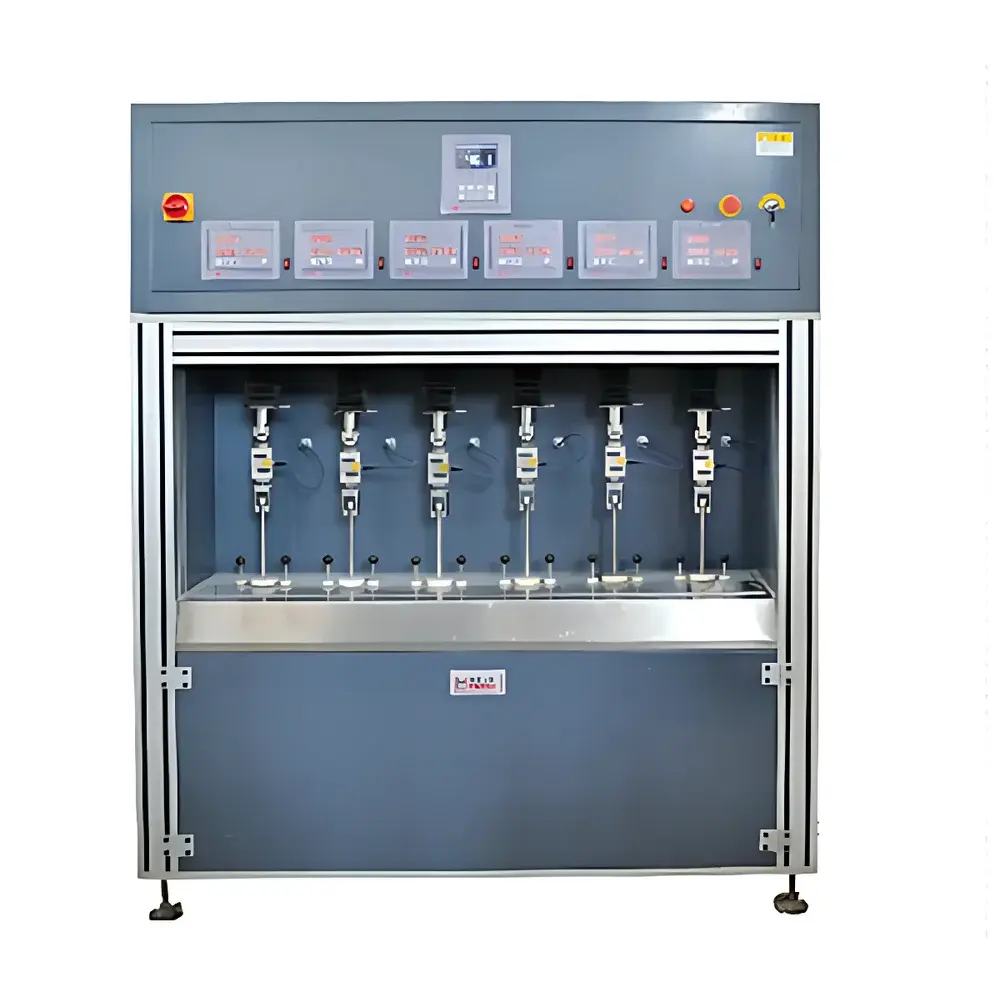
Hengyi Instruments HY-QKRB Full-Notch Creep Testing Machine
| Brand | Hengyi / Hengyitest |
|---|---|
| Origin | Shanghai, China |
| Manufacturer Type | Direct Manufacturer |
| Origin Category | Domestic (China) |
| Model | HY-QKRBRTY |
| Quotation | Available Upon Request |
| Load Capacity | 2000 N (interchangeable load cells available below 2000 N |
| Effective Force Measurement Range | 0.4%–99.999% of full scale |
| Test Width | 120 mm |
| Vertical Test Space | 200 mm |
| Test Speed | 0.001–100 mm/min (adjustable in real time) |
| Speed Accuracy | ±1% of indicated value |
| Displacement Accuracy | ±1% of indicated value |
| Strain/Deformation Accuracy | ±1% of indicated value |
| Number of Test Stations | 12 |
| Temperature Bath Control Range | Ambient to 95 °C |
| Temperature Stability | ±0.5 °C |
| Control System | PC-based closed-loop control |
| Power Requirement | 10 kW |
| Unit Weight | 850 kg |
| Voltage Supply | 220 V AC |
| Dimensions (W×D×H) | 1620 × 850 × 1750 mm |
| Compliance Standards | GB/T 15820–1995, GB/T 11546–2016, GB/T 32682–2016, ISO 899-1:2017, ISO 16770:2017, ISO 3501:1997 |
Overview
The Hengyi Instruments HY-QKRB Full-Notch Creep Testing Machine is a precision-engineered, multi-station static loading system designed for the quantitative assessment of environmental stress cracking (ESC) resistance in polyethylene (PE) and other thermoplastic polymers under sustained mechanical and chemical exposure. It operates on the principle of full-notch creep testing (FNCT), a standardized method in which pre-notched specimens are subjected to constant tensile load while immersed in a defined surfactant solution—typically Igepal CO-630—at elevated, tightly controlled temperatures. This configuration accelerates ESC initiation and propagation, enabling accelerated lifetime prediction of PE pressure pipes, fittings, and geomembranes used in gas distribution, water supply, and landfill containment systems. The instrument integrates a 12-position test rack with independent load application, synchronized temperature-controlled bath immersion, and high-fidelity displacement monitoring over extended durations—from hours to months—ensuring data integrity for regulatory submission and material qualification.
Key Features
- Twelve independent test stations with individually calibrated load cells (2000 N nominal capacity; optional lower-range sensors available for enhanced resolution at sub-500 N loads)
- High-stability temperature-controlled bath (ambient to 95 °C) with ±0.5 °C uniformity across all immersion zones, verified per ASTM E220 and ISO/IEC 17025 calibration protocols
- Motor-driven electromechanical actuation system delivering precise, programmable crosshead speeds from 0.001 to 100 mm/min, with closed-loop feedback ensuring ±1% speed accuracy over full range
- Real-time acquisition of force, displacement, and time-stamped event markers via industrial-grade DAQ hardware compliant with IEC 61000-4 electromagnetic immunity standards
- Modular mechanical architecture supporting both FNCT (full-notch tensile creep), standard uniaxial tensile creep (per ISO 899-1), and pipe pull-out testing (per GB/T 15820)
- Rigid steel frame (850 kg mass) minimizing vibration coupling and thermal drift during long-term tests exceeding 10,000 hours
Sample Compatibility & Compliance
The HY-QKRB accommodates standardized FNCT specimens per ISO 16770 and GB/T 32682–2016: rectangular bars (80 × 10 × 4 mm) with a 1-mm deep notch introduced at mid-length using certified tooling. Pipe pull-out fixtures conform to GB/T 15820–1995 geometry requirements for socket-type PE fittings. All test environments—including Igepal CO-630 concentration (10% w/w), bath volume (≥5 L per station), and immersion depth—are configurable to meet ISO, ASTM, and national regulatory validation criteria. The system is fully traceable to SI units through NIM (National Institute of Metrology, China)-certified load cell calibration certificates and supports audit-ready documentation for GLP-compliant laboratories.
Software & Data Management
Control and data acquisition are managed via Hengyi’s proprietary WinTest-FNCT software, built on a deterministic Windows OS platform with real-time scheduling priority. The software provides automated test sequencing, dynamic load ramping profiles, failure detection algorithms (based on displacement rate thresholds), and auto-generated compliance reports aligned with ISO 16770 Annex B and GB/T 32682–2016 Section 8. Raw data files are stored in HDF5 format with embedded metadata (operator ID, calibration expiry, ambient RH/temp logs). Audit trail functionality satisfies FDA 21 CFR Part 11 requirements for electronic records and signatures when deployed with domain-authenticated user accounts and role-based access control.
Applications
- Accelerated ESC screening of PE100 and PE100-RC resins for pipe extrusion grade certification
- Comparative evaluation of antioxidant package efficacy in HDPE geomembranes exposed to leachate simulants
- Validation of fusion joint integrity in PE gas distribution networks per EN 12201-3 and AS/NZS 4129
- Long-term creep rupture analysis of multilayer barrier structures in packaging films
- Material qualification for ISO 4427-2 and ISO 4437-2 certified pressure piping systems
FAQ
What standards does the HY-QKRB explicitly support?
It is configured and validated for GB/T 15820–1995, GB/T 11546–2016, GB/T 32682–2016, ISO 899-1:2017, ISO 16770:2017, and ISO 3501:1997.
Can the system operate unattended for multi-week tests?
Yes—integrated power-fail recovery, thermal runaway protection, and automatic data backup ensure continuity during extended testing cycles up to 6 months.
Is third-party calibration documentation provided?
Each unit ships with factory calibration certificates traceable to NIM (China) for force, displacement, and temperature subsystems, plus uncertainty budgets per ISO/IEC 17025.
How is specimen failure detected?
Failure is determined by either displacement threshold crossing (e.g., >5 mm extension beyond initial notch opening) or sustained load drop (>5% of setpoint over 30 s), configurable per test protocol.
Does the system support custom test sequences beyond FNCT?
Yes—WinTest-FNCT allows user-defined multi-step loading profiles, including hold-relax, ramp-hold, and cyclic creep segments, exportable as XML-based method templates.



