
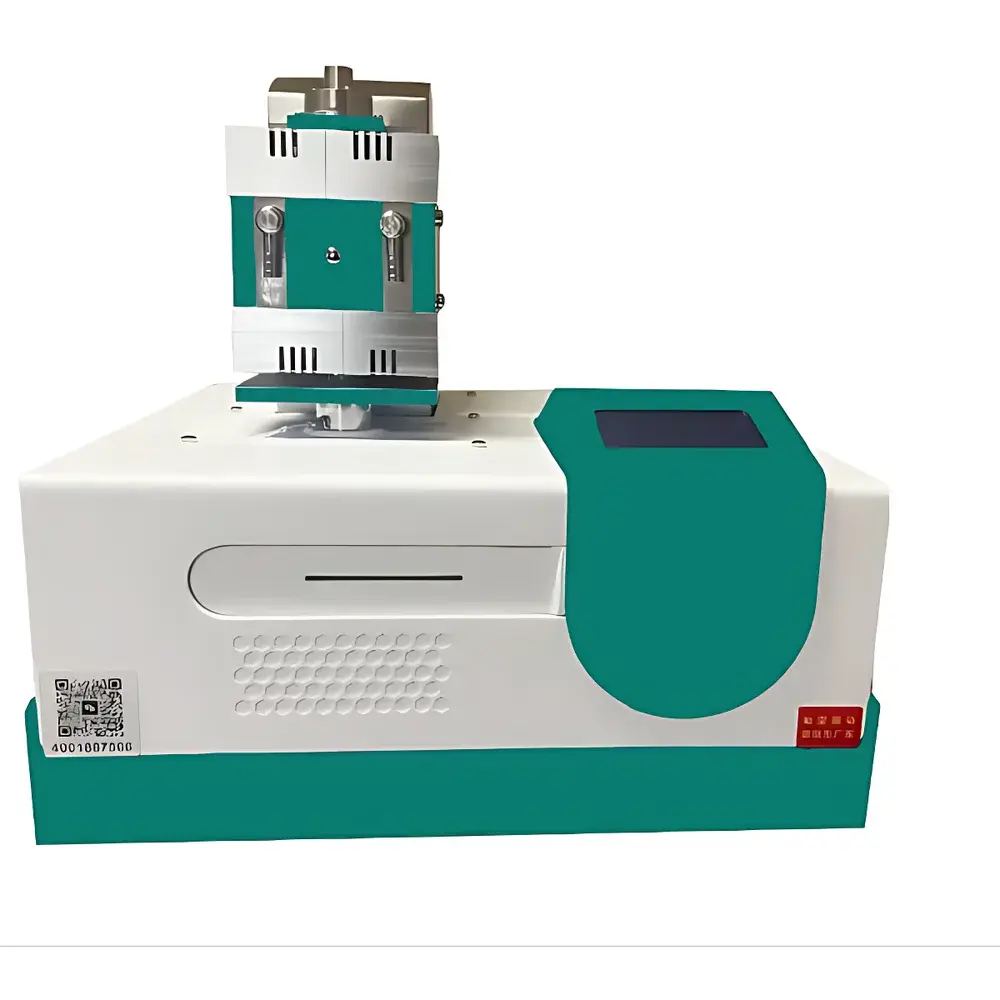
Henven HFCT-1 Optical Radiation Furnace Thermogravimetric Analyzer with DTA/DSC Capability
| Brand | Henven (Beijing) |
|---|---|
| Origin | Beijing, China |
| Manufacturer Type | Direct Manufacturer |
| Regional Classification | Domestic (China) |
| Model | HFCT-1 |
| Structural Design | Horizontal Configuration |
| Operating Environment | Ambient Pressure |
| Sample Capacity | Single Sample |
| Instrument Class | General-Purpose TGA-DTA/DSC Hybrid |
| Temperature Range | RT to 900 °C |
| Temperature Accuracy | ±0.1 °C |
| Temperature Precision (Uncertainty) | 0.1 K |
| Dynamic Weight Range | 1–300 mg |
| Balance Sensitivity | 0.1 μg |
| Mass Accuracy | 0.1 μg |
| Heating/Cooling Rate | Up to 300 K/min |
| Maximum Load Capacity | 5 g |
| DSC Signal Range | ±500 mW |
| DSC Resolution | ±0.1 μW |
| DSC Accuracy | ±0.1 μW |
| DTA Voltage Range | ±10–±2000 μV |
| DTA Resolution | 0.01 μV |
| TG Noise Level | <0.1 μg |
| Atmosphere Control | Dual-channel Mass Flow Controllers (MFCs), Programmable Gas Switching, Compatible with Inert, Oxidizing, Reducing, and Vacuum (Optional) |
| Crucible Standard | Al₂O₃ |
Overview
The Henven HFCT-1 Optical Radiation Furnace Thermogravimetric Analyzer is a horizontally configured, general-purpose thermal analysis system integrating simultaneous thermogravimetry (TG), differential thermal analysis (DTA), and heat-flux differential scanning calorimetry (DSC) capabilities. Engineered for precision and reproducibility in academic, industrial QC, and R&D laboratories, the instrument employs an optical radiation heating furnace — a design that minimizes thermal conduction and convection losses by isolating the sample zone from external thermal mass. This architecture enables rapid, uniform heating with minimal thermal lag, supporting high-fidelity kinetic studies and transient thermal event detection. The system operates under ambient pressure and accommodates single-sample measurements within a temperature range of room temperature to 900 °C, with calibrated accuracy of ±0.1 °C and thermal stability maintained across dynamic ramp rates up to 300 K/min. All thermal and mass signals are acquired synchronously at high sampling resolution, enabling robust multi-parameter correlation essential for material decomposition profiling, phase transition quantification, and reaction enthalpy determination.
Key Features
- Optical radiation furnace design ensures rapid thermal response, low thermal inertia, and superior temperature homogeneity across the sample zone.
- Integrated heat-flux DSC sensor enables direct measurement of energy absorption/emission, supporting quantitative enthalpy calculation per ASTM E794 and ISO 11357 standards.
- Dual independent thermocouples provide real-time, concurrent monitoring of sample temperature and furnace block temperature — critical for accurate baseline correction and thermal lag compensation.
- High-sensitivity microbalance with 0.1 μg resolution and <0.1 μg noise floor ensures reliable detection of minute mass changes during dehydration, volatilization, or oxidative gain events.
- Programmable dual-gas atmosphere control using precision mass flow controllers (MFCs) supports automated switching between inert (N₂, Ar), oxidizing (air, O₂), reducing (H₂, CO), and vacuum conditions — configurable for corrosive gas compatibility upon request.
- Full-spectrum data acquisition engine captures TG, DTG, DTA, DSC, and derivative signals simultaneously, with auto-ranging and real-time screen capture functionality.
- Large-format LCD interface displays live instrument status, thermal profiles, mass drift, and signal amplitudes — optimized for unattended operation and method validation.
Sample Compatibility & Compliance
The HFCT-1 accepts standard alumina crucibles (Al₂O₃) and is compatible with powders, granules, thin films, fibers, and small solid specimens (≤5 g max load). Its horizontal geometry facilitates easy loading, minimal buoyancy effects, and consistent gas flow distribution over the sample. The system meets fundamental requirements for GLP-compliant thermal analysis workflows, including traceable calibration procedures using certified reference materials (e.g., indium, zinc, and calcium oxalate monohydrate) for temperature, mass, and enthalpy verification. Software supports audit-trail generation, user access levels, and electronic signature capability — aligning with FDA 21 CFR Part 11 readiness when deployed in regulated environments. All hardware and firmware designs adhere to IEC 61000-6-3 (EMC) and IEC 61010-1 (safety) specifications.
Software & Data Management
The embedded analytical software offers multilingual support (English, Chinese, Russian) and provides comprehensive post-processing tools: baseline subtraction, peak integration (DTA/DSC), kinetic modeling (e.g., Kissinger, Ozawa-Flynn-Wall), glass transition identification (Tg), specific heat estimation via comparative method, and multi-curve overlay with statistical deviation mapping. Users may perform automatic calibration of temperature, mass, and heat flow channels using built-in routines and NIST-traceable standards. Raw data export is supported in ASCII, CSV, and universal .QTX formats for third-party analysis (e.g., OriginLab, MATLAB, Thermo-Calc). The software architecture includes full method storage, version-controlled protocol libraries, and timestamped metadata logging — ensuring full data integrity and regulatory traceability.
Applications
The HFCT-1 delivers validated performance across diverse thermal characterization use cases: polymer thermal degradation kinetics and filler content analysis; pharmaceutical polymorph screening and excipient compatibility assessment; catalyst thermal stability and coke burn-off profiling; battery electrode material decomposition and SEI layer formation studies; ceramic sintering behavior and binder removal optimization; metallurgical phase transformation mapping (e.g., austenite-to-ferrite); and nanomaterial surface functionalization verification via controlled oxidative weight loss. Its ability to resolve overlapping endothermic/exothermic events alongside concurrent mass loss makes it particularly suited for studying complex reactions such as dehydration–decomposition–oxidation sequences in hydrated salts or composite materials.
FAQ
What calibration standards are recommended for routine verification?
Indium (melting point 156.6 °C), zinc (419.5 °C), and calcium oxalate monohydrate (decomposition steps at ~180 °C and ~400 °C) are recommended for temperature, enthalpy, and mass calibration, respectively.
Can the instrument operate under vacuum?
Vacuum operation is available as an optional configuration with dedicated vacuum pump interface and sealed furnace housing — contact technical support for system integration details.
Is FTIR or MS coupling supported?
Yes — the HFCT-1 features standardized effluent port geometry and temperature-controlled transfer line interfaces compatible with commercial FTIR, quadrupole MS, and GC-MS systems for evolved gas analysis (EGA).
Does the software comply with 21 CFR Part 11 requirements?
The software supports electronic signatures, audit trails, and role-based access control — fully configurable to meet 21 CFR Part 11 expectations when deployed on validated IT infrastructure with appropriate administrative controls.
What maintenance intervals are recommended for optimal balance performance?
We recommend quarterly verification of balance sensitivity and zero stability using certified test weights, and annual recalibration of thermocouple circuits and MFC flow rates by authorized service personnel.



