
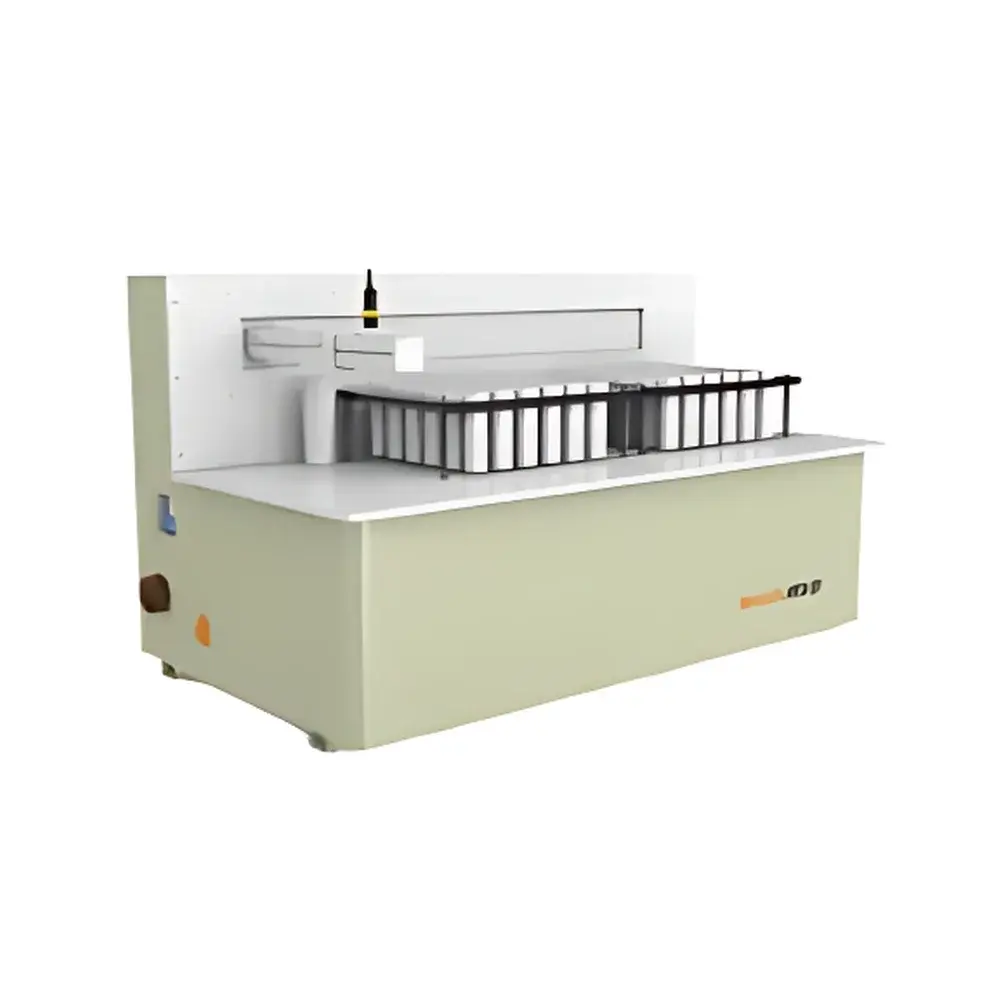
HePu A60 Fully Automated Graphite Block Digestion System
| Brand | HePu (Ji'nan HePu Instrument Co., Ltd.) |
|---|---|
| Origin | Shandong, China |
| Model | A60 |
| Digestion Positions | 60 |
| Heating Method | Graphite block heating module |
| Temperature Range | Ambient to 230 °C |
| Temperature Control Accuracy | ±0.1 °C |
| Number of Reagent Channels | 9 |
| Reagent Dispensing Speed | 0–11 mL/s |
| Reagent Dispensing Accuracy | <1% |
| Ultrasonic Volume Detection for Final Volume Adjustment | 10–50 mL |
| Final Volume Accuracy | ≤0.5% (typical) |
| Air Exhaust Flow Rate | 2200 m³/h |
| Dimensions (L×H×W) | 1150 × 600 × 1050 mm |
| Weight | 120 kg |
| Power Rating | 3000 W |
Overview
The HePu A60 Fully Automated Graphite Block Digestion System is an integrated, walk-away sample preparation platform engineered for high-throughput, reproducible acid digestion of solid and semi-solid samples prior to elemental analysis by ICP-OES, ICP-MS, or AAS. It implements a closed-loop, multi-stage automation architecture combining precision graphite-block thermal control, programmable reagent delivery, mechanical agitation, inert-gas-assisted acid fume management, and post-digestion volume standardization—all under unified software supervision. Unlike conventional hotplate or microwave digesters, the A60 eliminates manual intervention across the entire workflow: from initial reagent addition and ramped temperature programming to cooling, homogenization, and final volumetric adjustment. Its design adheres to core principles of analytical traceability—minimizing contamination risk through PTFE-wetted fluid paths, stainless-steel + fluoropolymer-coated hardware, and HEPA-filtered internal air recirculation—making it suitable for laboratories operating under GLP, ISO/IEC 17025, or USP compliance frameworks.
Key Features
- 60-position graphite digestion block with uniform radial heating and depth-adjustable wells (4–6 cm), enabling consistent thermal transfer and passive reflux condensation to reduce reagent consumption and blank contribution.
- Multi-stage PID temperature control with imported digital controllers; programmable up to 20 temperature ramps per method, with slope and dwell time independently configurable for optimized decomposition kinetics.
- 9-channel reagent dispensing system utilizing PTFE-tubing peristaltic pumps; each channel supports independent calibration, cleaning cycles, and flow-rate modulation (0–11 mL/s) with volumetric accuracy <1% RSD.
- Bi-axial robotic arm with sub-millimeter positional repeatability (<40 µm), capable of precise reagent addition, vortex mixing, and coordinated lift-and-cool sequencing for all 60 tubes without cross-contamination.
- Integrated ultrasonic level-sensing module for real-time, non-contact volume measurement during final dilution; paired with calibrated peristaltic pumping to deliver target volumes (10–50 mL) with ≤0.5% typical error.
- Self-contained acid fume management: 2200 m³/h exhaust capacity, HEPA-grade particulate filtration, automatic condensate drainage, and positive-pressure cabinet sealing to protect electronics from corrosive vapors—enabling safe operation outside fume hoods.
Sample Compatibility & Compliance
The A60 accommodates standard 50 mL PTFE digestion vessels (including EPA Method 3050B/3051A-compatible formats) and supports digestion protocols for soils, sediments, biological tissues, food matrices, polymers, and geological samples using HNO₃, HCl, HF, H₂O₂, and aqua regia mixtures. All wetted components—including tubing, bottle caps, tube racks, and chamber liners—are constructed from chemically inert fluoropolymers (PTFE, PFA) or electropolished stainless steel with multi-layer PEFE coating. The system meets structural requirements for CE marking (2014/30/EU EMC Directive and 2014/35/EU LVD), and its sealed enclosure and filtered exhaust path align with OSHA 29 CFR 1910.1200 (HCS) and ISO 15190:2020 laboratory safety standards. Audit trails, user access levels, and electronic signature support are configurable to satisfy FDA 21 CFR Part 11 readiness when deployed with validated software versions.
Software & Data Management
The A60 operates via a Windows-style embedded GUI on a 10.1″ capacitive touchscreen LCD, supplemented by optional remote PC control over Wi-Fi, USB, or RS-232. The method editor allows creation of unlimited digestion protocols, each supporting up to 100 sequential steps—including temperature setpoints, reagent selection/dose, agitation intensity/duration, lift timing, and final dilution volume. Methods store metadata (operator ID, timestamp, instrument serial number) and generate CSV-log files containing real-time temperature curves, dispense volumes, and status flags for every tube. Remote monitoring includes live video feed (via optional IP camera integration) and push notifications for step completion or fault conditions. All data exports are compatible with LIMS interfaces via standard FTP or shared network drive protocols.
Applications
- Environmental labs performing EPA 3050B, 3051A, and 3052 digestions for heavy metal quantification in soil and sludge.
- Clinical and food testing facilities executing AOAC 999.10 or ISO 11885 protocols for total As, Cd, Pb, and Hg determination.
- Geochemical laboratories preparing rock and ore samples for multi-element ICP-MS analysis under ISO 13877.
- Materials R&D centers digesting catalysts, battery cathodes, and nanocomposites where HF-based dissolution requires strict containment and repeatability.
- Contract testing organizations requiring full traceability, method version control, and electronic record retention for accreditation audits.
FAQ
Does the A60 require installation inside a fume hood?
No—the integrated 2200 m³/h exhaust system with HEPA filtration and acid-neutralizing media enables standalone operation on standard lab benches.
Can the system handle hydrofluoric acid (HF)?
Yes—provided HF-compatible PTFE/PFA consumables are used; all fluidic pathways and chamber surfaces are rated for prolonged HF exposure at concentrations up to 40% w/w.
Is method validation support available?
HePu provides IQ/OQ documentation templates, calibration certificates for temperature and volume subsystems, and on-site DQ/IQ assistance upon request.
What maintenance intervals are recommended?
Daily: visual inspection of tubing integrity and waste reservoir level. Quarterly: recalibration of ultrasonic sensor and peristaltic pump flow rates. Annually: full thermal mapping of the graphite block and HEPA filter replacement.
Can two different digestion protocols run simultaneously?
Yes—the dual-zone independent temperature control allows concurrent processing of two distinct sample batches (e.g., soil vs. tissue) on separate 30-position zones within the same 60-tube block.



