
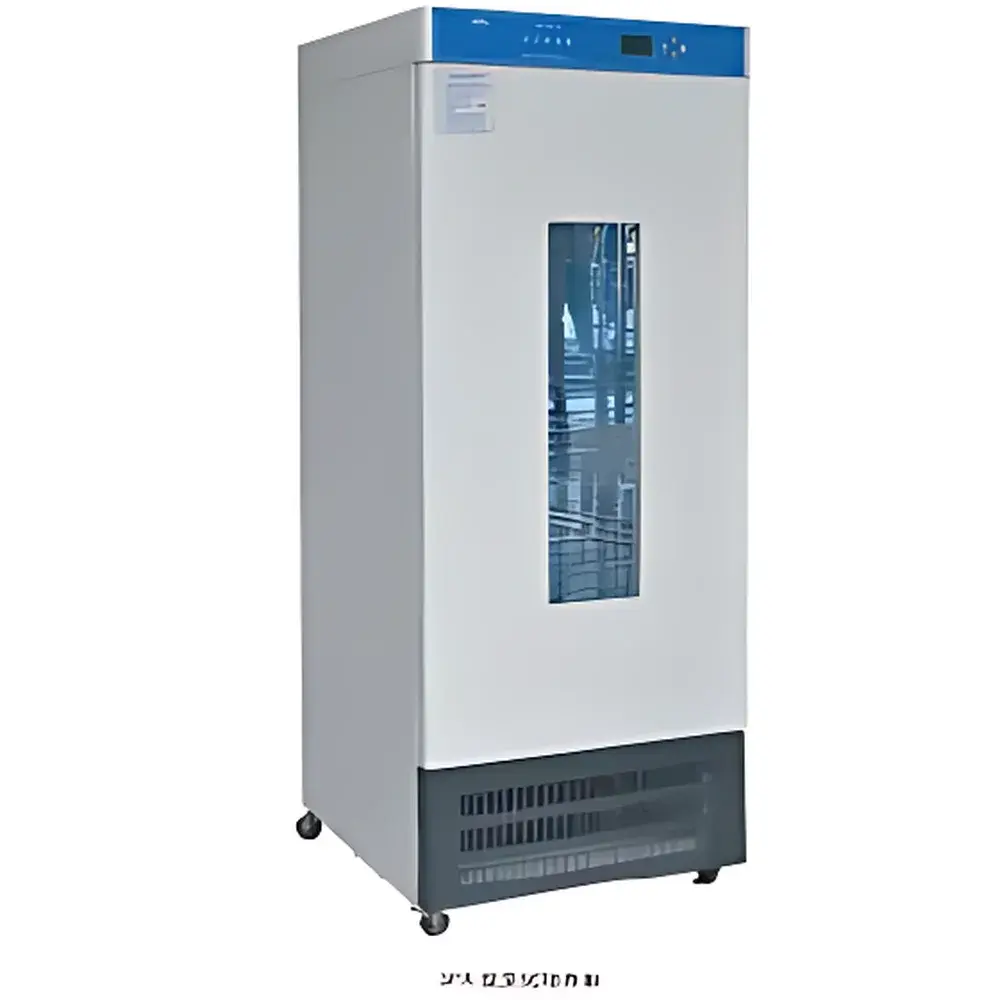
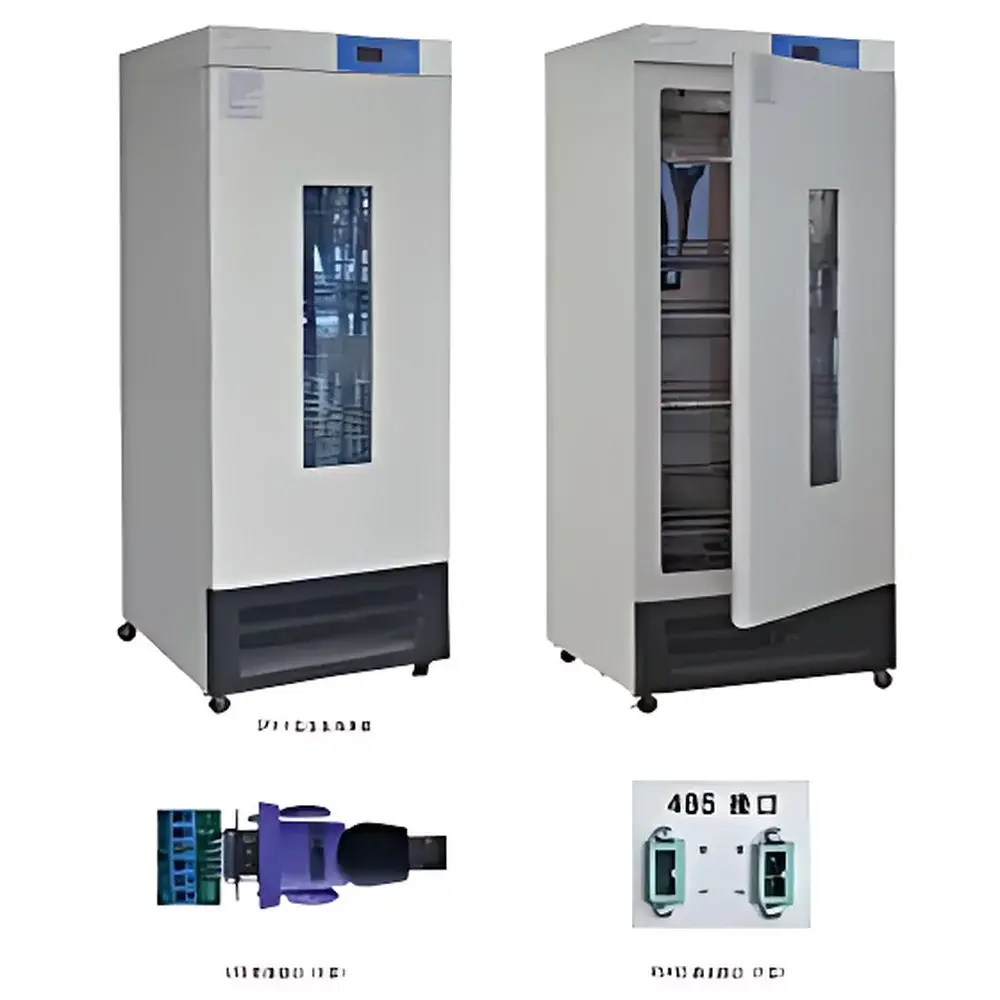
HePu SPX-80 Biochemical Incubator
| [Brand | HePu (Jihepu) |
|---|---|
| Origin | Shandong, China |
| Model | SPX-80 |
| Temperature Range | 5–50 °C (SPX-80-II: 0–50 °C) |
| Temperature Uniformity | ±2 °C (±1 °C for II-type) |
| Temperature Fluctuation | ±1 °C (±0.5 °C for heating only, II-type) |
| Chamber Volume | 80 L |
| Power Rating | 180 W |
| Refrigerant | R134a (CFC-free) |
| Control System | PID + Fuzzy Logic with PT100 Sensor (DIN Class A) |
| Display | LCD (English interface) |
| Communication | RS485 (up to 1.2 km) |
| Interior Material | SUS304 Mirror-Finish Stainless Steel |
| Insulation | High-Density Polyurethane Foam + Ultra-Fine Glass Fiber |
| Safety Features | Dual Independent Over-Temperature Protection, Compressor Pressure & Thermal Overload Protection, Auto Fault Detection & Cut-off, Audible Alarm] |
Overview
The HePu SPX-80 Biochemical Incubator is a precision-controlled, forced-air convection incubation system engineered for stable, reproducible thermal environments in life science laboratories. Designed around the principles of convective heat transfer and closed-loop thermoregulation, it maintains uniform temperature distribution across its 80 L working chamber through a horizontally directed, arc-shaped airflow pattern generated by a high-impedance centrifugal blower. The unit employs a dual-mode thermal management architecture—combining microprocessor-driven PID+Fuzzy logic control with independent heating and refrigeration circuits—to deliver accurate setpoint tracking across its operational range of 5–50 °C (0–50 °C for SPX-80-II variant). Its thermally insulated chamber, constructed from mirror-finish SUS304 stainless steel and surrounded by high-density polyurethane foam and ultra-fine glass fiber insulation, minimizes external thermal interference and ensures energy-efficient operation. This design meets the functional requirements for BOD testing, microbial culture maintenance, fungal propagation, plant tissue incubation, and short-term biological sample storage under controlled ambient conditions.
Key Features
- Forced-air horizontal circulation system with arc-shaped airflow path for enhanced temperature uniformity (±2 °C standard; ±1 °C in II-type configuration)
- Dual independent thermal control: P.I.D. + Fuzzy logic algorithm with DIN Class A PT100 sensor (Φ5 mm SUS304 sheath) enabling 0.1 °C display resolution and ±0.1 °C control accuracy
- CFC-free refrigeration circuit using R134a, integrated with hermetically sealed compressor, finned-tube evaporator/condenser, Danfoss dryer filter, and Parker oil separator (II-type)
- Intelligent power modulation: automatic adjustment of heating element output and compressor duty cycle based on real-time thermal load assessment
- Robust mechanical construction: cold-rolled steel exterior with electrostatic powder coating, 304 stainless steel interior chamber, and adjustable stainless steel wire shelving (2 pcs, 20 kg capacity each, 50 mm vertical increment)
- Integrated safety architecture: triple-layer protection including over-temperature cut-off (adjustable upper/lower limits), compressor pressure monitoring, thermal overload relays, and self-diagnostic fault reporting with audible alarm
- User-centric interface: English-language LCD display (LED for II-type), tactile keypad navigation, RS485 serial communication port compliant with Modbus RTU protocol for centralized lab equipment integration
Sample Compatibility & Compliance
The SPX-80 accommodates standard microbiological and biochemical workflows involving Petri dishes, test tubes, flasks, multi-well plates, and small-volume bioreactors. Its chamber dimensions (40 × 37 × 55 cm W×D×H) support common laboratory vessel configurations without spatial constraint. The inclusion of internal power outlets and LED illumination enables in-chamber instrumentation—such as dissolved oxygen probes or pH electrodes—during extended incubation periods. While not certified to ISO 13485 or FDA 21 CFR Part 11 out-of-the-box, the incubator’s deterministic control logic, audit-ready parameter logging (via optional RS485-connected data acquisition systems), and hardware-level fault tracing align with GLP-compliant documentation practices. It satisfies core performance criteria referenced in ASTM E1757 (Standard Practice for Laboratory Incubators) and supports method validation per USP and for microbial enumeration and assay applications.
Software & Data Management
The embedded controller provides local data handling capabilities including real-time temperature logging (with timestamp), deviation compensation calibration, and programmable timer operation (0–9999 minutes). When interfaced via RS485, the unit supports remote parameter setting, live data streaming, and event-triggered alarm notifications compatible with third-party SCADA platforms or LIMS middleware. Although no proprietary software suite is bundled, the open Modbus RTU implementation permits integration into enterprise-wide environmental monitoring systems that enforce 21 CFR Part 11 electronic record integrity—provided supplemental validation of the communication layer and associated database schema is performed per organizational SOPs. Firmware updates are delivered via physical USB interface (optional accessory) and retain all user-defined settings post-installation.
Applications
- Biochemical Oxygen Demand (BOD) measurement per APHA Standard Methods 5210B and ISO 5815-1
- Maintenance and propagation of bacterial cultures (e.g., E. coli, Bacillus subtilis) and filamentous fungi (Aspergillus, Penicillium) under aerobic conditions
- Seed germination studies and plant tissue culture pre-incubation at defined photoperiod-independent thermal setpoints
- Stability testing of diagnostic reagents and pharmaceutical excipients per ICH Q1A(R2) guidelines
- Environmental monitoring of water and wastewater samples in municipal and industrial QA/QC laboratories
- Short-term storage of clinical specimens prior to microbiological analysis under CLSI M22-A3-recommended conditions
FAQ
What is the maximum ambient temperature at which the SPX-80 maintains specified temperature uniformity?
The unit is rated for continuous operation within an ambient range of 5–35 °C; optimal thermal stability (±2 °C uniformity) is guaranteed between 15–30 °C ambient.
Does the incubator support humidity control?
No—this is a dry-air biochemical incubator. Humidity regulation is not implemented; users requiring RH control must select a dedicated CO2/humidity incubator model.
Can the RS485 interface be used for automated calibration verification?
Yes—the interface supports readout of real-time PT100 sensor values, setpoint history, and alarm event logs, enabling periodic verification against NIST-traceable reference thermometers as part of IQ/OQ protocols.
Is the interior lighting UV-safe for photosensitive samples?
The built-in white LED illumination emits no ultraviolet radiation (measured spectral output: 420–680 nm); however, prolonged exposure may affect light-sensitive compounds—users should assess photostability per compound-specific literature.
What maintenance intervals are recommended for long-term reliability?
Compressor oil inspection every 24 months; condenser coil cleaning quarterly in dusty environments; PT100 sensor verification annually using calibrated dry-block calibrator; door gasket integrity check semiannually.





