
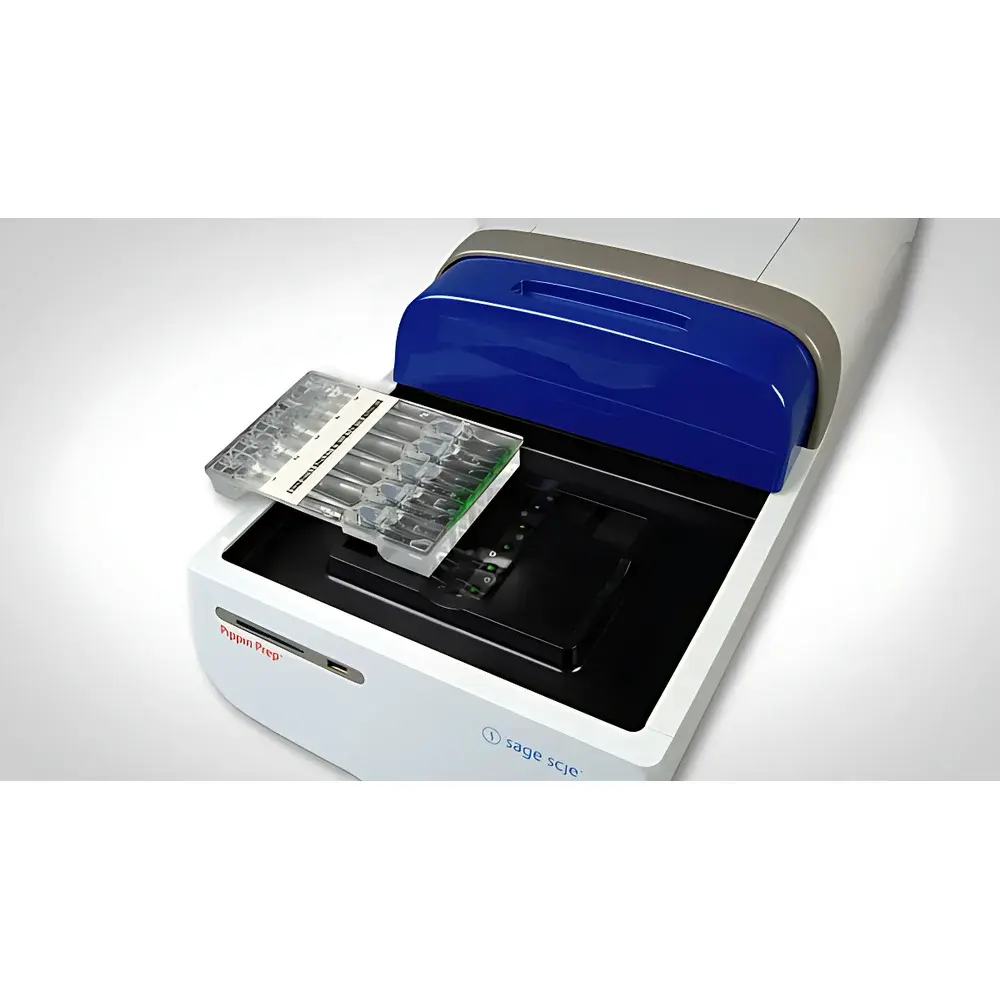
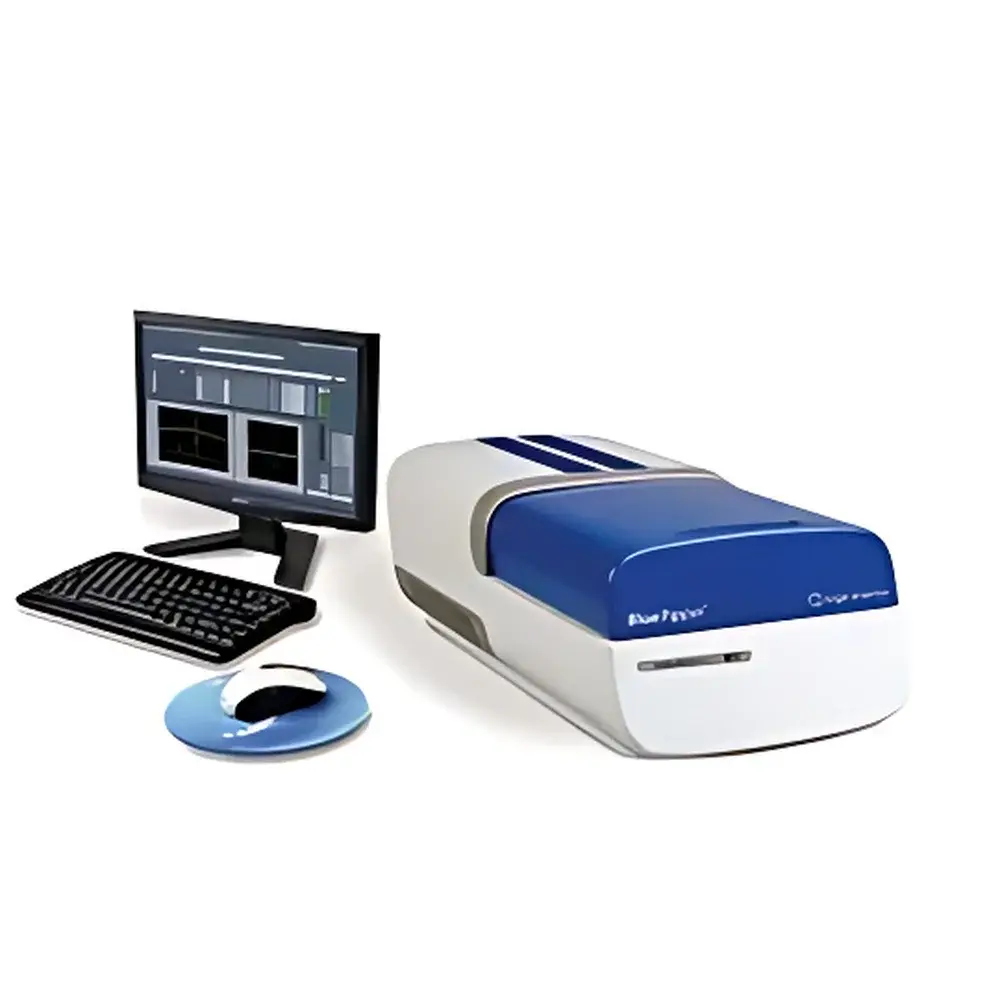
Sage Science Blue Pippin Automated Nucleic Acid Fragment Recovery System
| Brand | Sage Science |
|---|---|
| Origin | USA |
| Manufacturer Type | Authorized Distributor |
| Product Origin | Imported |
| Model | Blue Pippin |
| Instrument Type | Magnetic Bead-Free Electrophoretic Size Selection System |
| Automation Level | Dedicated Fully Automated |
| Batch Capacity | 1–5 samples |
| Sample Volume Range | 5 µL |
| Fragment Size Range | 50 bp – 50 kb |
| Recovery Efficiency | 50–80% |
| Detection Method | Real-Time Fluorescent DNA Detection (Non-UV) |
Overview
The Sage Science Blue Pippin Automated Nucleic Acid Fragment Recovery System is an electrophoretically driven, size-selective nucleic acid purification platform engineered for high-precision DNA and RNA fragment isolation without reliance on magnetic beads or manual gel excision. Unlike conventional agarose or polyacrylamide gel-based methods, the Blue Pippin employs a proprietary integrated microfluidic electrophoresis chamber with five parallel disposable pre-cast gel lanes and an in-line fluorescence detection module. Its core principle leverages real-time, non-UV fluorescent monitoring of migrating DNA fragments against a co-electrophoresed ladder standard—enabling dynamic, software-controlled electrode switching to divert target fragments into an elution channel at precisely determined migration times. This closed-system architecture eliminates UV-induced DNA damage, minimizes operator variability, and ensures reproducible recovery across the full 50 bp to 50 kb range—including challenging large-fragment and low-input applications common in long-read sequencing library preparation and structural variant analysis.
Key Features
- Dedicated fully automated operation with walk-away processing for 1–5 samples per run
- Disposable 5-lane pre-cast gel cassettes—no gel pouring, staining, or destaining required
- Real-time fluorescent DNA detection using safe blue-light excitation (no UV exposure or ethidium bromide)
- Dynamic electrode switching enables precise temporal gating of fragment elution—eliminating manual band excision
- Integrated size calibration via internal DNA ladder tracking for sub-100 bp resolution accuracy
- Optimized recovery of low-abundance, precious samples (e.g., cfDNA, ChIP-seq, single-cell libraries) with minimal loss
- Robust architecture compliant with laboratory environmental standards (CE, FCC, RoHS)
Sample Compatibility & Compliance
The Blue Pippin accommodates double-stranded DNA, single-stranded DNA, and denatured RNA across diverse input sources—including enzymatically sheared, sonicated, or enzymatically fragmented libraries. It supports post-ligation, post-PCR, and post-adapter ligation workflows without requiring cleanup prior to loading. The system is routinely validated for use in GLP- and GMP-aligned environments where traceability and process consistency are critical; its software logs all run parameters, detection timestamps, and elution events with user-defined metadata tagging. While not inherently 21 CFR Part 11–compliant out-of-the-box, audit-trail export functionality (CSV/JSON) and configurable user access controls enable integration into regulated workflows when deployed with validated IT infrastructure.
Software & Data Management
Controlled via the PippinHT Software Suite (v3.x), the Blue Pippin provides intuitive graphical interface for defining size ranges (inclusive lower/upper bounds), setting voltage gradients, and configuring elution buffer volumes. All runs generate timestamped .pippin files containing raw fluorescence traces, migration velocity calculations, ladder alignment metrics, and elution event logs. Export options include PDF run reports, tabular fragment distribution summaries, and machine-readable data for downstream bioinformatic integration (e.g., alignment QC, insert size distribution modeling). Software updates are delivered through secure authenticated channels and include version-controlled release notes aligned with ISO 13485 design history file requirements.
Applications
- Next-generation sequencing (NGS) library size selection—particularly for PacBio SMRT, Oxford Nanopore, and Illumina long-insert protocols
- Precise removal of adapter dimers and short fragments (<200 bp) in RNA-seq and small RNA workflows
- Recovery of large genomic fragments (>10 kb) for optical mapping and BAC library construction
- Size-fractionation of CRISPR editing products and transgene integration junctions
- Isolation of subpopulations from heterogeneous amplicon pools (e.g., tumor heterogeneity studies)
- Preparative purification prior to cloning, Sanger sequencing, or mass spectrometry-based nucleic acid characterization
FAQ
How does the Blue Pippin differ from magnetic bead-based size selection systems?
The Blue Pippin uses electrophoretic mobility as the sole separation mechanism—avoiding binding bias, over- or under-binding artifacts, and yield loss associated with bead surface chemistry and wash stringency. It delivers superior resolution for fragments differing by <5% in length.
Can the system recover RNA fragments?
Yes—when used with denaturing conditions (e.g., formaldehyde-containing gels or RNA-specific buffers), the Blue Pippin achieves reproducible recovery of RNA fragments from 100 nt to >10 kb.
What is the minimum input DNA required for reliable detection and recovery?
The system reliably detects and recovers fragments from inputs as low as 1 ng total DNA per lane, provided the target size fraction constitutes ≥5% of the total mass.
Are the gel cassettes compatible with downstream enzymatic reactions?
Eluted fragments are recovered in low-salt Tris-EDTA or custom buffers—fully compatible with end-repair, A-tailing, ligation, and PCR without desalting or cleanup.
Does the Blue Pippin support custom ladder integration?
No—the system requires use of Sage Science–validated fluorescent ladders calibrated for migration kinetics within the proprietary gel matrix; third-party ladders are not supported due to differential electroosmotic flow characteristics.



