
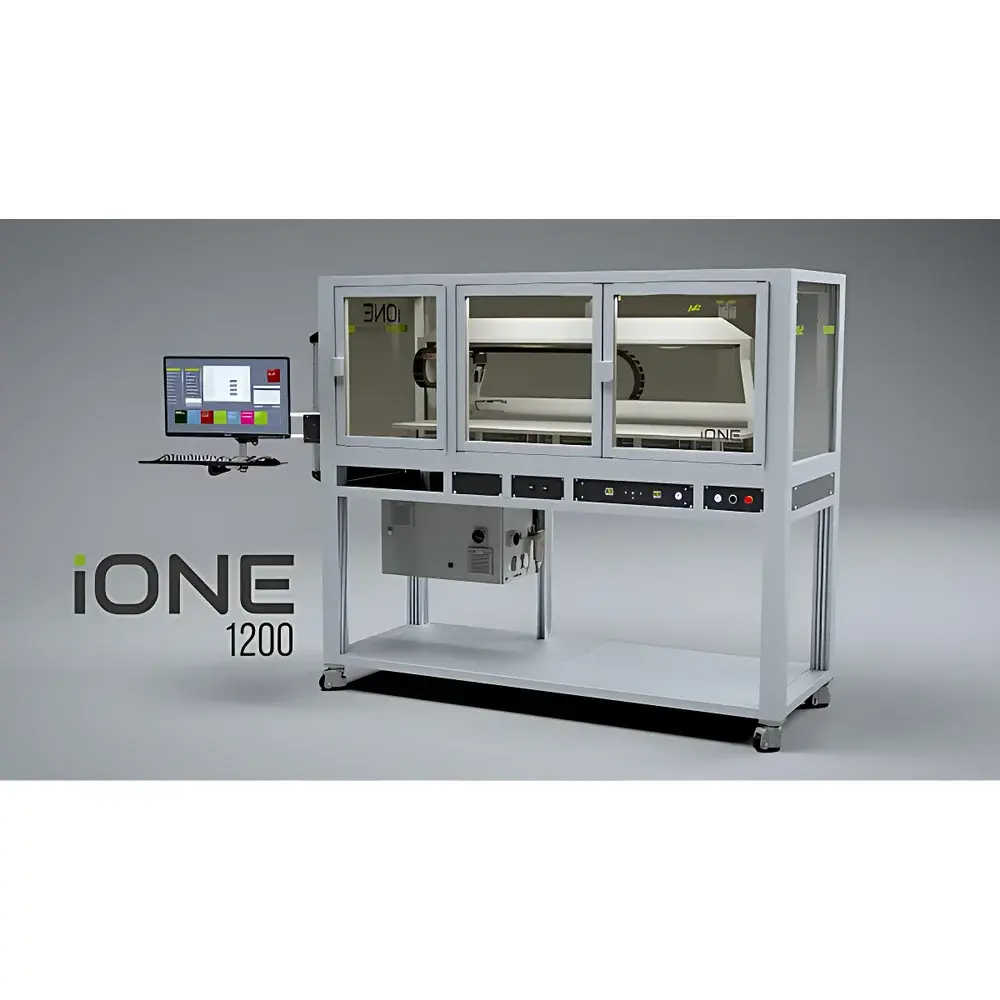
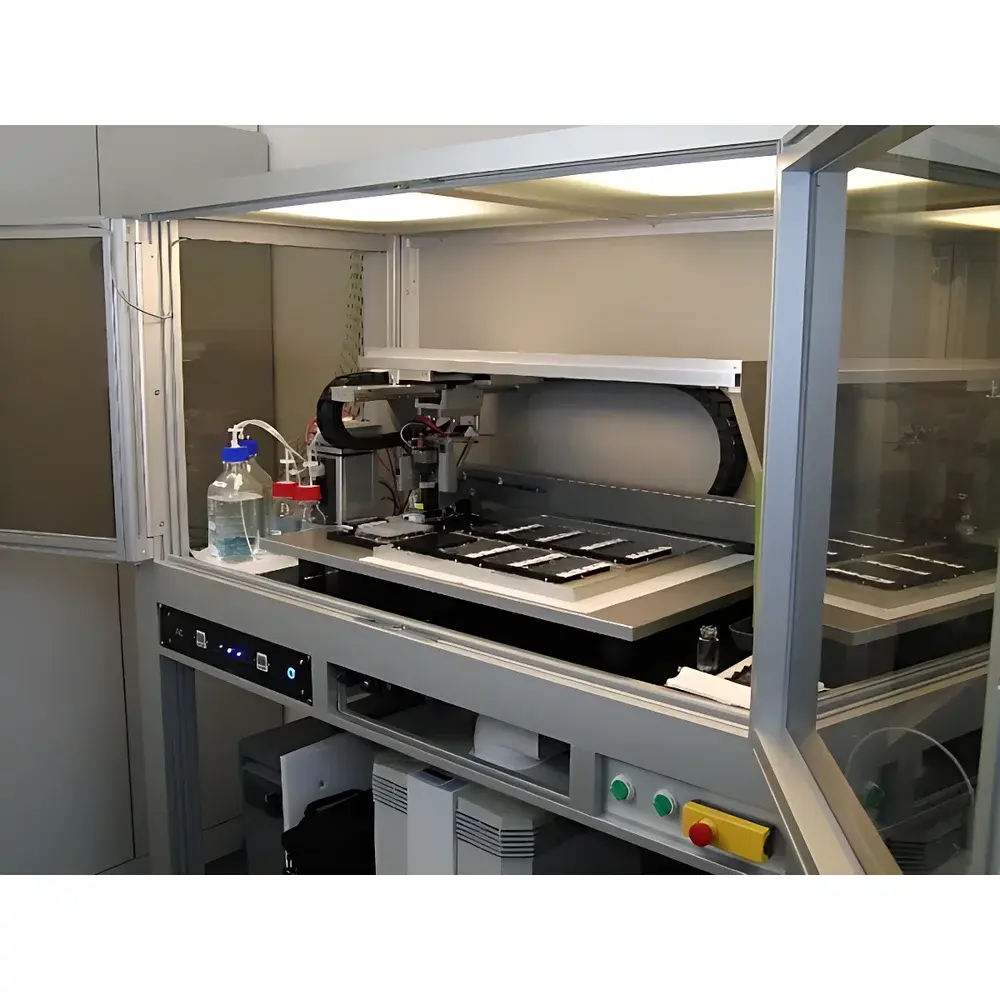
M24you iONE-600 Non-Contact Microarray Spotting Instrument
| Brand | M24you |
|---|---|
| Origin | Germany |
| Model | iONE-600 |
| Spotting Type | Non-contact piezoelectric dispensing |
| Maximum Spotting Rate | 1000 spots/s |
| Spot Volume Range | 30 pL to 1 µL |
| Spotting Precision (CV) | < 2% |
| Repeatability (Positional Accuracy) | ±3 µm |
| Maximum Stage Velocity | 100 cm/s |
| Substrate Capacity | Up to 80 standard microscope slides (75 × 25 mm) |
| Compatible Plates | 96-well, 384-well, 1536-well microplates, PCR tubes, and custom substrates |
| Dispensing Head Options | Piezoelectric (pL), M2MD (nL), solenoid valve, and multi-pin contact modules |
| Dual Onboard Vision Systems | Top-view substrate QC camera + in-line droplet imaging camera |
| Environmental Control | Optional humidity/temperature-regulated spotting chamber |
Overview
The M24you iONE-600 is a high-precision, non-contact microarray spotting instrument engineered for reproducible, low-volume biomolecular deposition onto diverse solid-phase substrates. It operates on the principle of piezoelectric-driven droplet ejection—where controlled voltage pulses deform a piezoceramic actuator to generate pressure waves within the fluid reservoir, enabling deterministic ejection of picoliter-scale droplets without physical contact between nozzle and substrate. This mechanism eliminates cross-contamination risks, preserves surface integrity of delicate substrates (e.g., functionalized glass, polymer films, or microfluidic channels), and supports ultra-low-volume applications such as single-cell RNA capture probe printing, antibody microarrays, and spatial transcriptomics slide preparation. Designed for integration into regulated life science workflows, the iONE-600 meets foundational requirements for GLP-compliant assay development and preclinical biomarker validation studies.
Key Features
- Non-contact piezoelectric dispensing platform with selectable head configurations: pL-range piezo nozzles, nL-range M2MD heads, solenoid valves, and multi-channel contact pins—enabling method flexibility across assay formats.
- Dual real-time vision systems: a top-mounted high-resolution camera monitors substrate alignment and surface defects; an inline droplet imaging module captures individual jetting events at >10,000 fps to verify drop formation, trajectory, and impact morphology—critical for statistical process control.
- Integrated pneumatic deaeration and inline filtration (0.22 µm) upstream of each dispensing channel, minimizing bubble-induced clogging and ensuring consistent volumetric delivery across extended run times.
- High-throughput stage architecture supporting up to 80 standard microscope slides (75 × 25 mm) per unattended batch, with bidirectional linear motor-driven motion achieving ≤ ±3 µm repeatability and peak velocities of 100 cm/s.
- Environmental enclosure option featuring independent temperature and relative humidity regulation (±0.5 °C, ±3% RH), essential for maintaining protein stability and preventing evaporation during prolonged spotting sequences.
Sample Compatibility & Compliance
The iONE-600 accommodates a broad spectrum of substrates—including silanized or epoxy-coated glass slides, nitrocellulose membranes, PDMS microfluidic chips, polycarbonate discs, and standard SBS-format microplates (96-, 384-, and 1536-well). Sample containers include PCR tubes, tube racks, and deep-well plates compatible with robotic liquid handler interfaces. All dispensing hardware complies with ISO 8573-1 Class 4 compressed air purity standards. The system supports audit-ready operation under FDA 21 CFR Part 11 when paired with optional electronic signature and event-log modules, and its mechanical design adheres to IEC 61000-6-2/6-4 EMC requirements for laboratory environments.
Software & Data Management
The proprietary SpotControl Suite provides a validated, intuitive interface for protocol definition, calibration management, and real-time monitoring. Users define spot patterns via drag-and-drop grid editors or import coordinates from CSV/Excel files. Software enforces version-controlled method templates, automatic calibration logging (including nozzle response profiling), and raw image archiving from both vision subsystems. Exported data includes per-spot metadata (X/Y/Z position, timestamp, droplet success/failure flag, environmental readings), structured in MIAME-compliant JSON format. Integration with LIMS platforms is supported via RESTful API and OPC UA connectivity.
Applications
- High-density nucleic acid microarrays for genotyping, methylation profiling, and miRNA screening.
- Antibody and recombinant protein arrays for multiplexed immunoassay development and epitope mapping.
- Printing of synthetic oligonucleotide libraries onto spatially addressable surfaces for in situ sequencing library construction.
- Deposition of cell lysates or exosome suspensions onto functionalized substrates for proximity extension assay (PEA) platforms.
- Preparation of quality-controlled reference slides for inter-laboratory validation studies under ISO/IEC 17043 proficiency testing frameworks.
FAQ
What minimum droplet volume can the iONE-600 reliably dispense?
The system achieves stable ejection down to 30 pL using calibrated piezoelectric nozzles under optimized buffer conditions (e.g., low-viscosity, surfactant-stabilized solutions). Volumetric accuracy is verified via gravimetric analysis per ISO 8655-7.
Does the instrument support GMP documentation requirements?
Yes—when configured with the optional Compliance Pack, it provides full electronic records, user access controls, change history tracking, and 21 CFR Part 11–compliant digital signatures.
Can the same instrument switch between contact and non-contact spotting modes?
Yes—the modular head mount allows rapid mechanical and software-based reconfiguration between piezo, M2MD, solenoid, and multi-pin contact dispensing modules without recalibration.
Is remote monitoring supported during unattended runs?
Real-time status dashboards, email/SNMP alerts for error conditions, and secure web-based access to live camera feeds and log files are available via the integrated Ethernet interface.
How is nozzle clogging mitigated during long-duration assays?
The dual-stage deaeration/filtration system, combined with automated periodic nozzle purging routines and solvent-compatible wet-wash cycles, reduces unplanned downtime to <0.5% of total operational time in validated production environments.





