
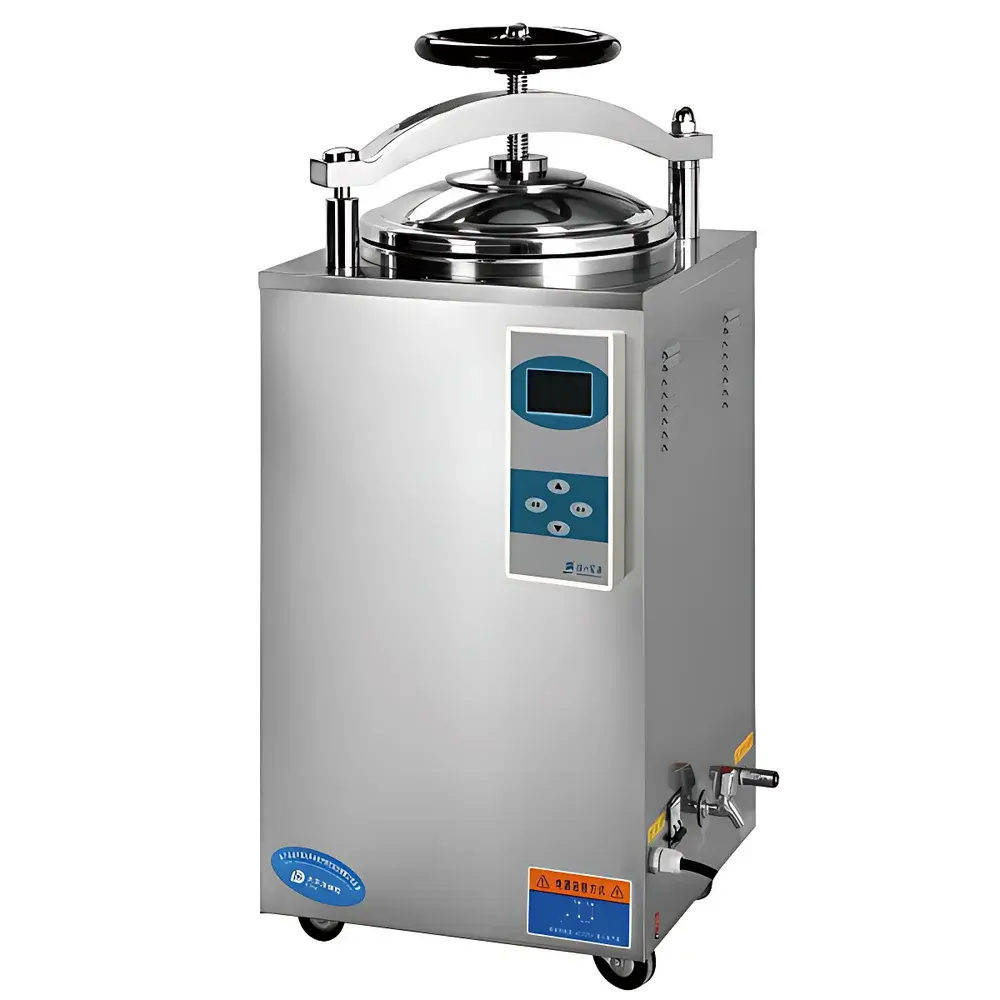
HePu LS-100HD Vertical Steam Autoclave
| Brand | HePu (Jihepu) |
|---|---|
| Origin | Shandong, China |
| Model | LS-100HD |
| Sterilization Chamber Volume | 100 L |
| Maximum Operating Temperature | 134 °C |
| Maximum Operating Pressure | 0.23 MPa |
| External Dimensions | 540 × 560 × 1250 mm |
| Power Rating | 4500 W |
| Voltage/Frequency | AC 220 V, 50 Hz |
| Temperature Uniformity | ≤ ±1 °C |
| Timer Range | 0–99 min |
| Safety Lock Activation Pressure | >0.027 MPa |
| Net Weight | 85 kg |
| Gross Weight | 110 kg |
Overview
The HePu LS-100HD Vertical Steam Autoclave is a fully automated, electrically heated sterilization system engineered for precision, safety, and regulatory compliance in laboratory, clinical, and research environments. It operates on the principle of saturated steam under controlled pressure and temperature—leveraging the well-established thermodynamic relationship between steam pressure and temperature to achieve microbial inactivation. At 134 °C and 0.23 MPa, the unit delivers validated sterilization cycles conforming to internationally recognized standards including ISO 17665-1 (Sterilization of health care products — Moist heat), EN 285 (Large sterilizers), and relevant clauses of USP and FDA 21 CFR Part 820. Designed as a vertical chamber autoclave with a 100 L effective sterilization volume, the LS-100HD supports routine sterilization of surgical instruments, textile dressings, glassware, culture media, and other heat-stable materials commonly processed in biomedical laboratories and healthcare facilities.
Key Features
- Intelligent LCD control panel with real-time display of chamber pressure, temperature, elapsed time, and cycle phase—enabling full visibility and traceability throughout each sterilization sequence.
- Pre-programmed cycle modes for instruments, dressings, and liquids, plus user-definable parameters for custom protocols (temperature setpoint: 105–134 °C; timer range: 0–99 minutes).
- Integrated air removal system ensuring complete displacement of ambient air prior to sterilization—critical for achieving uniform steam penetration and eliminating cold spots.
- Drying function post-sterilization to minimize condensation and support rapid instrument turnaround in high-throughput settings.
- Robust safety architecture including dual redundant protection: (1) mechanical full-lift safety valve calibrated to open automatically at ≥0.23 MPa; (2) electronic overpressure interlock preventing door opening when internal pressure exceeds 0.027 MPa.
- Comprehensive electrical safeguards: dry-run thermal cutoff, overcurrent protection, earth leakage detection, and automatic power disconnection upon cycle completion or fault detection.
- Chamber and jacket constructed from high-grade stainless steel (AISI 304 equivalent), offering corrosion resistance, ease of cleaning, and long-term structural integrity under repeated thermal cycling.
Sample Compatibility & Compliance
The LS-100HD accommodates standard sterilization loads including wrapped and unwrapped metal instruments, cotton gauze, rubber tubing, and liquid-filled containers (up to 500 mL per vessel). Its chamber geometry and steam distribution design ensure consistent thermal exposure across heterogeneous load configurations. The unit meets essential requirements for GLP-compliant laboratories and supports documentation readiness for internal quality audits. While not pre-certified to CE or UKCA, its functional architecture aligns with key elements of EN 61010-1 (Safety requirements for electrical equipment) and EN 61326-1 (EMC for laboratory use). Users are advised to perform installation qualification (IQ), operational qualification (OQ), and performance qualification (PQ) per institutional SOPs prior to routine operation.
Software & Data Management
The embedded microprocessor-based controller logs critical process variables—including start/stop timestamps, peak temperature, hold duration, and final pressure—with non-volatile memory retention. Cycle data can be reviewed locally via the LCD interface and exported manually using optional RS-232 or USB connectivity (hardware module sold separately). For regulated environments requiring audit trails, the system supports manual record-keeping compatible with 21 CFR Part 11 principles when paired with validated documentation practices. No cloud-based software or proprietary drivers are required—operation remains fully self-contained and offline-capable.
Applications
- Routine sterilization of reusable surgical tools and diagnostic equipment in hospital central sterile supply departments (CSSD).
- Preparation of microbiological growth media, buffers, and reagents in academic and industrial R&D labs.
- Decontamination of biohazardous waste (e.g., agar plates, pipette tips) prior to disposal in biosafety level 1 and 2 facilities.
- Validation studies supporting sterilization process development for medical device manufacturers operating under ISO 13485.
- Training environments where intuitive operation and visible feedback enhance student comprehension of moist-heat sterilization kinetics.
FAQ
What is the maximum recommended load volume for optimal sterilization efficacy?
For uniform steam penetration and validated lethality, the chamber should be loaded to no more than 80% of its 100 L capacity—approximately 80 L of porous or solid items, or 60 L when processing liquids.
Does the LS-100HD support gravity-displacement or pre-vacuum air removal?
It employs an integrated gravity-assisted air purge mechanism—relying on repeated steam flushes and natural convection—to evacuate ambient air before pressurization. This method is suitable for non-porous and moderately porous loads but not intended for wrapped lumened devices requiring vacuum-assisted cycles.
Is third-party validation support available?
HePu provides technical documentation (including electrical schematics, material certifications, and pressure vessel test reports) to facilitate IQ/OQ/PQ by qualified external vendors. On-site validation services are not offered directly by the manufacturer.
Can the unit operate continuously across multiple cycles without cooldown?
Yes—the robust cooling circuit and thermal management system allow sequential operation, though users must observe minimum 15-minute intervals between cycles when processing large liquid loads to prevent thermal stress accumulation.
What maintenance intervals are recommended for sustained performance?
Daily: Chamber wipe-down and drain filter inspection. Monthly: Safety valve functional test and door gasket integrity check. Annually: Full calibration of pressure transducer and temperature sensor against NIST-traceable references.



