
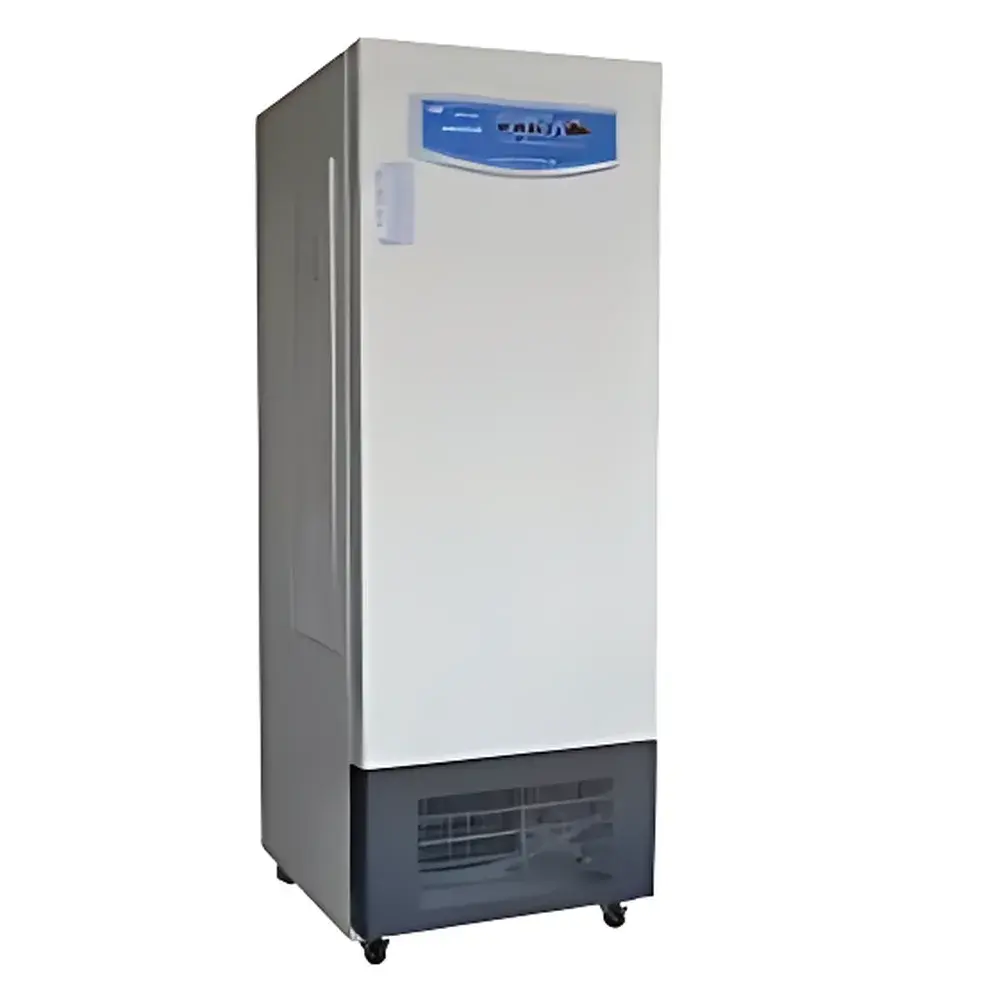
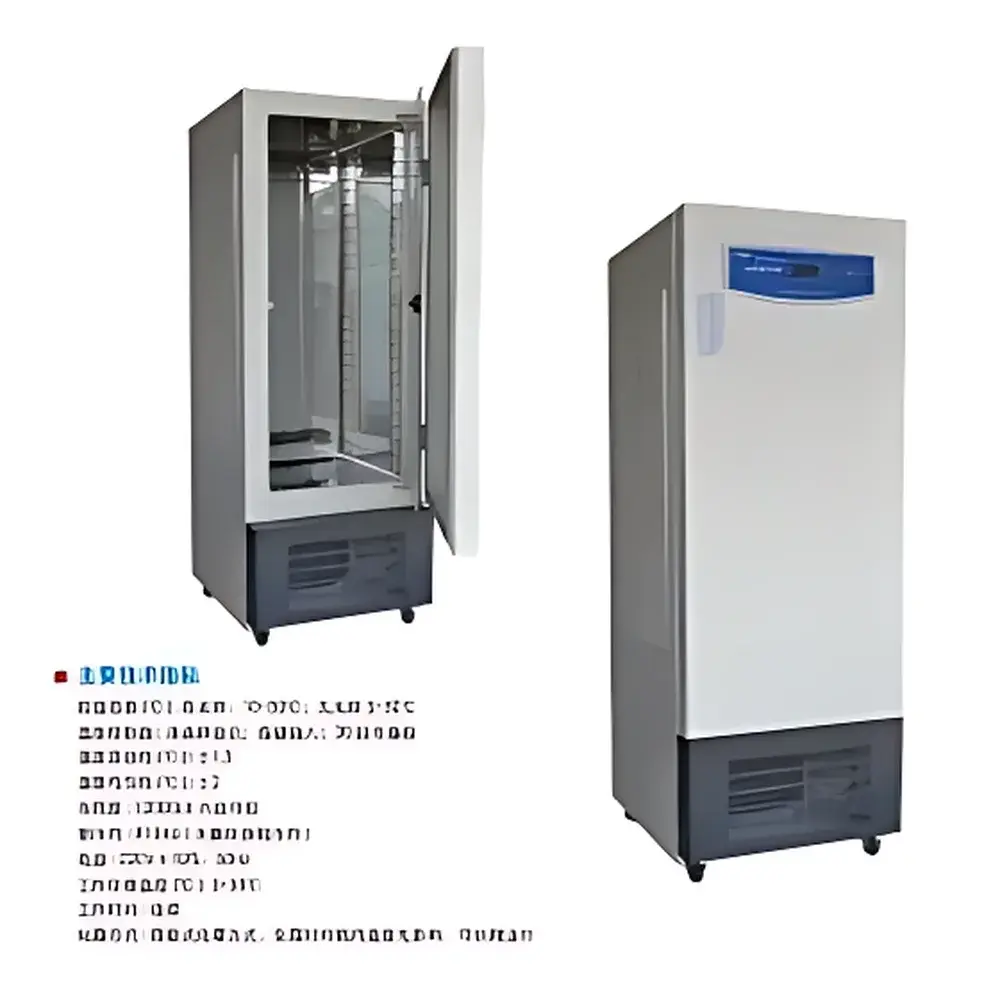
Jihepu SPX-150-GB Plant Growth Chamber with Programmable Temperature & 6-Level Adjustable Light
| Brand | Jihepu |
|---|---|
| Origin | Shandong, China |
| Model | SPX-150-GB |
| Temperature Range (with light) | 10–50°C |
| Temperature Range (dark) | 5–50°C |
| Temperature Uniformity | ±2°C |
| Temperature Fluctuation | ±1.5°C |
| Illuminance | 6000 lux (2-sided lighting) |
| Illuminance Control | 6-step adjustable |
| Refrigerant | R134a (CFC-free) |
| Power Supply | 220 V ±10%, 50 Hz |
| Rated Power | 1000 W |
| Working Volume | 150 L |
| Interior Dimensions (W×D×H) | 420 × 420 × 930 mm |
| Net Weight | 114 kg |
| Programmable Stages | 30 segments |
| Temperature Resolution | 0.1°C |
| Temperature Control Accuracy | ±0.1°C |
| Defrost Mode | Off-cycle defrost (GB model) |
| Safety Compliance | Over-temperature protection, compressor overload protection, sensor fault detection, auto power-off on critical fault |
Overview
The Jihepu SPX-150-GB Plant Growth Chamber is a precision-controlled environmental incubation system engineered for reproducible photobiological experimentation under tightly regulated temperature and illumination conditions. Designed around a dual-mode thermal architecture—capable of stable operation across both illuminated (10–50°C) and dark (5–50°C) regimes—the chamber employs a high-efficiency R134a refrigeration cycle combined with PID + Fuzzy logic temperature regulation to maintain thermal stability within ±0.1°C control accuracy and ±2°C spatial uniformity. Its core application domain spans plant physiology (germination, seedling development, photomorphogenesis), microbial culture under defined light spectra, BOD incubation per ASTM D5210, and controlled-environment studies in agricultural science, environmental toxicology, and pharmaceutical stability testing. The chamber’s stainless steel (SUS-304) interior, low-thermal-conductivity insulation (polyurethane foam + ultra-fine glass fiber), and double-glazed observation door ensure minimal radiant heat ingress from the 6000-lux fluorescent lighting array—enabling accurate light–temperature decoupling essential for GLP-compliant experimental design.
Key Features
- Microprocessor-based 30-segment programmable controller with English-language LCD interface, supporting ramp-soak profiles,预约 startup (date/time-scheduled activation), and deviation compensation calibration.
- Dual independent thermal control loops: P.I.D.-regulated electric heating (stainless steel tubular elements) and variable-load compressor cooling, each governed by DIN Class A PT100 sensors (Φ5 mm SUS-304 sheathed).
- 6-level adjustable illumination system using high-CRI fluorescent lamps mounted on two interior sidewalls; light intensity precisely modulated without altering spectral distribution or generating excess radiant heat.
- Forced-air convection via low-noise axial fans with arc-shaped horizontal airflow pattern—ensuring rapid thermal equilibration and minimizing vertical stratification.
- Robust mechanical construction: 304 stainless steel working chamber, SPCC cold-rolled steel exterior with electrostatic powder coating, heavy-duty locking casters (200 kg capacity per wheel), and adjustable stainless steel wire shelving (2 shelves, 20 kg load capacity, 50 mm vertical increment).
- Comprehensive safety architecture including over-temperature cutoff, compressor high-pressure/overheat protection, heater overcurrent sensing, sensor open-circuit/short-circuit detection, and audible alarm with automatic shutdown on critical fault.
Sample Compatibility & Compliance
The SPX-150-GB accommodates standard microbiological Petri dishes, multi-well plates, Erlenmeyer flasks (up to 1 L), hydroponic trays, and small potted plants (max height 850 mm). Its ISO 14644-1 Class 8-compatible interior finish supports routine cleaning with ethanol or 70% isopropanol without surface degradation. While not certified to IEC 61000-4 electromagnetic immunity standards, the unit meets CE marking requirements for electrical safety (EN 61010-1) and incorporates RS485 serial communication (1.2 km max distance) for integration into centralized lab monitoring systems compliant with FDA 21 CFR Part 11 data integrity protocols when paired with validated third-party software. It satisfies operational prerequisites for ASTM E1823 (BOD incubation), ISO 20387 (biobanking environmental controls), and OECD 208 (terrestrial plant toxicity testing) when operated within specified ambient conditions (15–30°C ambient, 40–80% RH non-condensing).
Software & Data Management
The embedded controller logs all operational parameters—including setpoint history, actual chamber temperature, illumination level, compressor duty cycle, and fault events—with timestamped records retained for up to 10 years post-power-loss (non-volatile memory). Data export is supported via RS485 to PC-based SCADA platforms (e.g., LabVIEW, Ignition) using Modbus RTU protocol. Audit trail functionality includes user login tracking, parameter change logging, and electronic signature-capable event annotation—enabling alignment with GLP/GMP documentation workflows. Firmware updates are performed via USB interface using manufacturer-validated binaries; no cloud connectivity or remote access capabilities are implemented, preserving data sovereignty and network security.
Applications
- Plant science: Photoperiod-controlled germination assays, shade-avoidance response studies, circadian rhythm entrainment, and stress physiology (e.g., heat/drought/light intensity gradients).
- Environmental microbiology: BOD5 determination per Standard Methods 5210B, nitrification inhibition screening, and algal growth rate quantification under variable PAR conditions.
- Pharmaceutical QA/QC: Stability testing of light-sensitive APIs per ICH Q1B, accelerated aging of solid dosage forms, and excipient compatibility studies.
- Agricultural biotechnology: Tissue culture initiation, callus induction, and transgenic line phenotyping under standardized photothermal regimes.
- Ecotoxicology: OECD 208 and EPA OPPTS 850.4400-compliant terrestrial plant bioassays using lettuce, mustard, or oat as test species.
FAQ
What is the maximum sample height accommodated inside the chamber?
The internal height is 930 mm; with two adjustable shelves, the maximum unobstructed vertical clearance between shelves is 830 mm. For tall specimens, the lower shelf may be removed to utilize full height.
Does the chamber support humidity control?
No—this is a temperature- and light-regulated growth chamber only. Humidity is not actively controlled or monitored; ambient lab RH (40–80%) is recommended for stable operation.
Can the lighting spectrum be customized?
The standard configuration uses broad-spectrum cool-white fluorescent tubes (CCT ≈ 6500 K). Custom narrow-band LED arrays (e.g., 450 nm blue, 660 nm red) are available as OEM options but require factory modification and recalibration.
Is validation documentation provided with the unit?
A Factory Acceptance Test (FAT) report is included, covering temperature mapping (9-point grid), illuminance uniformity verification, and safety circuit functional checks. IQ/OQ protocols are available upon request for GxP environments.
What maintenance intervals are recommended?
Compressor oil and refrigerant charge require inspection every 24 months; evaporator coil cleaning every 6 months in high-dust environments; door gasket integrity check quarterly; and PT100 sensor calibration annually using NIST-traceable dry-block calibrators.



