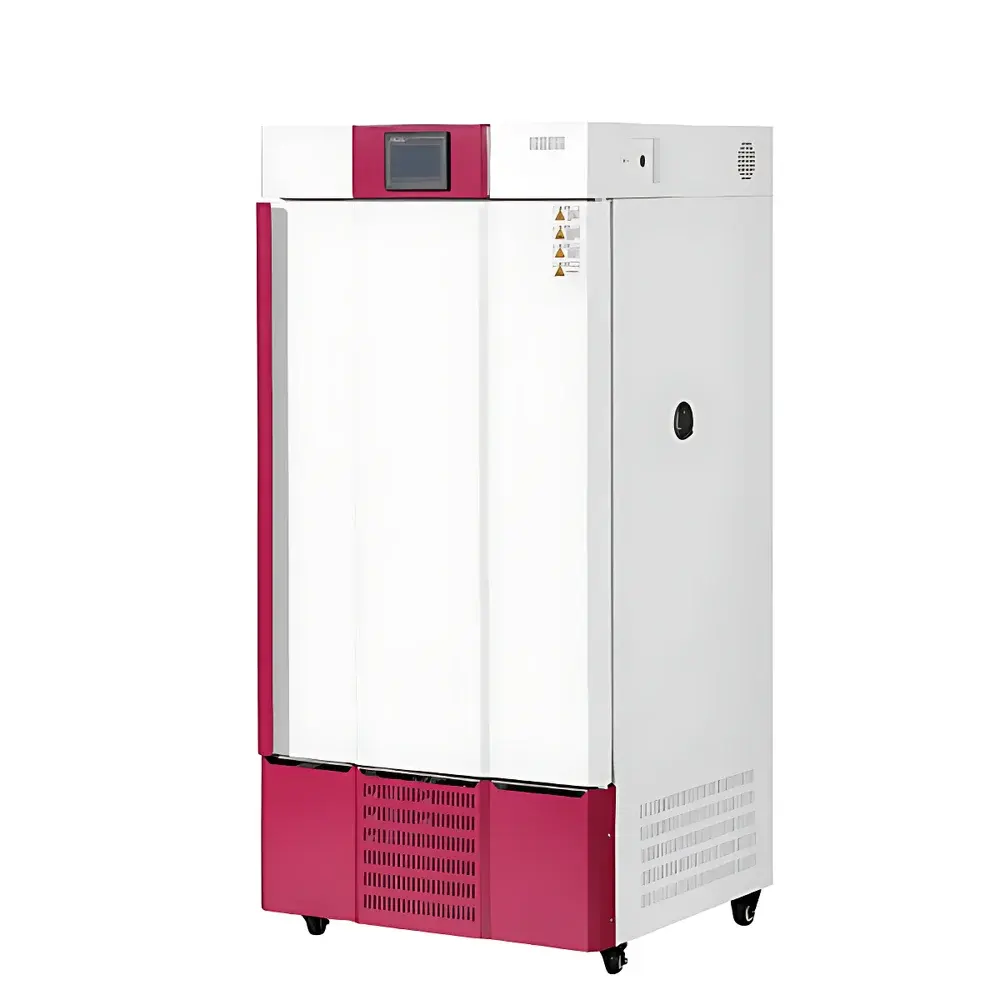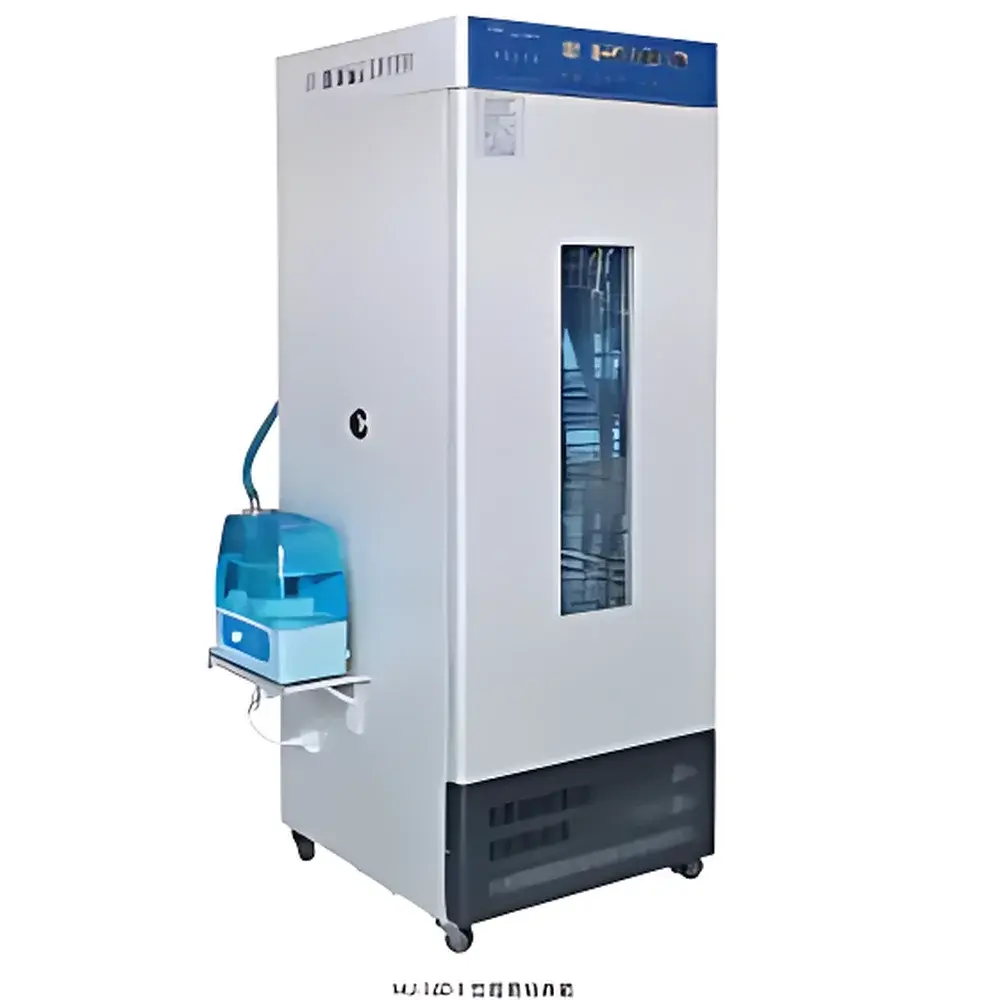
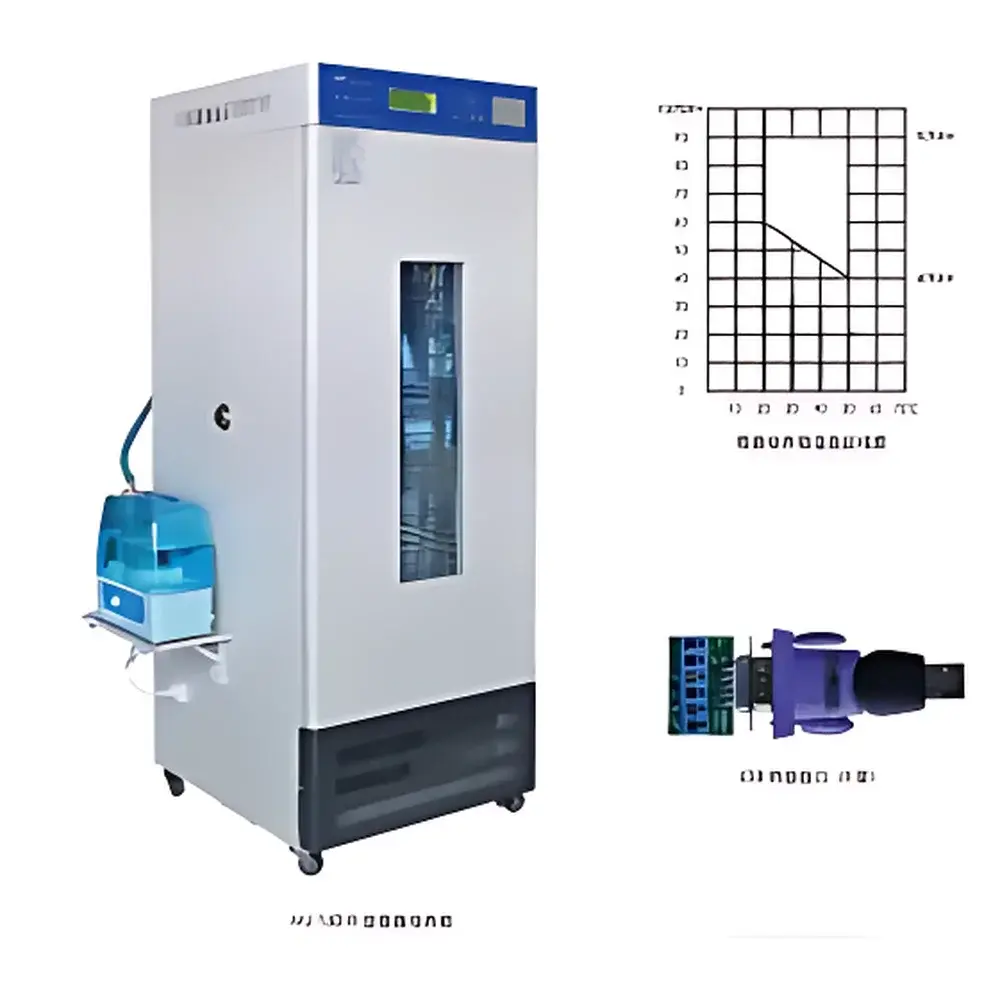
HePu MJ-160 Mold Incubator
| Brand | HePu |
|---|---|
| Origin | Shandong, China |
| Model | MJ-160 |
| Capacity | 150 L |
| Temperature Range | 5–50 °C (Standard), 0–50 °C (MJ-II/MJ-III) |
| Temperature Uniformity | ±2 °C (Standard), ±1 °C (MJ-II/MJ-III) |
| Humidity Range | 50–90 %RH (temperature-dependent, operational only above 10 °C for MJ-II/MJ-III) |
| Humidity Fluctuation | ±(5–8) %RH |
| Heating/Cooling Control | PID + Fuzzy logic algorithm |
| Display | Dual LED (MJ-I), large LCD menu-driven interface (MJ-III) |
| Communication | RS485 (up to 1.2 km), optional USB/RS485 converter or built-in thermal printer |
| Power Supply | 220 V ±10%, 50 Hz |
| Rated Power | 250 W / 300 W (MJ-II/MJ-III) |
| Refrigerant | R134a (CFC-free) |
| Internal Material | SUS-304 mirror-finish stainless steel |
| External Material | SPCC cold-rolled steel with electrostatic powder coating |
| Insulation | High-density polyurethane foam + ultra-fine glass fiber |
| Air Circulation | Horizontal forced-air convection via axial fan |
| Safety Protections | Over-temperature, over-humidity, compressor overload, water-level, phase-loss, and short-circuit protection |
| Compliance | Designed per IEC 61000-6-3 (EMI), IEC 61000-6-2 (EMS) |
Overview
The HePu MJ-160 Mold Incubator is a precision-engineered environmental chamber designed specifically for controlled mycological cultivation, fungal isolation, and spore germination studies in regulated laboratory settings. It operates on the principle of active thermohygrometric regulation—integrating refrigeration, resistive heating, ultrasonic humidification, and forced-air convection to maintain stable, reproducible conditions within the working chamber. Unlike general-purpose incubators, the MJ-160 series incorporates mold-specific design considerations: enhanced condensation management, minimized internal moisture gradients, and non-corrosive chamber architecture compatible with prolonged exposure to high relative humidity (50–90 %RH) at elevated temperatures. Its temperature range (0–50 °C, depending on configuration) and tight uniformity (±1 °C in MJ-II/MJ-III variants) meet the requirements of ISO 11133:2014 for microbiological culture media performance testing and ASTM D3273 for mold resistance evaluation. The unit is intended for continuous operation under GLP and ISO/IEC 17025-aligned quality systems, supporting traceable environmental monitoring in pharmaceutical QC, agrochemical R&D, and environmental microbiology labs.
Key Features
- Triple-layer insulation system combining high-density polyurethane foam and ultra-fine glass fiber for low thermal leakage and energy-efficient operation.
- SUS-304 mirror-finish stainless steel interior with removable, load-rated (15 kg per shelf) adjustable shelving—facilitating cleaning validation and residue-free decontamination between runs.
- Forced horizontal airflow via low-noise axial fan ensures uniform distribution of temperature and humidity, minimizing stratification—critical for consistent hyphal growth across sample zones.
- Dual-stage safety architecture: hardware-based thermal cutoffs (independent of controller) plus software-monitored fault detection (e.g., sensor open-circuit, compressor lockout, low-water alarm).
- Programmable multi-segment control: up to 30 user-defined segments, each configurable for duration (0–9999 min/h), target temperature, and target RH—enabling simulation of diurnal cycles or stress-acclimation protocols.
- Controller-level data integrity: real-time logging with timestamped temperature/humidity values; optional thermal printer or RS485-to-PC integration for CSV export and audit-ready record retention.
- Magnetic door seal with dual-glazed observation window (tempered inner glass + outer acrylic) maintains chamber integrity while enabling non-invasive visual monitoring without thermal disturbance.
Sample Compatibility & Compliance
The MJ-160 accommodates standard Petri dishes (90 mm and 150 mm), slant tubes, agar plates, and multi-well microtiter formats without spatial interference. Its 150 L usable volume (45 × 42 × 85 cm internal dimensions) permits simultaneous incubation of ≥48 standard Petri dishes per shelf. Chamber geometry and airflow path are optimized to avoid localized desiccation or condensation pooling—key failure modes in filamentous fungus culture. The unit complies with electromagnetic compatibility standards IEC 61000-6-2 (immunity) and IEC 61000-6-3 (emissions), and its control firmware implements fail-safe logic aligned with IEC 62304 Class B software safety requirements. When paired with validated third-party data acquisition software, it supports 21 CFR Part 11 compliance through electronic signature capability, audit trail generation, and role-based access control.
Software & Data Management
The MJ-II and MJ-III models feature embedded microcontroller firmware with PID + Fuzzy logic control algorithms—enabling rapid setpoint recovery (<15 min from 25 °C to 30 °C at 70 %RH) and minimal overshoot (<0.3 °C). Temperature and humidity sensors are DIN Class A PT100 (Φ5 mm stainless sheath) and capacitive polymer RH sensors, respectively, calibrated per ISO/IEC 17025 traceable procedures. All operational parameters—including setpoints, actual readings, alarms, and power state—are logged internally with 10-year non-volatile memory retention. RS485 Modbus RTU protocol enables bidirectional communication with LabVIEW, MATLAB, or custom SCADA platforms. Optional USB/RS485 converters support direct connection to Windows/Linux workstations for automated report generation, trend analysis, and integration into LIMS environments.
Applications
- Pharmaceutical stability testing of excipients and APIs under high-humidity stress (ICH Q1A–Q1E)
- Fungal identification and susceptibility profiling per CLSI M38-A3 guidelines
- Mold resistance assessment of building materials (ASTM D3273, ISO 846)
- Environmental monitoring of indoor air quality (IAQ) and bioaerosol source tracking
- Agrobiotech research on plant-pathogenic fungi (e.g., Aspergillus, Penicillium, Cladosporium) under controlled abiotic stress
- Validation of sterilization efficacy for HEPA-filtered laminar flow hoods using biological indicators
FAQ
What is the minimum operating temperature for humidity control?
Humidity regulation is only active when chamber temperature exceeds 10 °C—this prevents condensation-induced sensor drift and ensures stable RH feedback loop operation.
Can the MJ-160 be used for bacterial culture?
Yes—though optimized for mold, its temperature range, sterility features (UV lamp, stainless interior), and programmable profiles support aerobic and facultative anaerobic bacterial growth, including E. coli, Staphylococcus aureus, and Bacillus subtilis.
Is the RS485 interface compatible with common lab data loggers?
Yes—the Modbus RTU implementation conforms to standard register mapping (holding registers 40001–40050), enabling plug-and-play integration with Campbell Scientific, Omega, and Keysight data acquisition systems.
How often does the ultrasonic humidifier require maintenance?
Under typical use (70 %RH, 25 °C), descaling every 3–6 months is recommended; distilled or deionized water is required to prevent mineral buildup and extend transducer life.
Does the unit support remote monitoring via Ethernet or Wi-Fi?
No native Ethernet/Wi-Fi module is included; however, third-party RS485-to-Ethernet gateways (e.g., Moxa EDS-205A) can be deployed to enable TCP/IP-based supervision in networked lab infrastructures.
Related Products