
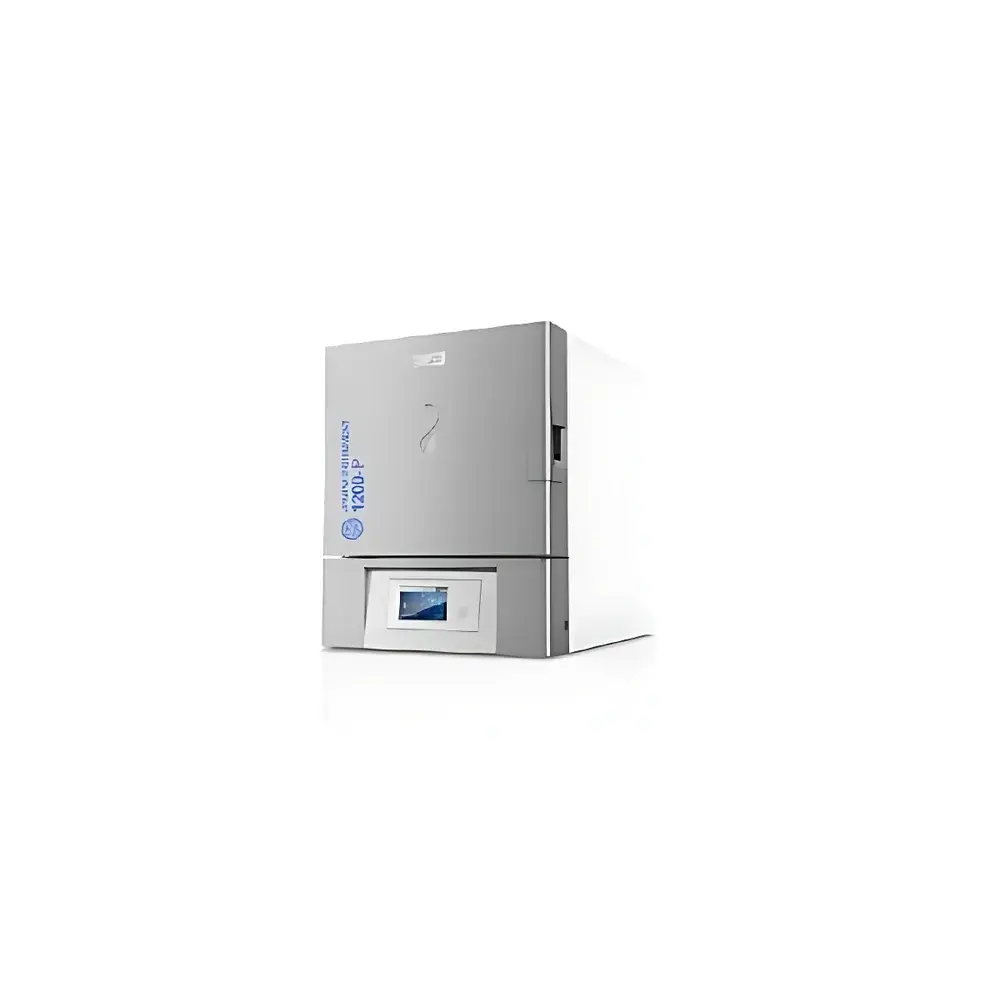
Hepu SX2-12-12GDP Benchtop Box-Type Resistance Furnace (Muffle Furnace), 1200 °C Maximum Temperature
| Brand | Hepu (Jinan Hepu) |
|---|---|
| Origin | Shandong, China |
| Model | SX2-12-12GDP |
| Internal Chamber Dimensions | 500 × 300 × 200 mm (30 L) |
| Maximum Operating Temperature | 1100 °C |
| Design Temperature Limit | 1200 °C |
| Temperature Control Accuracy | ±1 °C |
| Heating Rate | Up to 15 °C/min |
| Temperature Sensor Type | Dual K-type thermocouples |
| Power Supply | AC 220 V / 50 Hz or AC 380 V / 50 Hz (configurable) |
| Rated Heating Power | 12 kW |
| Control Interface | 5-inch color touchscreen with bilingual (English/Chinese) OS |
| Programmable Ramp Profiles | 1–40 segments |
| Heating Modes | Single-point setpoint mode & multi-segment programmable ramp mode |
| Safety Features | Automatic power cutoff upon door opening, dual-door structure, high-temp 304 stainless steel furnace mouth, observation window |
| Chamber Lining Material | Alumina (Al₂O₃) refractory ceramic |
Overview
The Hepu SX2-12-12GDP is a benchtop box-type resistance furnace engineered for precision thermal processing in research laboratories, quality control environments, and materials development facilities. Operating on resistive heating principles—where electrical current passes through high-resistivity alloy heating elements embedded in a thermally insulated chamber—the furnace delivers stable, uniform temperature distribution across its 30 L alumina-lined cavity. Designed for continuous operation up to 1100 °C (with a safety-rated design limit of 1200 °C), it meets fundamental requirements for ashing, calcination, sintering, annealing, and thermal decomposition studies. Its robust mechanical architecture—including a dual-door system, integrated observation window, and automatic cut-off circuitry—ensures operator safety and process repeatability under routine laboratory conditions. The furnace conforms to general-purpose industrial electrical safety standards (IEC 61000-6-3, IEC 61000-6-4) and supports traceable thermal validation when paired with external calibrated thermocouples and data loggers.
Key Features
- Dual-door configuration with inner ceramic fiber seal and outer stainless-steel barrier minimizes heat loss and improves thermal efficiency during extended dwell cycles.
- Automatic power interruption upon furnace door opening—a hardware-level interlock compliant with EN 61000-6-2 electromagnetic immunity requirements.
- Two independently positioned K-type thermocouples enable cross-verification of chamber temperature and support spatial uniformity mapping per ASTM E220 or ISO/IEC 17025 calibration protocols.
- 5-inch full-color touchscreen interface with real-time graphical display of ramp-hold profiles; firmware supports English/Chinese language switching without reboot.
- Programmable thermal sequences: up to 40 discrete ramp/soak segments with adjustable rate limits, dwell durations, and end-of-cycle actions (e.g., natural cool-down or forced ventilation trigger).
- Recovery function maintains program integrity after unexpected power interruption—resuming from the last executed segment with time compensation.
- Furnace mouth and observation window frame fabricated from 304 stainless steel to resist oxidation and mechanical deformation at elevated temperatures.
Sample Compatibility & Compliance
The SX2-12-12GDP accommodates standard crucibles (alumina, quartz, silicon carbide), ceramic boats, and metal trays within its 500 × 300 × 200 mm working volume. It is suitable for non-volatile inorganic samples, metal oxide precursors, catalyst supports, and geological specimens requiring inert-atmosphere-compatible thermal treatment. While the furnace itself does not include gas purge capability, optional flange-mounted inlet/outlet ports can be retrofitted for nitrogen or argon blanketing. The unit complies with CE marking directives for low-voltage equipment (LVD 2014/35/EU) and electromagnetic compatibility (EMC 2014/30/EU). For GLP/GMP-regulated workflows, users may integrate external audit-trail-capable data acquisition systems that record timestamped temperature logs meeting FDA 21 CFR Part 11 requirements.
Software & Data Management
No proprietary PC software is bundled; however, the furnace’s RS485 serial port (Modbus RTU protocol) enables integration with third-party SCADA platforms (e.g., LabVIEW, Ignition, or custom Python-based controllers) for remote monitoring and automated batch reporting. All ramp programs are stored internally with non-volatile memory retention (>10 years at 25 °C). The touchscreen interface logs operational history—including start/stop timestamps, peak temperature achieved, and fault codes—for internal review. User-defined program names (up to 12 characters) and parameter annotations facilitate method identification across shared lab environments.
Applications
- Thermal gravimetric analysis (TGA) sample pre-conditioning and residue quantification.
- Sintering of ceramic green bodies and powder metallurgy compacts.
- Ash content determination per AOAC 942.05, ASTM D3174, or ISO 1171.
- Heat treatment of tool steels and aluminum alloys in metallurgical R&D.
- Decomposition kinetics studies of battery cathode materials (e.g., LiCoO₂, NMC).
- Pre-firing of sensor substrates and MEMS packaging components.
FAQ
Does this furnace support inert or reducing atmospheres?
The base model operates in ambient air; optional gas inlet/outlet fittings (sold separately) allow connection to regulated nitrogen or argon supply lines for controlled-atmosphere processing.
What is the typical temperature uniformity across the chamber at 1000 °C?
Measured uniformity is ±8 °C within the central 60% volume (per internal verification using 9-point thermocouple mapping); actual performance depends on load geometry and placement.
Can I export temperature profiles to CSV format?
Direct USB export is not supported; however, Modbus-enabled data loggers (e.g., Omega OM-DAQPRO-5300) can capture and export time-stamped temperature sequences in CSV or Excel-compatible formats.
Is calibration documentation included with shipment?
A factory-assembled temperature verification report (at 500 °C, 800 °C, and 1000 °C) is provided; full ISO/IEC 17025-accredited calibration requires engagement with an accredited third-party lab.
What maintenance intervals are recommended for long-term reliability?
Inspect heating element continuity and insulation resistance annually; replace ceramic fiber door gaskets every 2–3 years under daily use; clean interior chamber surfaces after each high-ash-content run to prevent residue buildup.



