
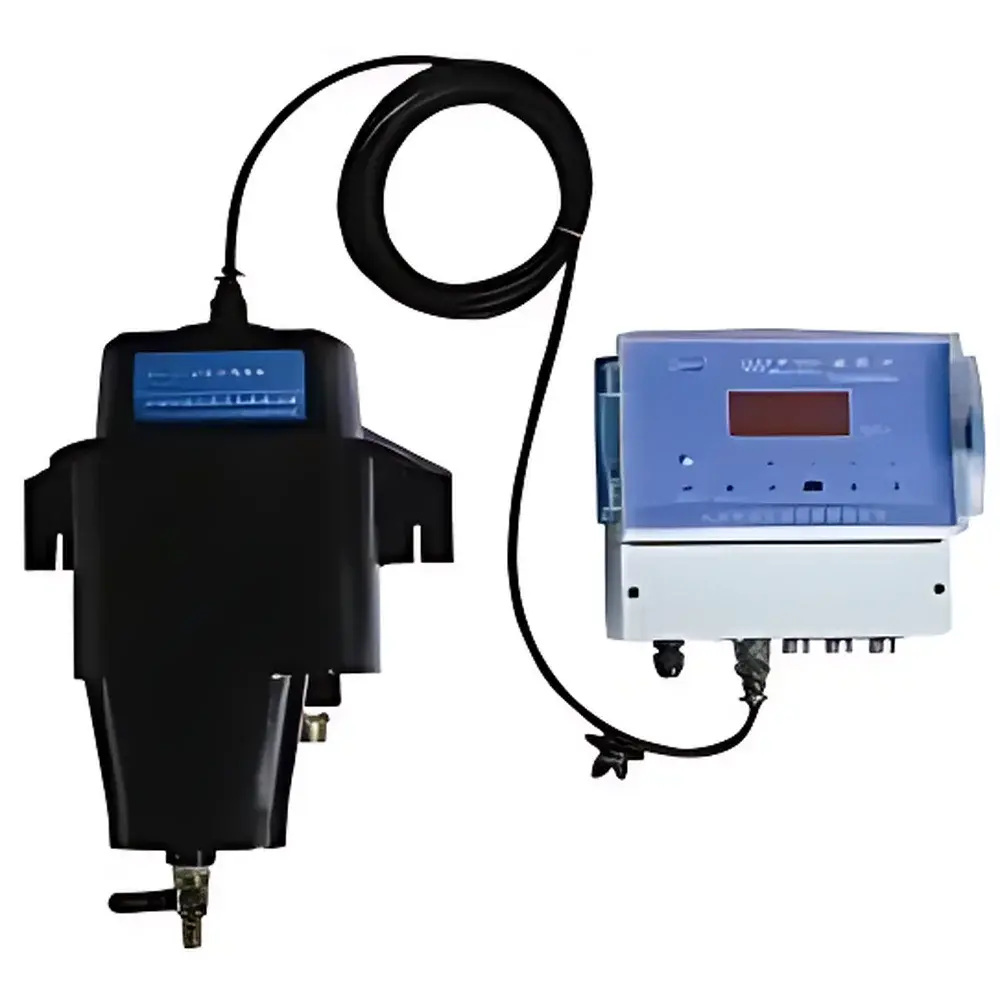
HePu WGZ-1C / WGZ-2C / WGZ-3C / WGZ-200C Online Turbidimeter
| Brand | HePu |
|---|---|
| Origin | Shandong, China |
| Model Series | WGZ-1C, WGZ-2C, WGZ-3C, WGZ-200C |
| Minimum Display Resolution | 0.001 NTU (WGZ-3C) / 0.01 NTU (WGZ-1C, WGZ-2C, WGZ-200C) |
| Measurement Range | 0–20 NTU (WGZ-1C), 0–200 NTU (WGZ-2C, WGZ-3C, WGZ-200C), 0–2000 NTU (WGZ-200C dual-channel) |
| Linearity Error | ±2% F.S. |
| Sample Flow Rate | 400–1000 mL/min |
| Inlet Pressure | 0.05–0.2 MPa |
| Operating Temperature | 4–40 °C |
| Output Signal | 4–20 mA (optional 0–10 mA), max. load 500 Ω |
| Housing | ABS plastic, wall-mounted split-type design |
| Key Features | Online continuous measurement, integrated flow stabilizer & de-foaming unit, high-intensity long-life light source, automatic range switching, upper/lower limit alarm (audible & visual), built-in self-diagnostic function, color compensation algorithm, real-time turbidity display |
Overview
The HePu WGZ-1C, WGZ-2C, WGZ-3C, and WGZ-200C series are industrial-grade online turbidimeters engineered for continuous, real-time monitoring of suspended particulate matter in transparent liquids—primarily water-based process streams. These instruments operate on the principle of 90° scattered light detection (nephelometry), compliant with ISO 7027 and EPA Method 180.1, where incident light from a stable infrared or tungsten-halogen source interacts with suspended particles, generating scattered photons measured by a precision photodetector. The optical path is optimized for minimal chromatic interference, incorporating active color compensation to mitigate spectral bias caused by yellowish or brownish dissolved organic matter—critical for accurate NTU reporting across diverse sample matrices. Designed for unattended operation in demanding utility and regulated environments, each model supports true online integration via pressure-driven flow-through sampling, eliminating manual grab sampling and associated variability.
Key Features
- Robust split-body architecture: ABS plastic sensor head and remote display unit enable flexible installation in confined or hazardous zones (IP65-rated enclosure)
- Integrated flow stabilization and mechanical de-foaming system ensures bubble-free optical measurement—eliminating false high readings common in aerated effluents or recirculated cooling water
- High-stability light source with >50,000-hour service life minimizes calibration drift and maintenance intervals
- Automatic range switching across multiple decades (e.g., WGZ-200C dual-channel supports seamless transition between 0–200 NTU and 0–2000 NTU ranges)
- Built-in self-test diagnostics monitor LED intensity, detector responsivity, and signal-to-noise ratio; alerts trigger on parameter deviation beyond preset thresholds
- Real-time analog output (4–20 mA, isolated, HART-compatible) with configurable damping and linearization per user-defined span
- Local alarm outputs (relay contacts) for programmable high/low turbidity thresholds, supporting fail-safe interlocks in treatment control logic
Sample Compatibility & Compliance
The WGZ series accommodates a broad spectrum of aqueous media—including potable water, filtered surface water, membrane filtrate, activated sludge supernatant, pharmaceutical rinse water, and beverage process streams—provided samples remain optically transparent with no significant absorbance at the operating wavelength (typically 860 nm). The system complies with key regulatory frameworks governing water quality instrumentation: ISO 7027:2016 (optical properties of turbidimeters), ASTM D6508 (standard practice for online turbidity measurement), and US EPA Guidance for Continuous Monitoring of Turbidity in Drinking Water Treatment. While not intrinsically certified for Class I Div 1 hazardous locations, its low-voltage design and non-sparking housing meet general-purpose industrial safety requirements (IEC 61000-6-2/6-4 EMI immunity). Data integrity aligns with GLP principles through timestamped event logging and non-volatile memory retention of calibration history.
Software & Data Management
Though primarily hardware-driven for embedded reliability, the WGZ platform supports integration into centralized SCADA and DCS architectures via standard 4–20 mA loops. Optional RS-485 Modbus RTU interface (available on WGZ-200C variants) enables bidirectional communication for remote configuration, firmware updates, and retrieval of diagnostic registers—including raw ADC counts, temperature-compensated gain values, and alarm status flags. All units store ≥1000 chronological turbidity records with UTC timestamps in internal flash memory. When interfaced with third-party historian systems (e.g., Ignition, Siemens Desigo CC), data conforms to ISA-95 Level 2 operational metrics, supporting trend analysis, SPC charting, and audit-ready reporting for FDA 21 CFR Part 11–aligned validation protocols.
Applications
- Drinking water treatment: Real-time monitoring at rapid sand filter effluent, clearwell outlet, and distribution system entry points to verify compliance with WHO and national turbidity limits (<0.1 NTU)
- Wastewater management: Secondary clarifier overflow surveillance, membrane bioreactor (MBR) permeate QC, and disinfection pre-check prior to UV/chlorine dosing
- Pharmaceutical manufacturing: Monitoring of purified water (PW) and water for injection (WFI) loop returns per USP and EU GMP Annex 1 requirements
- Food & beverage production: CIP rinse water verification, bottle/can rinser effluent control, and syrup dilution consistency checks
- Power generation: Condensate polishing system integrity verification and boiler feedwater purity assurance
FAQ
What calibration standards are recommended for routine verification?
Formazin-based primary standards (e.g., 0.1, 10, 100, 400 NTU) traceable to NIST SRM 2134 are required for initial setup and periodic verification. Polymer microsphere suspensions (e.g., AMCO AEPA) may be used for field checks but lack metrological traceability.
Can the WGZ-200C operate in dual-channel mode without external multiplexing?
Yes—the WGZ-200C dual-channel variant features independent optical cells and signal processing paths within a single housing, enabling simultaneous measurement of two separate streams (e.g., influent vs. effluent) with fully independent range selection and alarm thresholds.
Is temperature compensation applied automatically during measurement?
Yes—integrated Pt1000 RTD measures sample temperature in real time and applies ISO 7027–defined compensation coefficients to correct for refractive index variation, ensuring NTU stability across 4–40 °C operating range.
How often does the instrument require cleaning or maintenance under typical municipal water conditions?
With clean, filtered feedwater, optical windows typically require manual cleaning every 3–6 months; in high-silt environments (e.g., river intake), quarterly inspection and ultrasonic cleaning are advised. No consumables other than periodic gasket replacement are required.




