
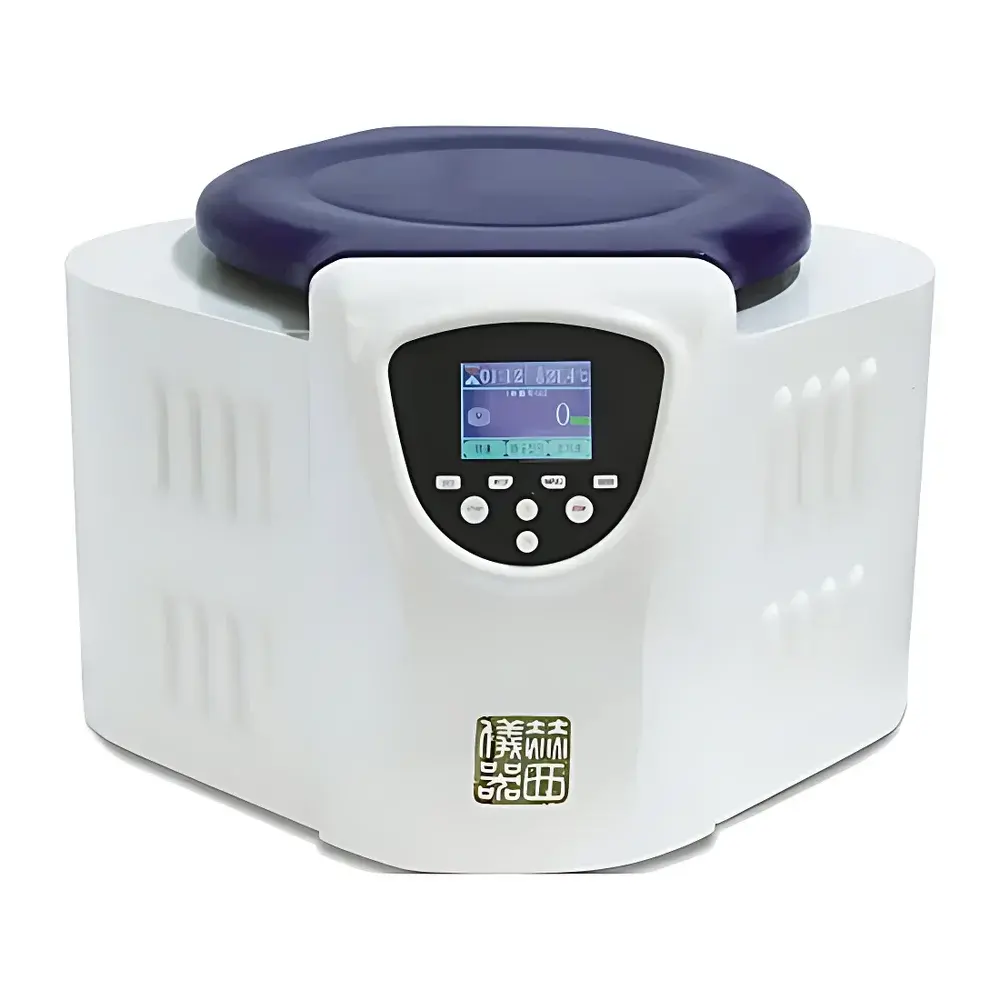
HEREXI H/T12MM Blood Group Serology-Specific Centrifuge
| [Brand | HEREXI |
|---|---|
| Origin | Hunan, China |
| Instrument Type | Benchtop Centrifuge |
| Max. Speed | 4000 rpm |
| Max. RCF | 2200 ×g |
| Max. Capacity | 12 microtube cards (6-/8-well gel cards) |
| Rotor Type | Fixed-angle card-specific rotor |
| Speed Accuracy | ±50 rpm |
| Timer Range | 1 min – 99 h 59 min |
| Noise Level | ≤60 dB(A) |
| Power Supply | AC 220 V, 50 Hz |
| Power Consumption | 120 W |
| Dimensions (W×D×H) | 550 × 440 × 330 mm |
| Net Weight | 35 kg |
| Drive System | High-torque brushless DC motor |
| Control System | Microprocessor-based with imbalance detection |
| Compliance | Designed for IVD laboratory workflows per ISO 15189 and CLIA-aligned operational requirements] |
Overview
The HEREXI H/T12MM Blood Group Serology-Specific Centrifuge is an engineered benchtop centrifuge optimized exclusively for immunohematology and transfusion medicine applications. Unlike general-purpose centrifuges, the H/T12MM implements a purpose-built mechanical architecture—featuring a fixed-angle, card-compatible rotor assembly—to deliver precise, reproducible sedimentation forces required for microcolumn gel card assays (e.g., ID-MT, Ortho BioVue, DiaMed ID-System). Its operational principle relies on controlled low-speed centrifugation (up to 4000 rpm, 2200 ×g) to separate red blood cells from serum/plasma while preserving antigen-antibody complexes within the gel matrix. This enables accurate interpretation of agglutination patterns in ABO/Rh typing, antibody screening, identification, and crossmatching—without requiring manual washing steps. The device complies with core preanalytical requirements defined in AABB Technical Manual (21st ed.), CAP Hematology Checklist (HMT.31120), and EU IVDR Annex I essential requirements for in vitro diagnostic devices used in clinical blood banking.
Key Features
- Card-specific rotor design accommodating 6-, 8-, and 12-well microcolumn gel cards—ensuring uniform force distribution across all columns during rotation
- Microprocessor-controlled timing (1 min to 99 h 59 min) with programmable presets for standard serological protocols: immediate spin (IS), IAT spin, Coombs control, and red cell washing cycles
- Brushless DC motor delivering high torque at low rotational speeds, minimizing thermal drift and mechanical vibration during extended runs
- Integrated imbalance detection system that automatically halts operation if load asymmetry exceeds ±5% mass differential—critical for maintaining gel column integrity
- Acoustically damped housing achieving ≤60 dB(A) noise level, suitable for shared clinical laboratory environments without dedicated isolation rooms
- Calibrated speed accuracy of ±50 rpm (adjustable in 10-rpm increments), traceable to internal encoder feedback and validated per ISO 21501-4 for rotational instrumentation
Sample Compatibility & Compliance
The H/T12MM accepts standardized commercial gel cards (e.g., DiaMed ID-Card, Immucor Gamma, Grifols ID-System) and supports both manual and semi-automated workflow integration. It is validated for use with EDTA, citrate, and heparin anticoagulated whole blood samples, as well as washed RBC suspensions. All rotors—including SERO (for RBC typing and Coombs testing), HLS (for lymphocyte separation), and the dedicated Gel Card Rotor—are autoclavable (121°C, 20 min) and certified free of leachable substances per USP . The instrument meets electromagnetic compatibility (EMC) requirements under IEC 61326-1 and safety standards per IEC 61010-1. While not FDA-cleared as an IVD device itself, its performance parameters align with analytical validation criteria outlined in CLSI EP05-A3 and ISO 15189:2022 clause 5.5.2 for equipment used in accredited medical laboratories.
Software & Data Management
The H/T12MM operates via a standalone embedded controller with no external PC dependency. All run parameters—including speed, time, acceleration/deceleration profiles, and program recall—are stored in non-volatile memory with timestamped audit logs. Though lacking network connectivity or LIS interface, the unit supports GLP-compliant documentation through printed run reports (via optional thermal printer module) listing operator ID, sample batch, protocol name, actual RCF achieved, and end-of-run status. Firmware updates are performed locally using USB flash drives, with version history retained in system memory. For laboratories subject to 21 CFR Part 11 compliance, procedural controls—including dual-operator verification for critical parameters and logbook-based record retention—are recommended and fully supported by the device’s deterministic behavior and absence of user-modifiable firmware logic.
Applications
- Blood group antigen typing (ABO, RhD, K, Fya, Jka) using gel card agglutination assays
- Antibody screening and identification in patient and donor sera, including IgG-class antibodies detected via indirect antiglobulin test (IAT)
- Compatibility testing (crossmatching) with direct and indirect methods—enabling one-step incomplete antibody detection without prior RBC washing
- Red blood cell washing protocols for DAT-negative samples and autocontrol preparation
- Lymphocyte isolation from peripheral blood mononuclear cells (PBMCs) using density gradient-compatible rotor configurations
- Preparation of platelet-poor plasma for HLA antibody testing and complement component analysis
FAQ
What types of gel cards are compatible with the H/T12MM?
The centrifuge accommodates all major commercially available microcolumn gel cards with 6-, 8-, or 12-well formats, including DiaMed ID-System, Immucor Precise, Grifols ID-System, and Bio-Rad ID-PaK cards.
Can the H/T12MM be used for routine plasma separation?
Yes—when equipped with appropriate tube adapters, it achieves consistent plasma yield from 1–2 mL EDTA tubes at 3000 rpm for 5 minutes, meeting CLSI H20-A3 recommendations for hematocrit and plasma harvesting.
Is calibration service available internationally?
HEREXI provides factory calibration certificates traceable to NIM (China National Institute of Metrology); third-party ISO/IEC 17025-accredited labs can perform field verification using calibrated tachometers and RCF calculators per ISO 21501-4.
Does the unit support continuous operation mode?
Yes—the “Hold” function allows indefinite spinning at set speed until manually stopped, useful for extended incubation-centrifugation hybrid protocols in research settings.
How is rotor lifetime managed?
Each rotor carries engraved serial numbers and maximum cycle ratings (≥10,000 runs); users are advised to log usage in accordance with ISO 15189 clause 5.5.3 and replace rotors after 5 years of clinical service regardless of cycle count.



