
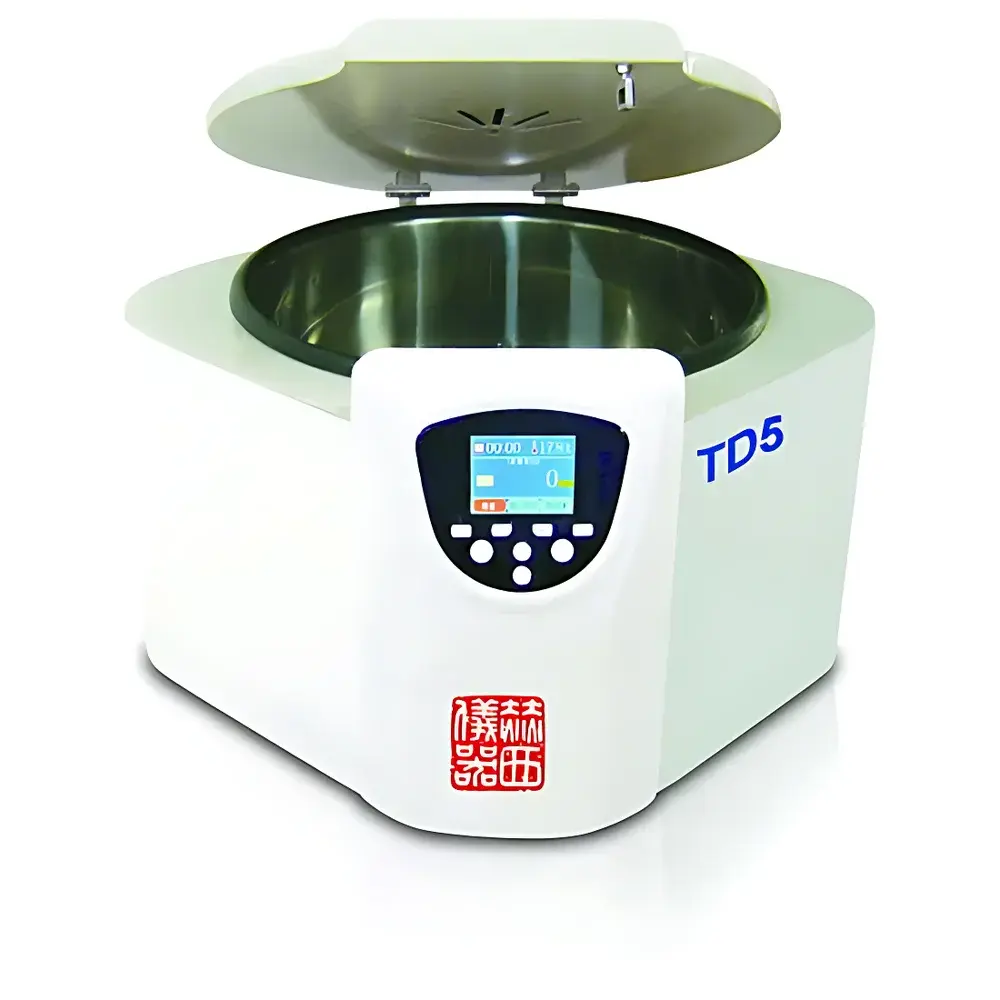
Herexi TD5 Automated Cap-Removal Benchtop Centrifuge
| Brand | Herexi |
|---|---|
| Origin | Hunan, China |
| Model | TD5 |
| Instrument Type | Benchtop Centrifuge |
| Speed Range | Up to 4000 rpm |
| Max RCF | 2960 ×g |
| Capacity | 48 vacuum blood collection tubes |
| Tube Compatibility | 75 mm & 100 mm standard vacuum tubes |
| Acceleration/Deceleration | 10-step programmable |
| Display | TFT-LCD touchscreen with multilingual UI (English, Chinese, Russian, Portuguese) |
| Safety Certifications | ISO 9001:2015, ISO 13485:2016, CFDA registered |
| Power Supply | AC 220 V, 50 Hz |
| Noise Level | ≤60 dB(A) |
| Dimensions (L×W×H) | 600 × 540 × 360 mm |
| Weight | 35 kg |
| Control System | Embedded microcontroller (Infineon driver + Yingruien MCU), brushless DC/AC inverter motor |
| Safety Features | Triple-damping suspension, imbalance detection, overspeed/overtemperature/under-voltage/over-voltage protection, stainless steel 304 rotor chamber, three-layer steel safety housing, auto-locking motorized door |
Overview
The Herexi TD5 Automated Cap-Removal Benchtop Centrifuge is an integrated clinical separation system engineered specifically for high-throughput processing of vacuum blood collection tubes in diagnostic and transfusion medicine environments. Unlike conventional centrifuges requiring manual cap removal prior to or after centrifugation, the TD5 performs cap detachment and sedimentation in a single, synchronized cycle—eliminating operator intervention during sample handling. Its operational principle combines precise mechanical actuation (pneumatically assisted cap ejection) with controlled rotor dynamics under defined g-force profiles (up to 2960 ×g at 4000 rpm), ensuring reproducible phase separation of whole blood into serum/plasma and cellular components without red blood cell resuspension. Designed for compliance with clinical laboratory workflow standards, the TD5 addresses critical biosafety and efficiency challenges associated with manual decapping—including aerosol generation, cross-contamination risk, inconsistent tube orientation, and vibration-induced hemolysis.
Key Features
- Automated cap removal mechanism achieving ≥97% success rate across 75 mm and 100 mm standard vacuum tubes (e.g., BD Vacutainer®, Greiner Bio-One); cap ejection occurs synchronously with rotor acceleration to minimize sample disturbance.
- Brushless DC/AC inverter motor with high-torque output and microprocessor-based speed regulation (±50 rpm accuracy), delivering stable rotational performance at low acoustic emission (≤60 dB[A]).
- Reinforced safety architecture: austenitic 304 stainless steel centrifuge chamber, triple-layer structural housing (including impact-resistant front panel and three-tier steel protective sleeve), and electromagnetic motorized door lock activated by gentle lid closure.
- Intelligent control system featuring dual-input interface (capacitive touchscreen + physical keys), real-time display of setpoints and actual values (speed, RCF, time, temperature), and dynamic parameter adjustment during active runs.
- Comprehensive safety monitoring: real-time detection of rotor imbalance, overspeed, overtemperature, supply voltage fluctuations (100–230 V AC compatible), and automatic emergency shutdown with audible/visual alerts.
- Programmable deceleration and acceleration profiles (10-step selection), 20 user-definable protocols, and graphical curve logging (speed ramp, cumulative centrifugation time, thermal profile).
Sample Compatibility & Compliance
The TD5 accommodates standardized vacuum blood collection tubes compliant with CLSI H20-A3 and ISO 6710 specifications, including serum separator tubes (SST), EDTA-K2/K3, heparin, citrate, and PST formulations. Its mechanical cap-removal head is calibrated for consistent force application across tube wall thicknesses (0.8–1.2 mm) and cap material types (rubber, thermoplastic elastomer). The device meets regulatory requirements for in vitro diagnostic (IVD) ancillary equipment under China’s NMPA (formerly CFDA) Class II registration framework and conforms to ISO 13485:2016 for medical device quality management systems. While not classified as an IVD instrument per se, its design supports GLP-aligned documentation practices, including audit-trail-capable parameter logging and non-volatile protocol storage—facilitating traceability in CAP- or ISO 15189-accredited laboratories.
Software & Data Management
The embedded firmware provides native support for multilingual operation (English, Chinese, Russian, Portuguese) and retains all user-defined programs in non-volatile memory. Time-stamped run logs—including start/stop timestamps, selected rotor ID, final RCF, total runtime, and fault codes—are exportable via USB interface in CSV format for integration into LIMS or electronic lab notebooks. No proprietary software installation is required; data retrieval is file-system based and compatible with standard Windows/macOS/Linux platforms. Firmware updates are delivered via encrypted USB key to maintain integrity and prevent unauthorized modification—consistent with cybersecurity expectations outlined in IEC 62304 for medical device software lifecycle management.
Applications
- Clinical chemistry and immunoassay pre-analytical processing: automated serum/plasma isolation from EDTA, heparin, and SST tubes prior to analyzer loading.
- Blood bank operations: efficient preparation of platelet-poor plasma (PPP) and platelet-rich plasma (PRP) for transfusion support or regenerative medicine workflows.
- Radiopharmaceutical handling in nuclear medicine departments: safe, hands-free processing of iodine-131 or technetium-99m labeled samples to minimize radiation exposure.
- Research laboratories conducting longitudinal biobanking studies: standardized cap removal and centrifugation across large cohorts ensures inter-sample comparability and reduces technician-dependent variability.
- Point-of-care testing (POCT) support in mobile health units or field-deployable diagnostics: compact footprint (0.116 m³), wide-voltage compatibility, and robust mechanical construction enable reliable operation in non-clinical infrastructure settings.
FAQ
Does the TD5 require calibration verification before routine use?
Yes. Users must perform initial verification of rotational speed (using a certified tachometer) and RCF calculation against manufacturer-specified rotor geometry prior to first deployment. Annual recalibration is recommended per ISO/IEC 17025 guidelines for accredited facilities.
Can the TD5 process tubes containing coagulants other than silica or thrombin?
It is validated for standard coagulant types per CLSI H20-A3. Non-standard additives (e.g., novel polymer-based clot activators) may affect cap adhesion strength and require site-specific validation of ejection reliability.
Is the rotor assembly autoclavable?
No. The rotor and cap-removal module are not designed for steam sterilization. Cleaning is performed using 70% ethanol or hospital-grade disinfectants compatible with stainless steel and polycarbonate components.
What maintenance intervals are specified for the motor drive system?
The brushless motor requires no scheduled lubrication. Annual inspection of drive belt tension (if applicable), door lock actuator responsiveness, and cap-ejection pin alignment is advised per the maintenance log included in the technical manual.
Does the TD5 support remote monitoring or network connectivity?
No Ethernet or Wi-Fi interface is provided. Remote status access is limited to local USB data export; integration with centralized lab monitoring systems requires third-party middleware or custom API development.



