
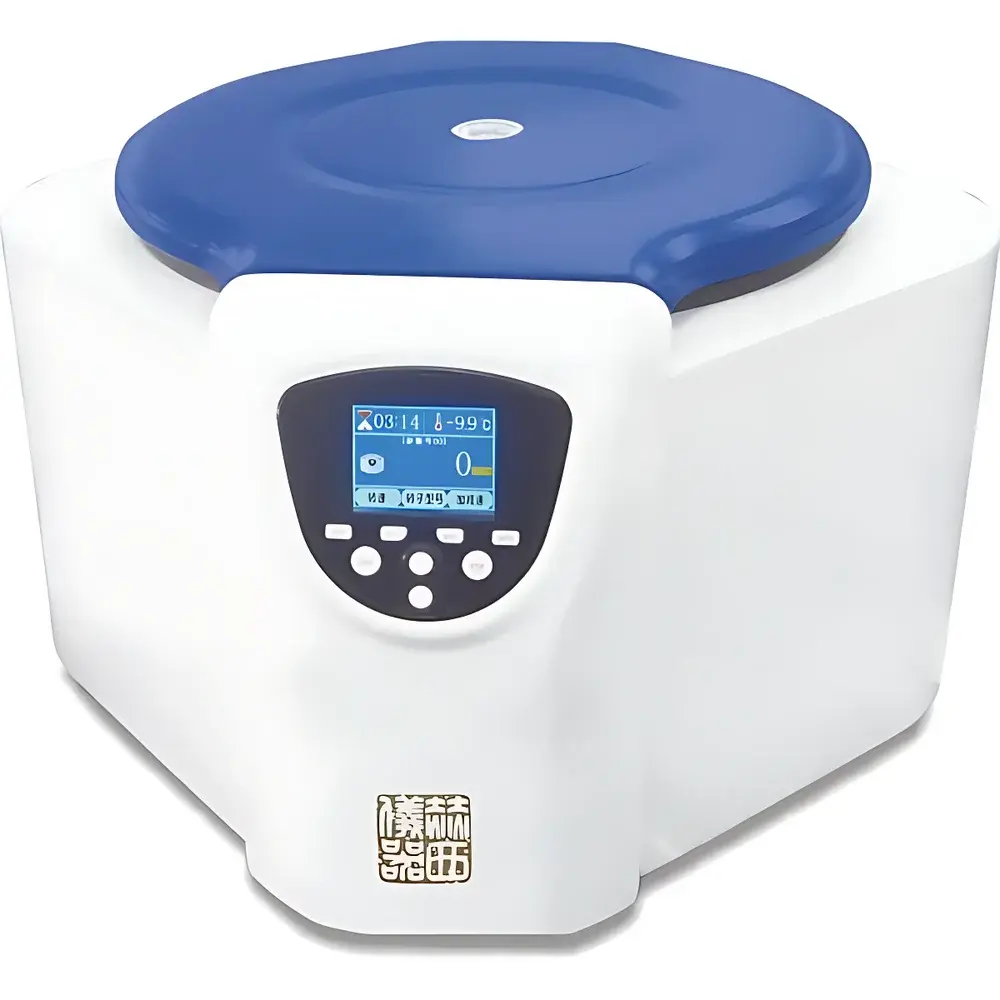
Herexi TDZ5 Low-Speed Multi-Rotor Urine Sediment Centrifuge
| Brand | Herexi |
|---|---|
| Origin | Hunan, China |
| Model | TDZ5 |
| Instrument Type | Benchtop Centrifuge |
| Speed Range | 0–4000 rpm |
| Max RCF | 2960 ×g |
| Max Capacity | 32 × 15 mL |
| Acceleration/Deceleration | 10-step programmable |
| Timer Range | 1 min – 99 h 59 min, continuous, or short-spin mode |
| Drive System | High-torque brushless DC motor with microprocessor control |
| Display | TFT-LCD color touchscreen + physical keypad |
| Language Support | English, Chinese, Russian, Portuguese |
| Safety Certifications | CFDA registered & licensed, ISO 9001:2015 & ISO 13485:2016 certified |
| Compliance | RoHS 2015/863 (silicone rubber sealing gasket), IP20 enclosure rating |
| Noise Level | ≤60 dB(A) |
| Power Supply | AC 220 V, 50 Hz (100–230 V optional) |
| Dimensions (W×D×H) | 600 × 540 × 360 mm |
| Net Weight | 35 kg |
| Motor Locking | Electromechanical auto-lock door system with soft-close actuation |
| Suspension | Triple-stage damping + composite shock absorption assembly |
| Chamber Material | AISI 304 austenitic stainless steel |
| Housing | Powder-coated steel frame with reinforced front panel and triple-layer safety shield |
Overview
The Herexi TDZ5 Low-Speed Multi-Rotor Urine Sediment Centrifuge is a CE-marked, ISO 13485-certified benchtop centrifuge engineered specifically for standardized urine sediment preparation in clinical diagnostics laboratories. It operates on the principle of sedimentation-based separation under controlled gravitational force (RCF), enabling reproducible pelleting of cellular elements—including erythrocytes, leukocytes, epithelial cells, casts, and crystalline debris—without inducing mechanical lysis or structural distortion. Designed to comply with CLSI GP17-A4 and ISO 15189 requirements for preanalytical phase standardization, the TDZ5 delivers consistent 15 mL tube processing across 32 positions at up to 4000 rpm (2960 ×g), meeting the operational parameters recommended by major urinalysis platform manufacturers for microscopic sediment analysis workflows.
Key Features
- High-reliability brushless DC motor with microprocessor-driven torque regulation ensures stable rotational dynamics and minimal thermal drift during extended runs.
- Triple-stage mechanical damping system combined with proprietary composite shock absorption minimizes vibration transmission, preventing sample resuspension and preserving pellet integrity.
- TFT-LCD full-color display supports dual-input operation (touchscreen + tactile keys), with real-time simultaneous readout of setpoint and actual values—including RCF, rpm, time remaining, and temperature (ambient-sensed).
- Programmable acceleration and deceleration profiles (10 steps each) allow optimization for fragile urinary sediments, reducing shear-induced artifact formation during spin-up and brake phases.
- Biocontainment-compliant horizontal rotor features an integrated silicone rubber gasket (RoHS 2015/863 compliant), providing aerosol-tight sealing to mitigate biohazard exposure risk during lid opening.
- Robust safety architecture includes active monitoring for imbalance, overspeed, overtemperature, undervoltage, and overvoltage conditions, with automatic rotor stop and visual/audible alerts.
- Electromechanical door lock engages automatically upon gentle lid closure—no manual latching required—ensuring operator safety without compromising workflow efficiency.
Sample Compatibility & Compliance
The TDZ5 accommodates standard 15 mL conical-bottom polypropylene centrifuge tubes (e.g., BD Vacutainer® UroCult™, Sarstedt 62.547.201) in its fixed-angle compatible horizontal rotor configuration. All wetted components are inert to common urine preservatives (e.g., boric acid, sodium azide, refrigeration). The device meets essential requirements of IEC 61010-1:2010 for laboratory electrical equipment safety and carries CFDA registration (Class II medical device, registration number available upon request). Its quality management system is certified to ISO 13485:2016, supporting GLP/GMP-aligned documentation practices including audit trails for parameter changes and run logs exportable via USB interface.
Software & Data Management
While the TDZ5 operates as a standalone instrument without cloud connectivity, its embedded firmware supports full traceability through non-volatile memory storage of up to 20 user-defined protocols. Each protocol retains independent settings for speed, time, acceleration/deceleration rate, and RCF calculation mode. Run history—including date/time stamp, rotor ID, total runtime, and any triggered safety events—is retained for ≥100 cycles and exportable in CSV format via USB-A port. Optional firmware updates maintain alignment with evolving CLIA and CAP checklist requirements for centrifuge validation and preventive maintenance logging.
Applications
Primarily deployed in hospital core labs, reference laboratories, and point-of-care clinics, the TDZ5 supports standardized preparation of urine sediment specimens prior to microscopy, flow cytometry (e.g., Sysmex UF-series), or automated digital image analysis (e.g., Iris iQ200). It is also validated for use in renal pathology specimen processing, microbiological culture inoculum concentration, and low-speed plasma separation where preservation of cell morphology is critical. Its wide voltage tolerance (100–230 V) enables deployment in mobile health units and resource-limited settings without external voltage regulators.
FAQ
Is the TDZ5 suitable for use with urine preservative tubes containing sodium azide?
Yes—the rotor chamber and gasket materials exhibit chemical resistance to concentrations ≤0.1% w/v sodium azide, per manufacturer compatibility testing.
Can the centrifuge be validated for IQ/OQ/PQ according to GxP standards?
Yes—full validation documentation packages (including test protocols, acceptance criteria, and raw data templates) are available upon request from Herexi’s Regulatory Affairs team.
Does the TDZ5 support rotor calibration verification?
Yes—built-in calibration mode allows verification of speed accuracy against NIST-traceable tachometer references; deviation tolerance is ±50 rpm at maximum setting.
What maintenance intervals are recommended for routine operation?
Daily visual inspection of rotor integrity and gasket condition; biannual cleaning of chamber and air vents; annual performance verification per ISO 20958-2:2017 Annex B.
Is remote monitoring or network integration possible?
No—the TDZ5 does not feature Ethernet, Wi-Fi, or RS-232 interfaces; all operation and data retrieval occur locally via front-panel interface or USB port.



