
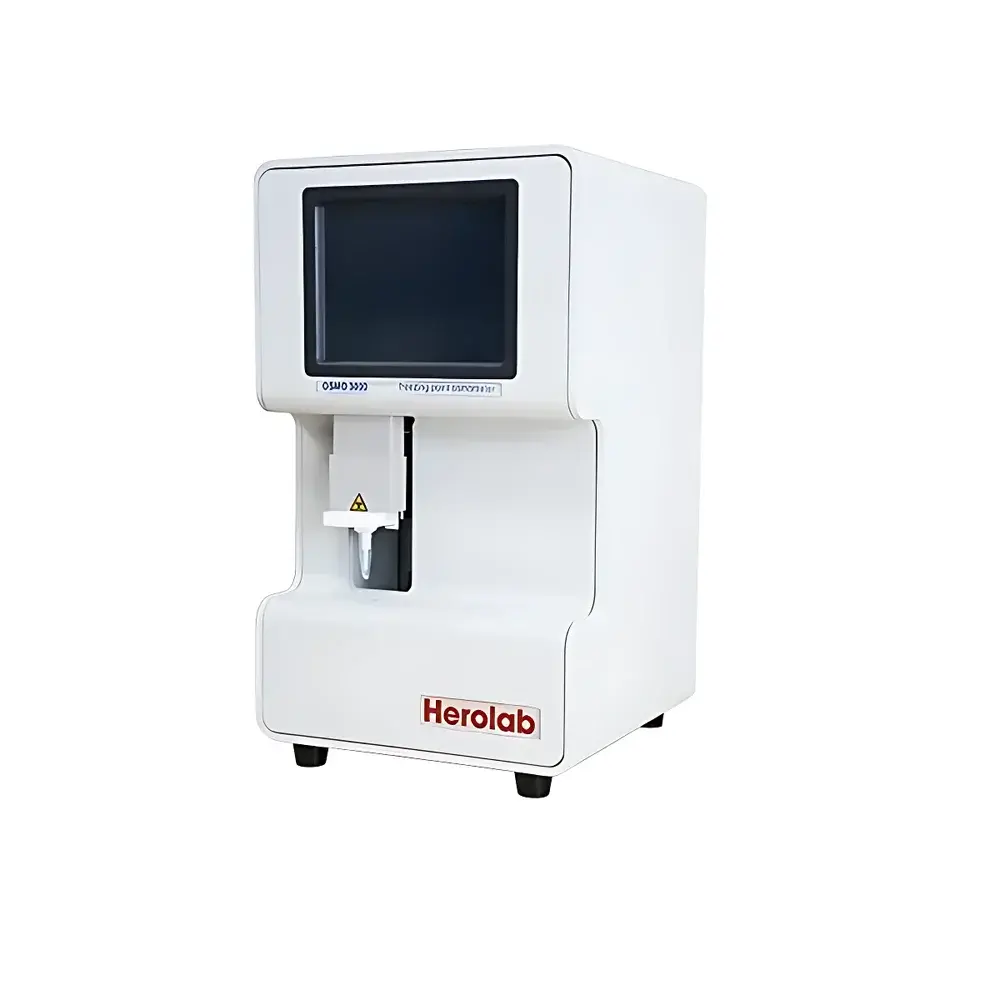
Herolab OSMO 3000 Freezing Point Osmometer
| Brand | Herolab |
|---|---|
| Model | OSMO 3000 |
| Measurement Principle | Freezing Point Depression |
| Measurement Range | 0–3000 mOsmol/kg |
| Resolution | 1 mOsmol/kg |
| Sample Volume (Standard) | 30–50 µL |
| Sample Volume (Optional M Kit) | 15 µL |
| Measurement Time | ~60 s |
| Repeatability | ≤ ±2 mOsmol/kg (0–400), ≤ ±0.5% (400–1500), ≤ ±1% (1500–3000) |
| Calibration Options | 2-point or 3-point |
| Cooling System | Dual independent Peltier modules with electronic temperature monitoring |
| Display | 5.7″ LCD touchscreen |
| Data Interfaces | 2 × RS232, 1 × USB |
| Power Supply | 220 V (±20 V), 50–60 Hz, 120 VA |
| Dimensions (W×H×D) | 220 × 205 × 360 mm |
| Weight | ~6.5 kg |
| Operating Environment | 10–35 °C |
| Compliance | Chinese Pharmacopoeia General Chapter 0632 |
Overview
The Herolab OSMO 3000 Freezing Point Osmometer is a precision analytical instrument engineered for the accurate and reproducible determination of osmolality in aqueous solutions via freezing point depression—a thermodynamic colligative property directly proportional to the total concentration of solute particles. This principle enables quantitative assessment of osmotic activity without dependence on molecular identity, making it indispensable for quality control in pharmaceutical manufacturing, biologics formulation, clinical diagnostics, and contract research laboratories. The OSMO 3000 is specifically designed to meet the regulatory requirements outlined in the Chinese Pharmacopoeia General Chapter 0632 “Determination of Osmolal Concentration”, and its measurement traceability aligns with internationally recognized reference standards used in pharmacopeial compliance workflows. Its dual Peltier-based cooling architecture ensures stable thermal control across the full 0–3000 mOsmol/kg range, eliminating ice accumulation at the sample chamber base—a common source of drift in conventional systems—and supporting uninterrupted operation under GLP- or GMP-aligned laboratory conditions.
Key Features
- Automated ice nucleation using a stainless-steel needle—eliminates manual seeding and reduces operator variability.
- Dual independent semiconductor (Peltier) cooling modules with real-time electronic temperature monitoring for enhanced thermal stability and reduced measurement drift.
- 5.7″ high-contrast LCD touchscreen interface with intuitive navigation; supports user-selectable language pairs (English/German/Chinese—two active at a time).
- Flexible calibration architecture: configurable 2-point or 3-point calibration; ten certified osmolality standards available (100–2500 mOsmol/kg) to match application-specific ranges.
- User-accessible password protection for method settings, calibration records, and system configuration—prevents unauthorized parameter changes during routine QC testing.
- Low sample consumption: standard mode requires only 30–50 µL; optional Micro-Sampling Kit (M) reduces volume requirement to 15 µL while maintaining ≤ ±2% repeatability.
- Integrated microprocessor controls all stages—from sample cooling and nucleation detection to data acquisition and osmolality calculation—ensuring consistent algorithmic processing per ISO 17511 and CLSI EP15-A3 guidelines.
Sample Compatibility & Compliance
The OSMO 3000 is validated for use with parenteral solutions including intravenous infusions, electrolyte replacements, total parenteral nutrition (TPN) formulations, ophthalmic preparations, and osmotic diuretics. It accommodates samples with moderate viscosity and low particulate load, provided they remain fully miscible in water and do not interfere with ice crystal formation kinetics. The instrument complies with Chinese Pharmacopoeia General Chapter 0632 and supports audit-ready documentation when paired with optional accessories such as the barcode reader (BC kit) for sample ID traceability and the thermal printer (D kit) for hard-copy reporting of date/time, sample ID, and result—both critical for FDA 21 CFR Part 11–aligned environments. All firmware and calibration logs retain timestamps and user IDs, enabling full traceability required under GLP and GMP frameworks.
Software & Data Management
Data output is managed through dual RS232 serial ports and one USB interface, enabling seamless integration with LIMS, ELN, or custom QA/QC databases. Raw thermogram data—including cooling curve slope, nucleation onset, and freezing plateau duration—is accessible for secondary analysis. Optional software packages support automated report generation compliant with Annex 11 and 21 CFR Part 11 requirements, including electronic signatures, audit trails, and version-controlled method storage. Calibration history, maintenance logs, and user activity records are retained internally with tamper-evident timestamps—no external database dependency required for basic compliance.
Applications
- Final product release testing of sterile injectables and IV bags per pharmacopeial monographs.
- Stability-indicating assay during accelerated and real-time shelf-life studies.
- In-process control of buffer and formulation steps in monoclonal antibody and vaccine development.
- Verification of dialysate and irrigation solution osmolality in hospital pharmacy compounding units.
- Supporting USP , EP 2.2.42, and JP 17 validation protocols where osmolality serves as a critical quality attribute.
FAQ
What regulatory standards does the OSMO 3000 support?
It conforms to Chinese Pharmacopoeia General Chapter 0632 and is compatible with USP , EP 2.2.42, and JP 17 osmolality testing requirements.
Can the instrument be integrated into a 21 CFR Part 11–compliant environment?
Yes—when used with optional audit-trail-enabled software and electronic signature modules, it meets data integrity requirements for regulated pharmaceutical QC labs.
Is the 15 µL micro-sampling option suitable for precious clinical specimens?
Yes—the M kit maintains metrological equivalence across the 0–1500 mOsmol/kg range and is routinely employed in neonatal and cerebrospinal fluid analysis where volume is critically limited.
How often must calibration be performed?
Per ICH Q2(R2) guidance, initial qualification includes 3-point calibration; routine use requires daily verification with at least one reference standard bracketing the expected sample range.
Does the system require consumables beyond calibration standards?
No—except for disposable sample tubes and optional printer paper, the OSMO 3000 operates without proprietary reagents or wear-prone mechanical parts.




