
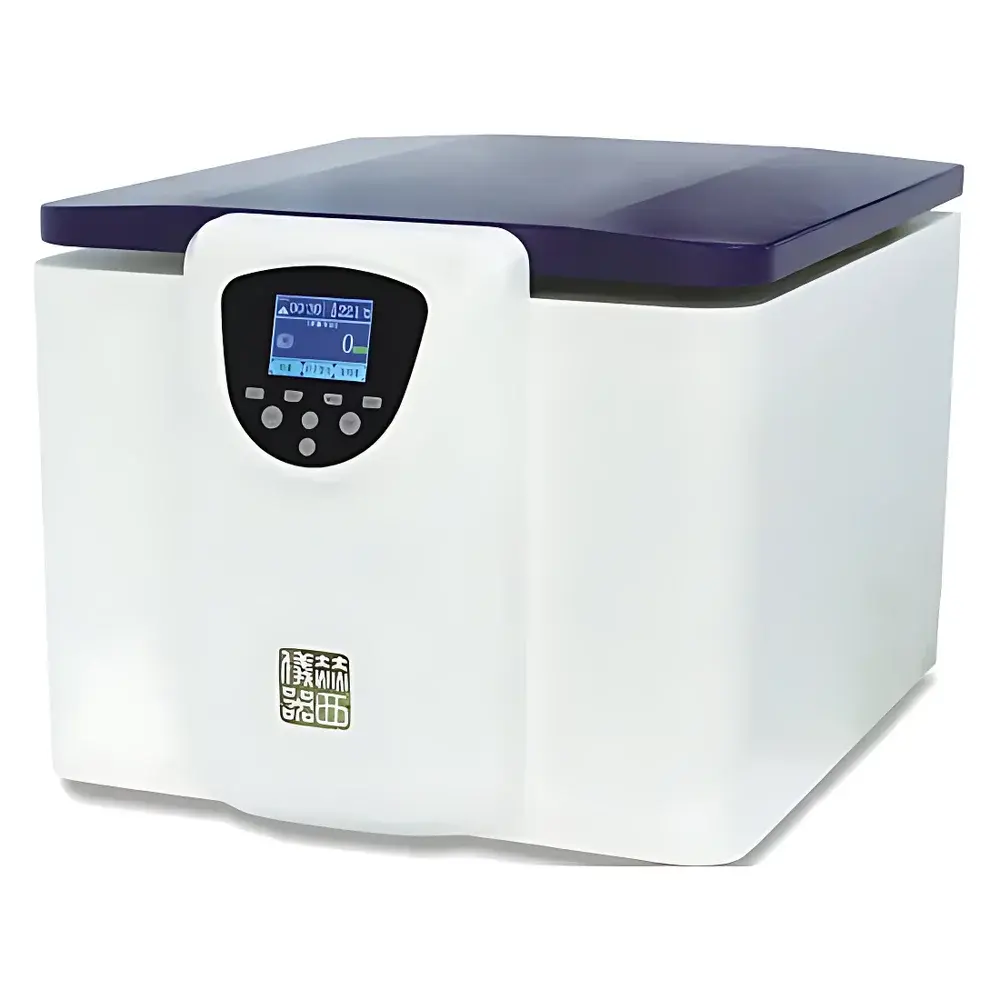
Hershey DD5 Automated Cap-Removal Refrigerated Centrifuge
| Brand | Hershey |
|---|---|
| Origin | Hunan, China |
| Model | DD5 Automated Cap-Removal Centrifuge |
| Instrument Type | Benchtop Centrifuge |
| Speed Range | 0–4000 rpm |
| Max RCF | 3020 ×g |
| Speed Accuracy | ±50 rpm |
| Capacity | 48 or 76 vacuum blood collection tubes (75 mm or 100 mm) |
| Temperature Control | Refrigerated (operating range: –20 °C to +40 °C) |
| Acceleration/Deceleration | 10-step programmable |
| Noise Level | ≤60 dB(A) |
| Power Supply | AC 220 V, 50 Hz |
| Dimensions (L×W×H) | 630 × 500 × 420 mm |
| Weight | 50 kg |
| Certifications | CFDA Registration & Manufacturing License, ISO 9001:2015, ISO 13485:2016 |
| Compliance | Designed for IVD sample preparation per CLSI GP44-A4 and ISO 15189 pre-analytical requirements |
Overview
The Hershey DD5 Automated Cap-Removal Refrigerated Centrifuge is a purpose-built benchtop centrifuge engineered for high-throughput, standardized pre-analytical processing of clinical blood specimens. It integrates precise refrigerated centrifugation with fully automated cap removal—eliminating manual handling of vacuum blood collection tubes (VBCTs) during serum or plasma separation workflows. Operating on the principle of sedimentation under controlled gravitational force (RCF), the DD5 delivers reproducible separation of cellular components from whole blood while maintaining specimen integrity across temperature-sensitive analytes. Its design adheres to core pre-analytical standards including CLSI GP44-A4 for centrifugation parameters and ISO 15189 Annex A.3 for equipment validation in medical laboratories. The unit supports both 75 mm and 100 mm tube formats, enabling flexibility across routine clinical chemistry, immunoassay, and coagulation testing pipelines.
Key Features
- Automated cap-removal mechanism with ≥97% success rate—validated across two standard VBCT lengths (75 mm and 100 mm)—reducing operator exposure, minimizing aerosol generation, and eliminating inter-sample carryover risk.
- Refrigerated operation (–20 °C to +40 °C) ensures thermal stability of labile analytes (e.g., cortisol, ACTH, catecholamines) during centrifugation and post-separation hold.
- Brushless AC/DC inverter motor with high-torque output and microprocessor-based control enables stable rotor acceleration/deceleration profiles; 10 programmable ramp rates support optimization for fragile samples or high-viscosity specimens.
- Dual-mode interface: TFT-LCD color display with touch-sensitive and physical key inputs; real-time simultaneous display of setpoints (speed, time, temperature, RCF) and actual running parameters—including dynamic curves for speed, RCF, and temperature over time.
- Triple-stage damping system comprising asymmetric rubber mounts, spring-damped rotor suspension, and reinforced stainless-steel chamber housing—ensuring mechanical stability under load imbalance up to 5 g and suppressing re-suspension of pellet layers.
- Safety architecture includes motorized door lock with stainless-steel latch, three-layer protective casing (AISI 304 inner chamber, powder-coated steel outer shell, structural front panel), and comprehensive electronic monitoring for overspeed, overtemperature, imbalance, undervoltage, and overvoltage conditions.
Sample Compatibility & Compliance
The DD5 accommodates standard vacuum blood collection tubes compliant with ISO 6710:2017 and CLSI H20-A3 specifications—including EDTA, heparin, citrate, SST, PST, and serum separator tubes. Its 48-tube (swing-out) and 76-tube (fixed-angle) configurations are validated for use with common 13 × 75 mm and 13 × 100 mm formats. All operational protocols meet ISO 13485:2016 requirements for in vitro diagnostic (IVD) device manufacturing and align with FDA 21 CFR Part 820 quality system regulations. The instrument’s CFDA registration and manufacturing license confirm its qualification for clinical laboratory deployment in regulated healthcare environments.
Software & Data Management
The DD5 firmware supports audit-trail-enabled parameter logging, storing timestamps, user IDs (via optional login module), run history, and error logs for GLP/GMP traceability. Twenty customizable protocols can be saved, edited, and recalled without interrupting active runs. While the device does not feature network connectivity or remote software integration, all stored data are exportable via USB interface in CSV format for LIMS ingestion. Firmware updates are performed locally using signed binaries, ensuring version control and compliance with ISO 13485 change management procedures.
Applications
- Routine serum/plasma separation for clinical chemistry, immunoassay, and hematology analyzers.
- Pre-analytical processing in central labs, hospital core labs, and reference laboratories performing high-volume CBC, lipid panels, liver function tests, and therapeutic drug monitoring.
- Supporting biobanking workflows requiring consistent, low-heat plasma isolation under defined temperature conditions.
- QC/QA validation of centrifugation parameters in method verification studies per CLSI EP05-A3 and ISO 15197:2013.
- Research applications involving PBMC isolation when used with density gradient media and compatible swing-out rotors (optional accessory).
FAQ
What tube sizes does the DD5 support?
The DD5 is validated for both 75 mm and 100 mm vacuum blood collection tubes, accommodating standard diameters of 13 mm.
Does the DD5 meet international regulatory requirements for clinical labs?
Yes—it holds CFDA registration and manufacturing license, and is certified to ISO 9001:2015 and ISO 13485:2016, supporting compliance with ISO 15189, CLIA, and CAP pre-analytical standards.
Can centrifugation parameters be modified mid-run?
Yes—the interface allows real-time adjustment of speed, time, and temperature without stopping the rotor, provided changes remain within safety limits.
Is the refrigeration system compressor-based or thermoelectric?
The DD5 employs a hermetically sealed, oil-free scroll compressor with independent evaporator coils, delivering stable temperature control across ambient ranges of 15–30 °C.
What safety certifications apply to the mechanical door lock?
The motorized door lock conforms to IEC 61010-1:2010 Clause 7.6.2 for interlocked access protection and undergoes cyclic life testing to ≥100,000 operations.



