
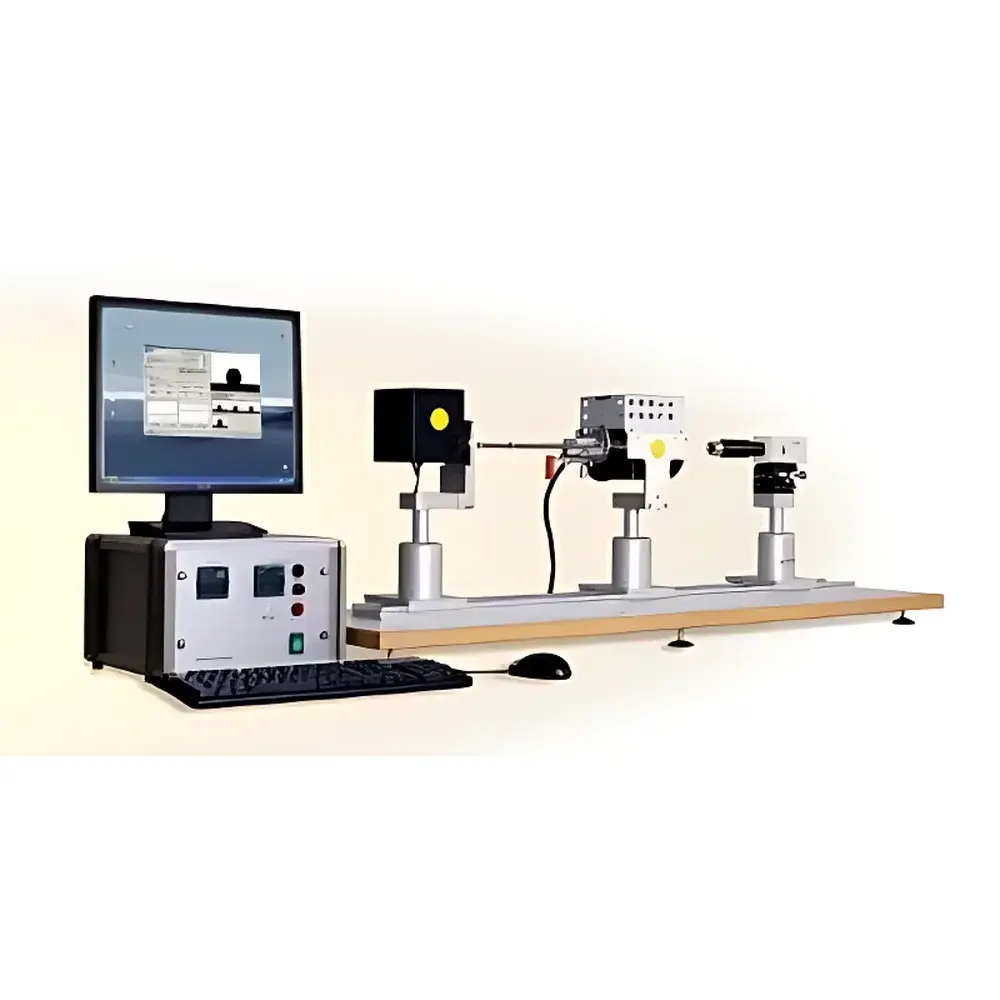
HESSE EM301-M17 High-Temperature Heating Microscope
| Brand | HESSE |
|---|---|
| Origin | Germany |
| Model | EM301-M17 |
| Total Magnification | 30× |
| Eyepiece | 20× |
| Objective | 20× |
| Maximum Temperature | 1700 °C |
| Heating Rate | 0–80 °C/min |
| Optional Ultra-Low Heating Rate | 0.1 K/h |
| Sample Chamber Dimensions | 80 cm × 200 cm |
| Power Supply | 220 V / 50 Hz, 1500 W |
| Sample Size Limit | 3 mm × 3 mm × 3 mm |
| Illumination | High-Stability LED System |
| Atmosphere Options | Ambient Air (Standard), Inert Gas (Optional) |
| Image Processing | Real-Time Digital Acquisition & Quantitative Morphometric Analysis |
Overview
The HESSE EM301-M17 High-Temperature Heating Microscope is an engineered optical instrumentation platform designed for in situ thermal analysis of solid-state materials undergoing phase transitions under controlled elevated temperatures. Based on the principle of high-resolution optical observation coupled with precise thermally regulated sample staging, this metallurgical-grade heating microscope enables real-time visualization and quantitative morphological characterization of thermal behavior—including sintering onset, deformation, softening, hemispherical formation, melting, and fluid flow dynamics—across a broad range of refractory and functional materials. It operates within a calibrated temperature range up to 1700 °C, with programmable heating rates spanning from ultra-slow (0.1 K/h) to rapid ramping (80 °C/min), ensuring compatibility with both kinetic studies and equilibrium-phase determination protocols. The system integrates a robust metallurgical optical path optimized for reflected-light imaging, supporting quantitative geometry extraction from high-contrast, low-noise digital video streams.
Key Features
- High-stability LED illumination system delivering uniform, flicker-free brightness across the full temperature range—eliminating thermal drift-induced intensity variation and enabling consistent image acquisition during dynamic heating cycles.
- Precision-engineered heating stage with dual-zone PID control and integrated overtemperature protection circuitry, certified to IEC 61000-4-2/4-4 compliance for electromagnetic immunity in laboratory environments.
- Digital image capture subsystem featuring real-time frame buffering, timestamped metadata embedding (temperature, time, stage position), and lossless 12-bit grayscale output at 30 fps for high-fidelity morphological tracking.
- Modular gas environment interface supporting standard air operation or optional inert gas purging (N₂, Ar) via sealed chamber design—critical for oxidation-sensitive samples such as metal powders, electronic pastes, and reducing slag systems.
- Thermally compensated mechanical structure minimizing focus drift; optical axis remains stable within ±0.5 µm over 1700 °C ramp cycles, preserving measurement repeatability across multi-day experimental series.
- Pre-calibrated temperature verification points traceable to NIST-certified reference materials (e.g., Al₂O₃, Pt, Ni), with optional calibration certificate per ASTM E2550 and ISO 11357-1.
Sample Compatibility & Compliance
The EM301-M17 accommodates compact solid specimens up to 3 mm × 3 mm × 3 mm, making it suitable for standardized test pellets, pressed powders, sintered compacts, and thin-sectioned metallurgical coupons. It is routinely deployed in laboratories adhering to ASTM C1351 (softening point of refractories), ASTM C1479 (sintering behavior of ceramic powders), ISO 5660 (fire testing—heat release rate), and USP (melting point determination). All firmware and data logging modules comply with FDA 21 CFR Part 11 requirements for audit trail generation, electronic signature support, and data integrity preservation. Full GLP/GMP documentation packages—including IQ/OQ/PQ protocols—are available upon request.
Software & Data Management
The proprietary HESSE ThermalVision™ software provides a validated, standalone Windows application for experiment orchestration, image quantification, and report generation. Core functionalities include automated detection of sintering onset (via pixel-intensity gradient thresholding), contact angle calculation using Young–Laplace curve fitting, vertex angle measurement with sub-pixel interpolation, and time-temperature-morphology correlation matrices. All raw image sequences, metadata logs, and processed parameters are stored in vendor-neutral HDF5 format, ensuring long-term archival stability and third-party interoperability (e.g., MATLAB, Python pandas, OriginLab). Software validation documentation supports regulatory submissions under EU Annex 11 and ICH GCP guidelines.
Applications
- Quantitative sintering kinetics analysis of advanced ceramics, battery electrode materials, and additive manufacturing feedstocks.
- Softening and melting behavior assessment of glass frits, photovoltaic screen-printing pastes, and low-temperature co-fired ceramics (LTCC).
- Slag viscosity modeling via geometric deformation analysis in metallurgical slag systems (e.g., CaO–SiO₂–Al₂O₃–MgO).
- Thermal stability evaluation of protective coatings, refractory linings, and nuclear fuel matrix composites.
- Process window definition for thermal plasma spray deposition, laser sintering, and furnace-based densification processes.
- Interfacial wetting studies of solder alloys, brazing fillers, and electronic interconnect materials on substrate surfaces.
FAQ
What temperature calibration standards are supported?
The system supports NIST-traceable calibration using certified reference materials including alumina (2072 °C), platinum (1768 °C), and nickel (1455 °C), with optional factory calibration report per ISO/IEC 17025.
Can the system operate under vacuum conditions?
Vacuum operation is not supported; however, inert gas purging (≤10⁻² mbar residual pressure) is fully integrated and compatible with glovebox coupling.
Is remote operation possible?
Yes—Ethernet-based remote monitoring and control are enabled via secure TLS-encrypted API, supporting integration into centralized lab automation platforms.
What file formats are exported for image and thermal data?
Images: TIFF (12-bit), AVI (uncompressed); Metadata: CSV, HDF5, XML; Reports: PDF/A-2b compliant with embedded digital signatures.
Does the software meet FDA 21 CFR Part 11 requirements?
Yes—the software includes role-based access control, electronic audit trails, immutable data archiving, and 21 CFR Part 11-compliant electronic signatures with biometric or PKI options.





