
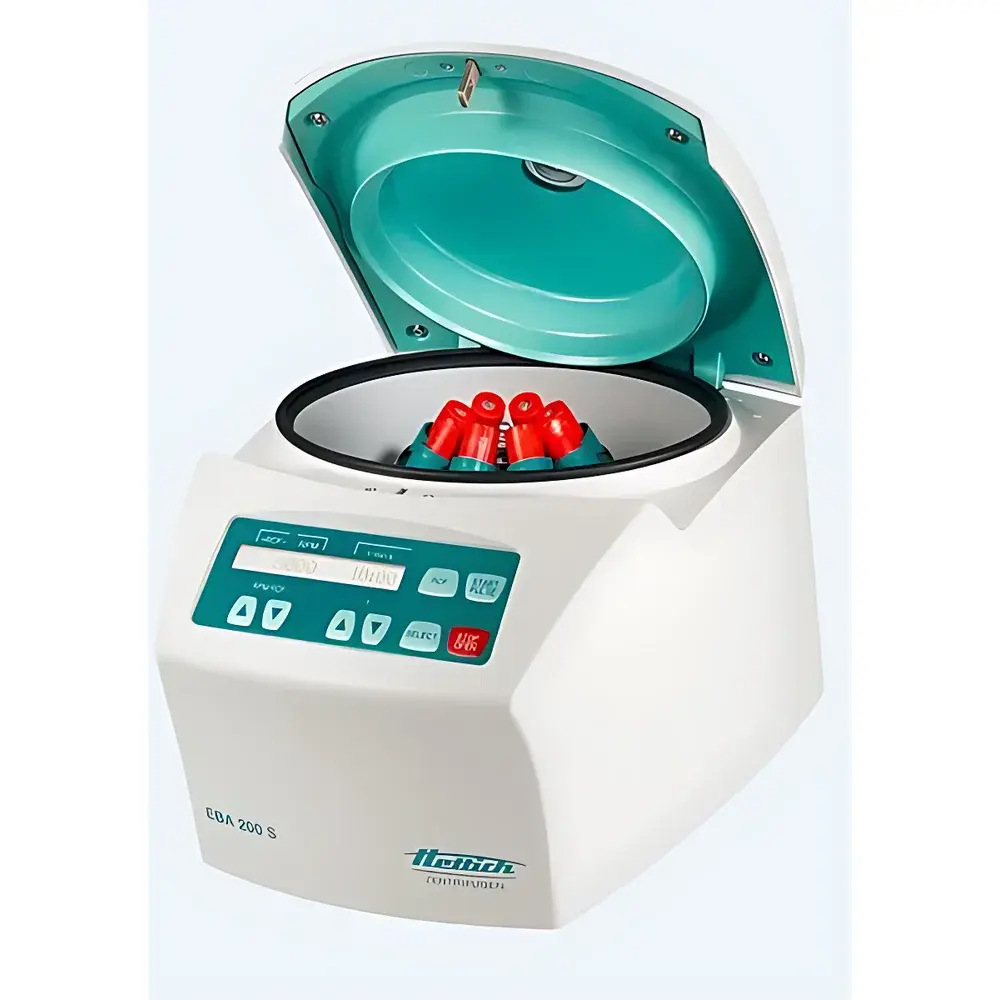
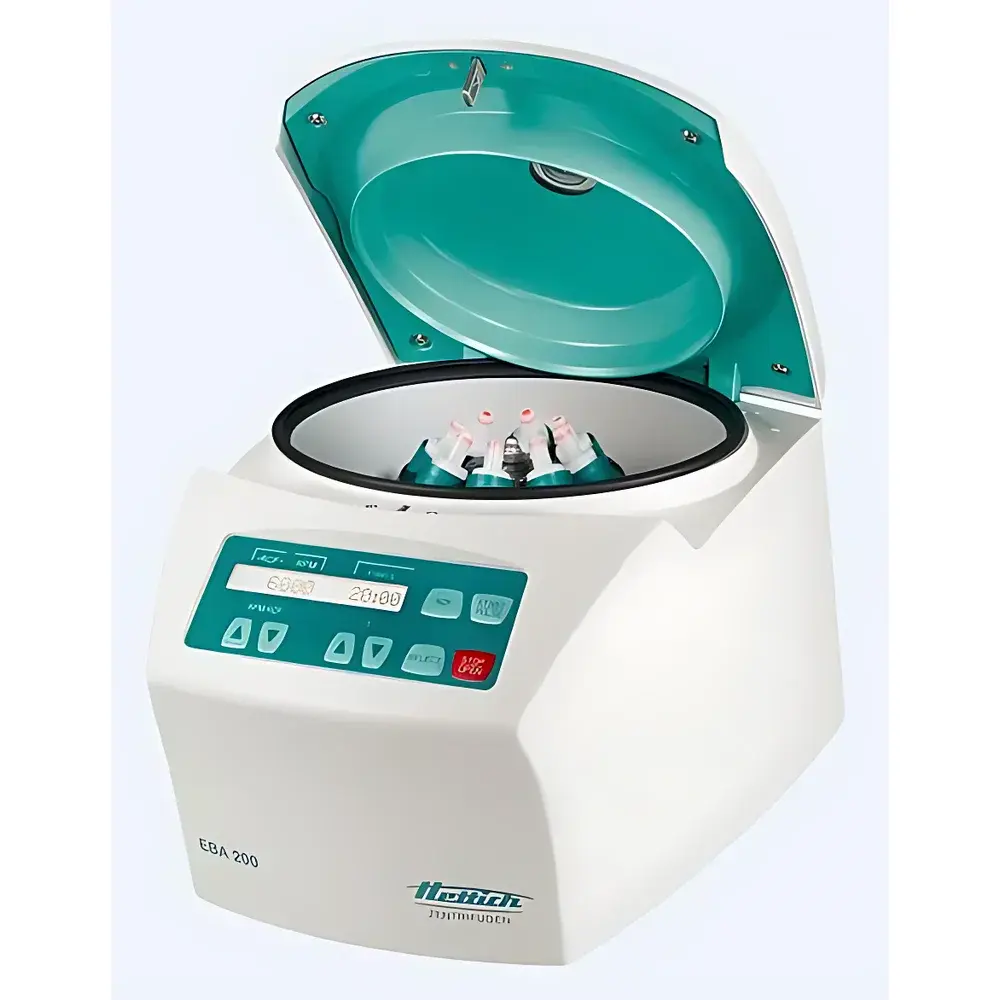
Hettich EBA200 and EBA200S Benchtop Centrifuges
| Brand | Hettich |
|---|---|
| Origin | Germany |
| Model | EBA200 / EBA200S |
| Instrument Type | Benchtop Centrifuge |
| Speed Range | 6,000 min⁻¹ (EBA200) / 8,000 min⁻¹ (EBA200S) |
| Max RCF | 3,461 × g (EBA200) / 6,153 × g (EBA200S) |
| Max Capacity | 8 × 15 mL |
| Dimensions (H×W×D) | 228 × 261 × 353 mm |
| Weight | 9 kg (EBA200) / 11 kg (EBA200S) |
| Power Supply | 200–240 V, 50–60 Hz |
| Power Consumption | 100 VA (EBA200) / 160 VA (EBA200S) |
| Electromagnetic Compatibility | EN/IEC 61326-1, Class B |
| Timer Range | 1–99 min, ∞ (continuous), and short-spin mode |
| Rotor Type | Fixed-angle rotor (8-place, 15 mL) |
Overview
The Hettich EBA200 and EBA200S are compact, high-reliability benchtop centrifuges engineered for routine separation tasks in clinical diagnostics, emergency laboratories, and general research settings. Operating on the principle of sedimentation under controlled centrifugal force, these instruments utilize fixed-angle rotors to generate reproducible relative centrifugal forces (RCF) — 3,461 × g at 6,000 rpm (EBA200) and 6,153 × g at 8,000 rpm (EBA200S). Their design prioritizes operational safety, intuitive usability, and compliance with international electromagnetic compatibility standards (EN/IEC 61326-1, Class B), making them suitable for installation in shared laboratory environments where electrical noise sensitivity is a concern. The integrated lid-locking mechanism ensures mechanical interlock during operation, while an emergency lid-release function enables rapid access when required — a critical feature in time-sensitive clinical workflows such as emergency plasma preparation.
Key Features
- Robust all-metal chassis with vibration-damping base for stable operation at maximum speed
- Intuitive rotary dial interface with LED display for precise time and speed setting (1–99 min, continuous, or short-spin mode)
- Automatic rotor identification not supported; however, pre-calibrated speed-to-RCF conversion tables are provided per rotor configuration
- Integrated safety systems: lid interlock, automatic brake deceleration, and imbalance detection with audible/visual alert
- Low acoustic signature (<55 dB(A)) optimized for open-lab or point-of-care deployment
- Energy-efficient brushless motor with thermal protection and extended service life
Sample Compatibility & Compliance
The EBA200/EBA200S accommodates standard conical-bottom polypropylene or glass tubes up to 15 mL in volume, mounted in an 8-position fixed-angle rotor (angle: 45°). It supports common anticoagulant tubes used in hematology (e.g., EDTA, citrate, heparin) and is routinely employed for platelet-poor plasma (PPP) isolation — particularly valuable in coagulation assays requiring minimal platelet contamination. While not certified for biosafety level (BSL)-2 containment, its sealed rotor chamber meets ISO 13485-aligned manufacturing controls and complies with essential requirements of the EU Medical Device Regulation (MDR 2017/745) when used with CE-marked accessories. Routine calibration and performance verification align with CLSI EP15-A3 guidelines for centrifuge validation in clinical labs.
Software & Data Management
These models operate without embedded software or network connectivity. All parameters are set locally via hardware controls, ensuring deterministic response and eliminating cybersecurity exposure. For laboratories operating under GLP or GMP frameworks, manual logbook entries — including date, operator ID, rotor serial number, speed, time, and sample load configuration — constitute the primary audit trail. Optional Hettich-certified calibration services provide traceable documentation compliant with ISO/IEC 17025-accredited metrology practices. No FDA 21 CFR Part 11 electronic record functionality is included, consistent with their classification as Class I general-purpose laboratory equipment.
Applications
- Routine plasma separation from whole blood, especially in emergency departments where rapid PPP generation is required for PT, aPTT, and fibrinogen testing
- Preparation of supernatants in ELISA, PCR, and immunoassay workflows involving cell lysates or serum-based matrices
- Sedimentation of particulates in environmental water samples prior to filtration or spectrophotometric analysis
- Clarification of bacterial or yeast cultures in microbiology teaching labs and QC procedures
- Low-speed pelleting of erythrocytes or leukocytes in hematological fractionation protocols
FAQ
What tube formats are compatible with the EBA200/EBA200S?
Standard 15 mL conical centrifuge tubes (polypropylene or borosilicate glass) with screw caps or snap caps — up to 8 tubes per run. Round-bottom tubes are not recommended due to rotor geometry.
Is rotor balancing required before each run?
Yes. Symmetrical loading of opposing positions is mandatory. The instrument does not compensate for mass imbalance; failure to balance may trigger automatic shutdown.
Can the EBA200S be used for viral pellet isolation?
No. Its maximum RCF of 6,153 × g is insufficient for pelleting most viruses, which typically require ≥100,000 × g (ultracentrifugation). It is appropriate for cellular debris removal and large-particle clarification only.
Does Hettich provide IQ/OQ documentation for regulated environments?
Yes — upon request, Hettich offers optional Installation Qualification (IQ) and Operational Qualification (OQ) templates aligned with ISO 9001 and ISO/IEC 17025 requirements, intended for use by qualified lab personnel or third-party validation partners.
What maintenance intervals are recommended?
Visual inspection and cleaning every 3 months; full mechanical service (bearing check, brake calibration, lid latch verification) every 24 months or after 5,000 cycles — whichever occurs first.



