
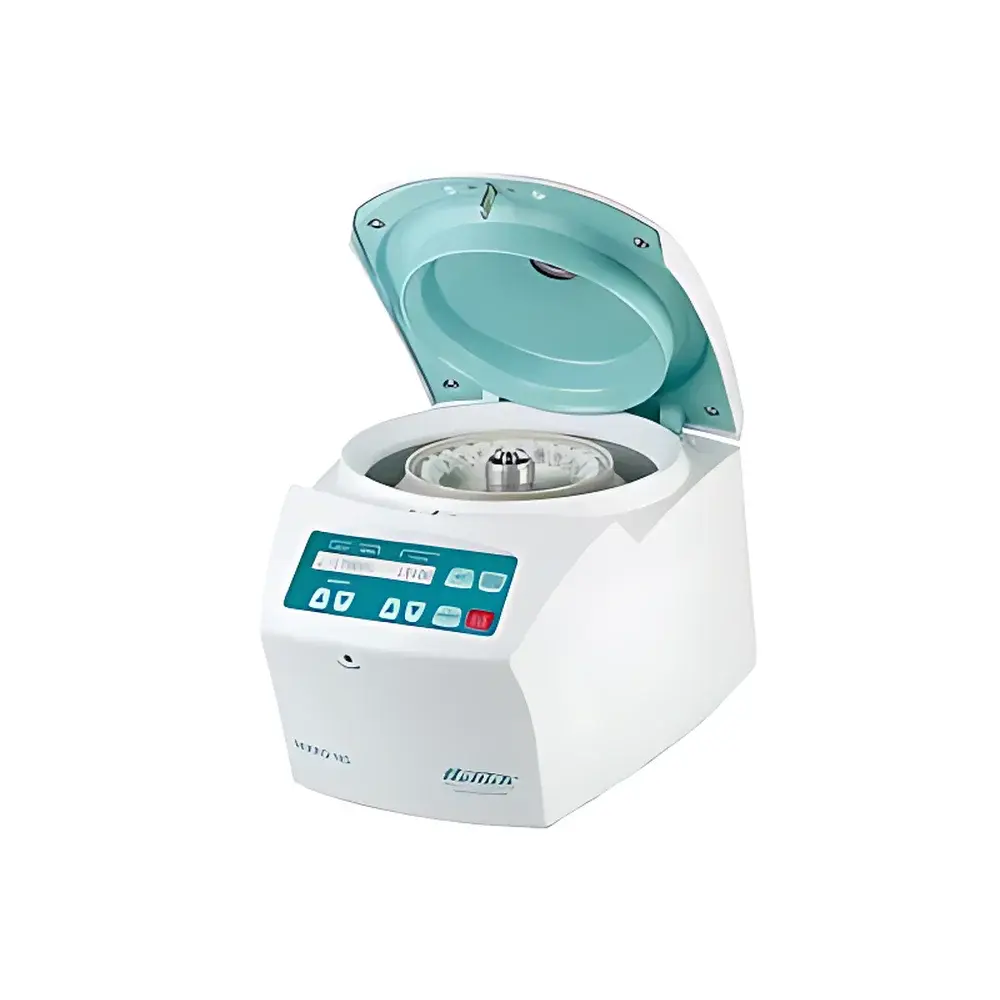
Hettich Mikro 185 Microcentrifuge
| Brand | Hettich |
|---|---|
| Origin | Germany |
| Model | Mikro 185 |
| Centrifuge Type | Benchtop Microcentrifuge |
| Speed Range | Up to 14,000 min⁻¹ |
| Max RCF | 18,845 × g |
| Max Capacity | 24 × 1.5 / 2.0 mL tubes |
| Dimensions (W × D × H) | 228 × 262 × 352 mm |
| Rotor Options | 4 interchangeable rotors |
| Display | LCD with real-time RPM/RCF readout |
| Safety Features | Automatic imbalance shutdown, rotor auto-recognition, emergency lid release, instant centrifugation button |
| Compliance | IEC 61010-1, EN 61326-1, CE-marked for laboratory use |
Overview
The Hettich Mikro 185 Microcentrifuge is a precision-engineered benchtop centrifuge designed for routine and demanding micro-volume separation tasks in life science laboratories. Operating on the principle of radial acceleration-induced sedimentation, it delivers high reproducibility and consistent pellet formation for samples in standard microtubes (0.2–2.0 mL). With a maximum rotational speed of 14,000 min⁻¹ and a peak relative centrifugal force (RCF) of 18,845 × g, the Mikro 185 meets the performance requirements for nucleic acid precipitation, protein pelleting, cell harvesting, and rapid spin-down of column-based purification kits. Its compact footprint (228 × 262 × 352 mm) and robust all-metal construction—including a reinforced stainless-steel centrifuge chamber—ensure long-term mechanical stability and resistance to chemical exposure common in molecular biology workflows.
Key Features
- Four interchangeable rotor configurations support diverse tube formats and application needs, including fixed-angle and horizontal options optimized for microtubes.
- Intuitive LCD interface displays real-time RPM and RCF values; dedicated toggle key enables instant conversion between rotational speed and g-force without recalculating.
- Integrated safety architecture includes automatic imbalance detection and immediate power cutoff, rotor auto-recognition to prevent mismatched operation, and mechanical emergency lid release for rapid access during unexpected stoppages.
- Instant centrifugation function allows single-button activation for short-duration spins (e.g., quick tube wall clearing), eliminating the need to set time or speed parameters repeatedly.
- Optimized airflow design minimizes heat buildup during extended runs, supporting temperature-sensitive sample integrity without active refrigeration.
- Compliant with IEC 61010-1 (safety requirements for electrical equipment for measurement, control, and laboratory use) and EN 61326-1 (EMC requirements for laboratory instrumentation), ensuring safe integration into regulated environments.
Sample Compatibility & Compliance
The Mikro 185 accommodates up to 24 × 1.5 mL or 2.0 mL conical or round-bottom microcentrifuge tubes per run, with rotor configurations validated for compatibility with common consumables from leading suppliers (e.g., Eppendorf, Axygen, Sarstedt). It supports standard protocols referenced in ISO 15195 (clinical laboratory testing — requirements for reference measurement systems) and aligns with general Good Laboratory Practice (GLP) documentation expectations for instrument qualification. While not refrigerated, its thermal management profile permits use in ambient-controlled labs where sample temperature deviation ≤ ±3 °C over 10-minute runs is acceptable—making it suitable for pre-analytical processing prior to downstream analysis by PCR, electrophoresis, or mass spectrometry.
Software & Data Management
As a stand-alone benchtop device, the Mikro 185 does not incorporate onboard data logging or network connectivity. However, its operational parameters (RPM, RCF, time) are retained on the LCD display until manually reset, enabling manual entry into electronic lab notebooks (ELNs) or LIMS platforms. The rotor auto-recognition system ensures traceability of mechanical configuration during method execution—a foundational element for audit readiness under FDA 21 CFR Part 11 when paired with procedural SOPs. Routine maintenance logs (e.g., rotor usage cycles, calibration verification dates) can be maintained externally to satisfy internal quality assurance requirements.
Applications
- Routine spin-down of PCR reaction mixtures and enzyme digestion products prior to gel electrophoresis or sequencing library preparation.
- Pelleting of bacterial or yeast cells from small-volume cultures (≤2 mL) for genomic DNA extraction or protein expression analysis.
- Clarification of lysates in affinity chromatography workflows using spin-column formats.
- Concentration of dilute nucleic acid solutions via ethanol precipitation followed by brief high-g-force pelleting.
- Separation of phase layers in phenol-chloroform extractions, particularly when working with low-volume aqueous phases.
- Pre-analytical processing in clinical diagnostics labs performing rapid point-of-care sample preparation under CLIA-waived or moderate-complexity testing conditions.
FAQ
Does the Mikro 185 support refrigerated operation?
No—the Mikro 185 is a non-refrigerated microcentrifuge. It relies on passive thermal dissipation and is intended for applications where sample temperature stability is maintained externally (e.g., pre-chilled tubes, ambient lab temperatures ≤25 °C).
Can I use this centrifuge with 0.2 mL PCR tubes?
Yes—when equipped with the appropriate rotor (e.g., fixed-angle rotor with PCR tube adapters), the Mikro 185 is validated for secure spinning of 0.2 mL strip tubes and individual PCR tubes at full speed.
Is rotor calibration required before first use?
Hettich rotors are factory-calibrated and do not require user calibration. However, users must verify rotor identification via the auto-recognition system upon installation and record rotor model and serial number in their equipment log per GLP guidelines.
What safety certifications apply to this instrument?
The Mikro 185 carries CE marking and complies with IEC 61010-1 (electrical safety) and EN 61326-1 (electromagnetic compatibility), confirming conformity with European Union directives for laboratory equipment.
How often should the centrifuge undergo preventive maintenance?
Hettich recommends annual inspection by an authorized service technician, including bearing assessment, lid latch functionality test, and imbalance sensor validation—particularly in high-throughput environments exceeding 500 runs per month.



