
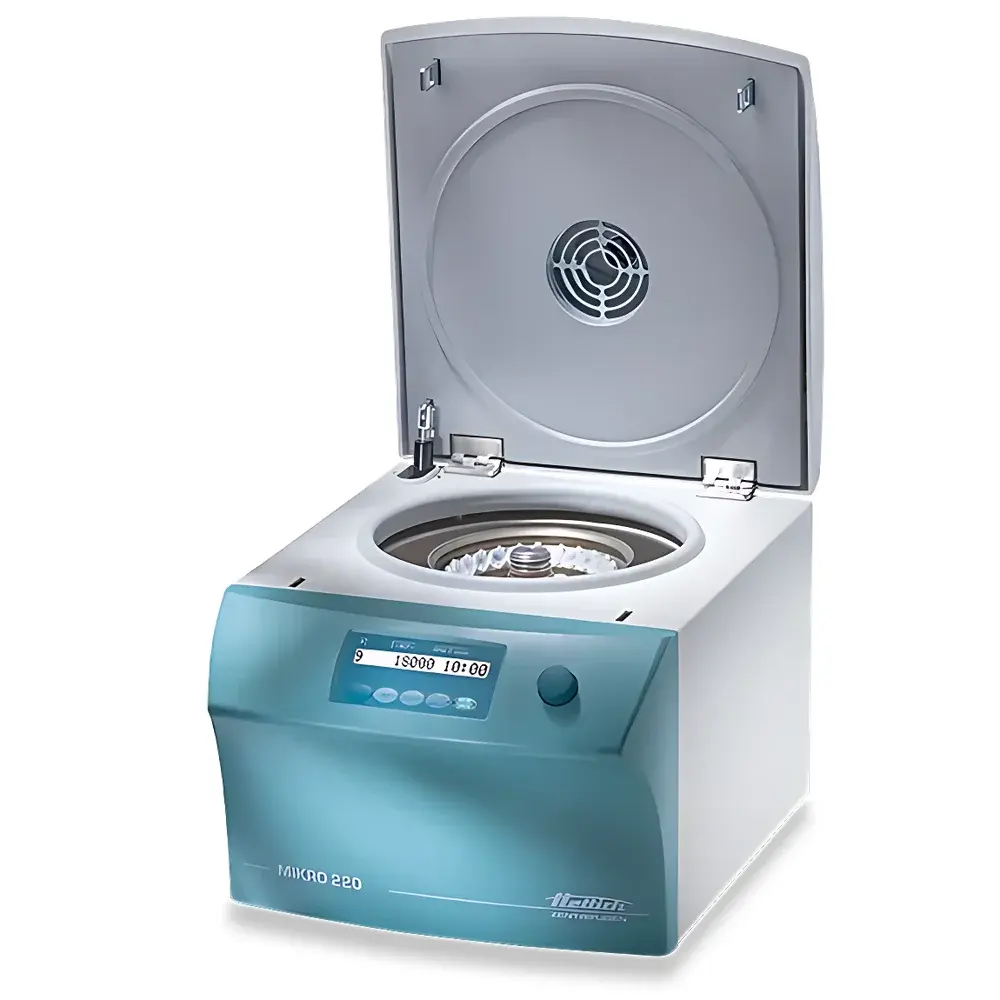
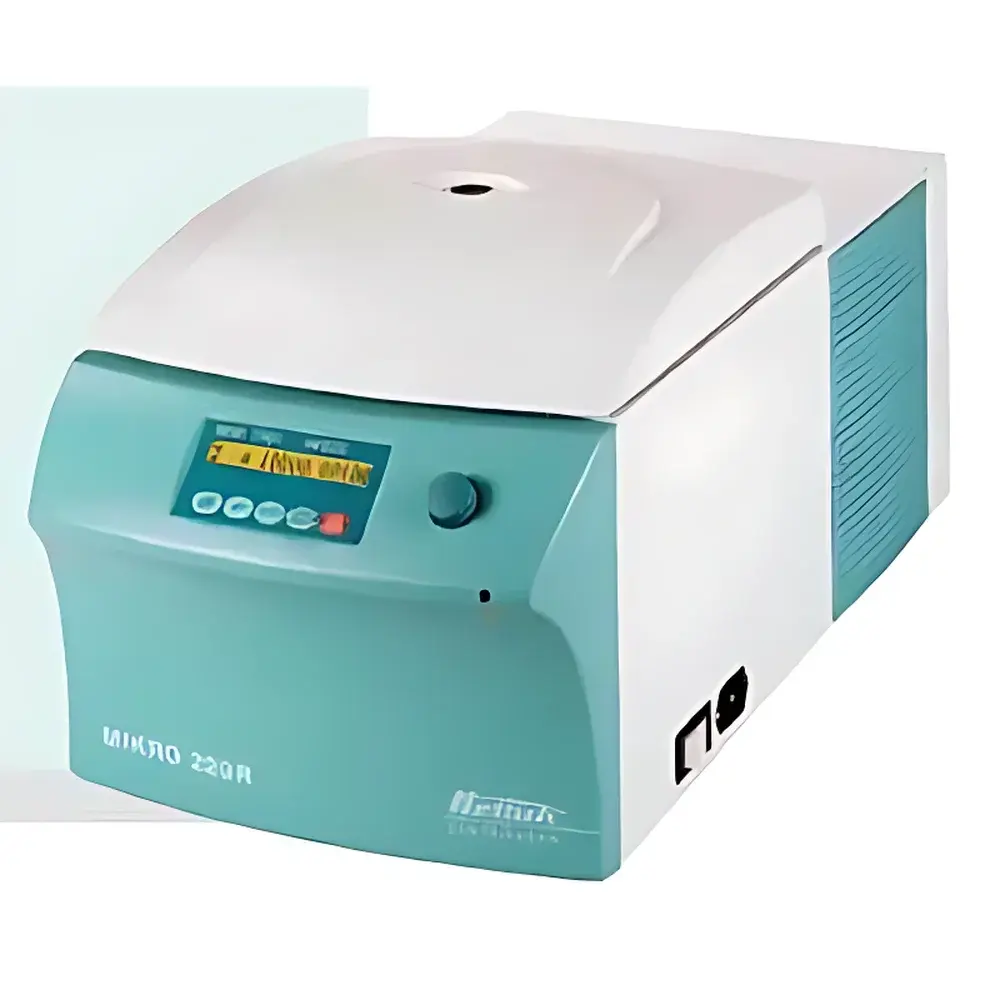
Hettich MIKRO 220 / MIKRO 220R Benchtop Microcentrifuge
| Brand | Hettich |
|---|---|
| Origin | Germany |
| Model | MIKRO 220 / MIKRO 220R |
| Type | Benchtop Centrifuge |
| Speed Range | 0–18,000 rpm |
| Max RCF | 31,514 × g |
| Max Capacity | 48 × 1.5 mL / 2.0 mL (angular rotor) or 60 × 1.5 mL / 2.0 mL (swing-bucket rotor) |
| Temperature Range (MIKRO 220R) | –20 °C to +40 °C |
| Dimensions (W × D × H) | 330 mm × 420 mm × 313 mm (MIKRO 220), 330 mm × 650 mm × 313 mm (MIKRO 220R) |
| Weight | 21 kg (MIKRO 220), 42 kg (MIKRO 220R) |
| Power Input | 200–240 V, 50–60 Hz |
| Compliance | EN/IEC 61326-1 Class B |
Overview
The Hettich MIKRO 220 and refrigerated MIKRO 220R are high-performance benchtop microcentrifuges engineered for precision separation of small-volume biological samples in demanding laboratory environments. Based on the principles of sedimentation centrifugation—where differential particle migration under controlled gravitational force enables separation by size, density, and shape—these instruments deliver reproducible, high-resolution pelleting of nucleic acids, proteins, cellular organelles, and microorganisms. Designed and manufactured in Germany, the MIKRO 220 series integrates robust mechanical architecture with intuitive human-machine interface design, ensuring operational reliability across routine QC workflows, molecular biology applications, and clinical diagnostics. The MIKRO 220R variant extends functionality with active refrigeration, enabling temperature-sensitive protocols such as RNA isolation, enzyme preservation, and cold-chain-compatible sample preparation.
Key Features
- High-speed capability up to 18,000 rpm with maximum relative centrifugal force (RCF) of 31,514 × g—optimized for rapid pelleting of sub-microliter to 2.0 mL samples.
- Two rotor configurations supported: angular rotor (48 × 1.5/2.0 mL) and swing-bucket rotor (60 × 1.5/2.0 mL); MIKRO 220R additionally accommodates six 50 mL conical tubes for scalable processing.
- Refrigerated model (MIKRO 220R) features continuous, electronically regulated temperature control from –20 °C to +40 °C with fast-cool function—critical for maintaining sample integrity during extended runs.
- Motor-driven lid lock ensures secure operation at all speeds; tactile membrane keypad enables rapid parameter entry and recall of up to 10 user-defined programs.
- Stainless steel chamber, metal housing, and transparent polycarbonate lid provide durability, corrosion resistance, and real-time visual monitoring without interrupting operation.
- Short acceleration and deceleration profiles minimize run time while preserving sample viability—particularly beneficial for heat- or shear-sensitive biomolecules.
- Low-noise operation (<55 dB[A]) and vibration-damped base contribute to ergonomic lab environments and stable placement on shared benchtops.
Sample Compatibility & Compliance
The MIKRO 220/220R is validated for use with standard polypropylene and PCR-grade microtubes (0.2 mL to 2.0 mL), as well as conical centrifuge tubes (up to 50 mL on MIKRO 220R). It supports common biosafety level 1–2 (BSL-1/2) workflows involving bacteria, yeast, mammalian cells, viral particles, and nucleic acid preparations. All units comply with electromagnetic compatibility (EMC) standards per EN/IEC 61326-1 Class B, ensuring interference-free integration into automated laboratory networks. While not certified for GMP or GLP environments out-of-the-box, the instrument’s consistent performance, audit-ready programmability, and traceable parameter logging support alignment with ISO/IEC 17025 quality management frameworks when integrated into documented SOPs.
Software & Data Management
The MIKRO 220/220R operates via embedded firmware with no external PC dependency. Parameter inputs—including speed (rpm), RCF, time (1 sec to 99 min 59 sec), temperature (MIKRO 220R), and acceleration/deceleration profiles—are stored locally in non-volatile memory. Ten customizable protocols can be saved, recalled, and edited directly via the front panel interface. No proprietary software is required for basic operation; however, optional RS232 or USB interfaces (available via accessory module) enable remote command execution and timestamped event logging compatible with LIMS or ELN systems. Audit trail functionality—such as start/stop timestamps, rotor ID recognition, and error code history—is retained internally for post-run verification.
Applications
- Molecular biology: DNA/RNA precipitation, plasmid purification, PCR product cleanup, and cDNA synthesis prep.
- Clinical microbiology: Bacterial pellet concentration prior to Gram staining, MALDI-TOF identification, or antibiotic susceptibility testing.
- Cell culture & hematology: Rapid separation of peripheral blood mononuclear cells (PBMCs), platelet-rich plasma (PRP), and exosome-enriched supernatants.
- Quality control labs: Filtration validation, particulate analysis in injectables, and residual moisture assessment in lyophilized formulations.
- Food safety testing: Pathogen enrichment steps (e.g., Salmonella, Listeria) and allergen extraction from complex matrices.
FAQ
What is the difference between the MIKRO 220 and MIKRO 220R?
The MIKRO 220R includes a compressor-based refrigeration system enabling precise temperature control from –20 °C to +40 °C, whereas the MIKRO 220 is a non-refrigerated unit optimized for ambient-temperature applications.
Can the MIKRO 220R accommodate 50 mL tubes simultaneously with 1.5 mL tubes?
No—rotor configurations are mutually exclusive. The 6-position 50 mL rotor requires full chamber utilization; switching to microtube rotors necessitates manual rotor replacement.
Is rotor imbalance detection built into the instrument?
Yes—the drive system continuously monitors load symmetry and automatically halts operation if imbalance exceeds safe thresholds, preventing mechanical stress and ensuring operator safety.
Does the MIKRO 220/220R meet FDA 21 CFR Part 11 requirements?
Out-of-the-box, it does not include electronic signature or audit trail export capabilities required for full Part 11 compliance; however, its parameter logging and program recall functions may serve as foundational elements when deployed within validated IT infrastructure.
What maintenance intervals are recommended for optimal performance?
Hettich recommends biannual inspection of rotor threads, lid seal integrity, and brake performance; annual calibration of speed and temperature sensors (MIKRO 220R) by authorized service personnel is advised for critical applications.



