
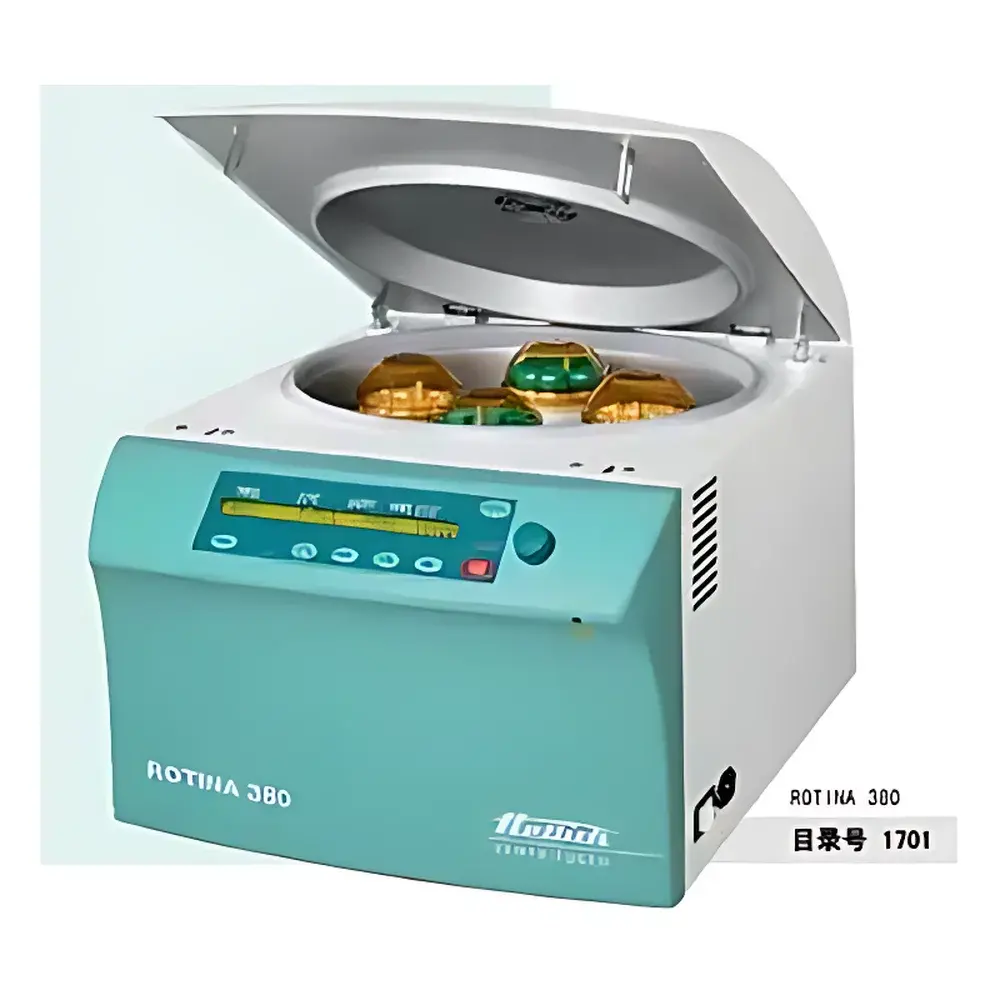
Hettich ROTINA 380 / ROTINA 380R Benchtop High-Speed Centrifuge
| Brand | Hettich |
|---|---|
| Origin | Germany |
| Model | ROTINA 380 / ROTINA 380R |
| Instrument Type | Benchtop Centrifuge |
| Speed Range | 15,000 min⁻¹ |
| Max RCF | 24,400 × g |
| Max Capacity | 4 × 290 mL (swing bucket) |
| Temperature Range (ROTINA 380R only) | −20 °C to +40 °C |
| Dimensions (ROTINA 380) | 418 × 457 × 600 mm (H × W × D) |
| Dimensions (ROTINA 380R) | 260 × 281 × 547 mm (H × W × D) |
| Weight (ROTINA 380) | 58.5 kg |
| Weight (ROTINA 380R) | 88.5 kg |
| Power Supply | 200–240 V, 1~, 50–60 Hz |
| Power Consumption | 650 VA (ROTINA 380), 1300 VA (ROTINA 380R) |
| Electromagnetic Compatibility | EN/IEC 61326-1, Class B |
| Safety Compliance | IEC 61010-2-020, EN 61326-1 |
| Programmable Methods | 98 user-defined protocols |
| Rotor Recognition | Automatic |
| Unbalance Detection | Real-time electronic monitoring |
| Emergency Lid Release | Yes |
| Refrigeration | Compressor-based (ROTINA 380R only) |
Overview
The Hettich ROTINA 380 and ROTINA 380R are high-performance benchtop centrifuges engineered for precision, reproducibility, and operational safety in demanding laboratory environments. Designed according to the principles of rotor dynamics and thermally stable mechanical architecture, these instruments employ a brushless frequency-controlled motor coupled with active vibration damping and real-time imbalance detection. The ROTINA 380 operates at ambient temperature, while the ROTINA 380R integrates a high-efficiency compressor-based refrigeration system enabling precise temperature control from −20 °C to +40 °C—critical for heat-sensitive biological samples such as plasmid DNA, primary cell lysates, or enzyme preparations. Both models comply with IEC 61010-2-020 for laboratory centrifuge safety and meet electromagnetic compatibility requirements per EN/IEC 61326-1, Class B, ensuring stable operation in shared instrument suites.
Key Features
- Robust stainless-steel chamber and reinforced metal housing ensure long-term structural integrity and chemical resistance.
- Large transparent lid window enables real-time visual monitoring of sample integrity and rotor behavior during operation.
- Motorized lid locking mechanism provides secure engagement and automatic verification prior to acceleration—eliminating manual torque checks.
- Ergonomic control panel with intuitive rotary encoder and high-contrast LCD display supports rapid parameter entry and method recall.
- Automatic rotor identification via integrated RFID or optical coding prevents mismatched speed/RCF settings and enforces safe operating envelopes.
- Electronic unbalance detection continuously monitors load distribution; acceleration halts immediately if deviation exceeds ISO 10105-compliant thresholds.
- Emergency lid release system allows manual override under power failure or thermal lockout conditions without tools.
- 98 programmable methods support complex multi-step protocols—including ramp rate control, deceleration profiles, and hold-at-speed segments—essential for standardized SOP execution.
Sample Compatibility & Compliance
The ROTINA 380/380R accommodates a broad range of sample formats through interchangeable rotors certified to ISO 10105 and DIN EN 61010-2-020. Standard configurations include swing-out buckets for 4 × 290 mL tubes (RCF up to 4,863 × g) and fixed-angle rotors optimized for 50 mL conical tubes (RCF up to 15,692 × g). All rotors undergo full dynamic balancing and fatigue testing per ASTM F2119. The system supports GLP/GMP workflows via audit-trail-capable software integration (optional), and its temperature stability (±0.5 °C at setpoint, ROTINA 380R) meets USP and ISO 13485 requirements for diagnostic reagent preparation. CE marking confirms conformity with EU Machinery Directive 2006/42/EC and Low Voltage Directive 2014/35/EU.
Software & Data Management
While the ROTINA 380/380R operates autonomously via front-panel controls, optional Hettich LabCenter™ software enables remote configuration, method synchronization across multiple units, and export of timestamped run logs in CSV or PDF format. Each centrifugation event records start/stop time, actual RCF, rotor ID, temperature history (380R), and fault diagnostics—supporting 21 CFR Part 11 compliance when deployed with validated user access controls and electronic signature modules. Data export interfaces include USB 2.0 and Ethernet (via optional module), allowing integration into LIMS platforms using standard HL7 or ASTM E1384 message structures.
Applications
These centrifuges serve core separation tasks across clinical, academic, and industrial laboratories. In clinical microbiology, they isolate serum, plasma, and PBMCs from whole blood using density gradient protocols. In molecular biology labs, they pellet nucleic acids post-phenol-chloroform extraction or concentrate viral vectors prior to transduction assays. Cell culture facilities rely on their consistent RCF delivery for harvesting adherent and suspension cells with minimal shear-induced apoptosis. The ROTINA 380R’s sub-zero capability supports cryopreservation workflows, mitochondrial isolation, and cold-active enzyme purification where thermal denaturation must be avoided. Its compact footprint and low acoustic emission (<55 dB[A]) make it suitable for biosafety cabinets and shared core facilities.
FAQ
What is the maximum relative centrifugal force (RCF) achievable with the ROTINA 380 using the standard swing-bucket rotor?
The standard 4 × 290 mL swing-bucket rotor delivers up to 4,863 × g at 15,000 min⁻¹.
Does the ROTINA 380R maintain temperature uniformity across all tube positions during prolonged runs?
Yes—its dual-zone airflow design and calibrated platinum RTD sensors ensure ±0.5 °C uniformity across the rotor chamber at steady state.
Can third-party rotors be used with this centrifuge?
No—only Hettich-certified rotors with embedded identification tags are recognized and enabled by the safety interlock system.
Is the emergency lid release mechanism compliant with ISO 13857 safety distances?
Yes—the mechanical override complies with ISO 13857 Category 1 requirements for accessible hazardous zones.
How does the system handle rotor wear monitoring over time?
Rotor usage history—including total run hours, max speed cycles, and thermal stress events—is logged internally and retrievable via service mode for preventive maintenance scheduling.



