
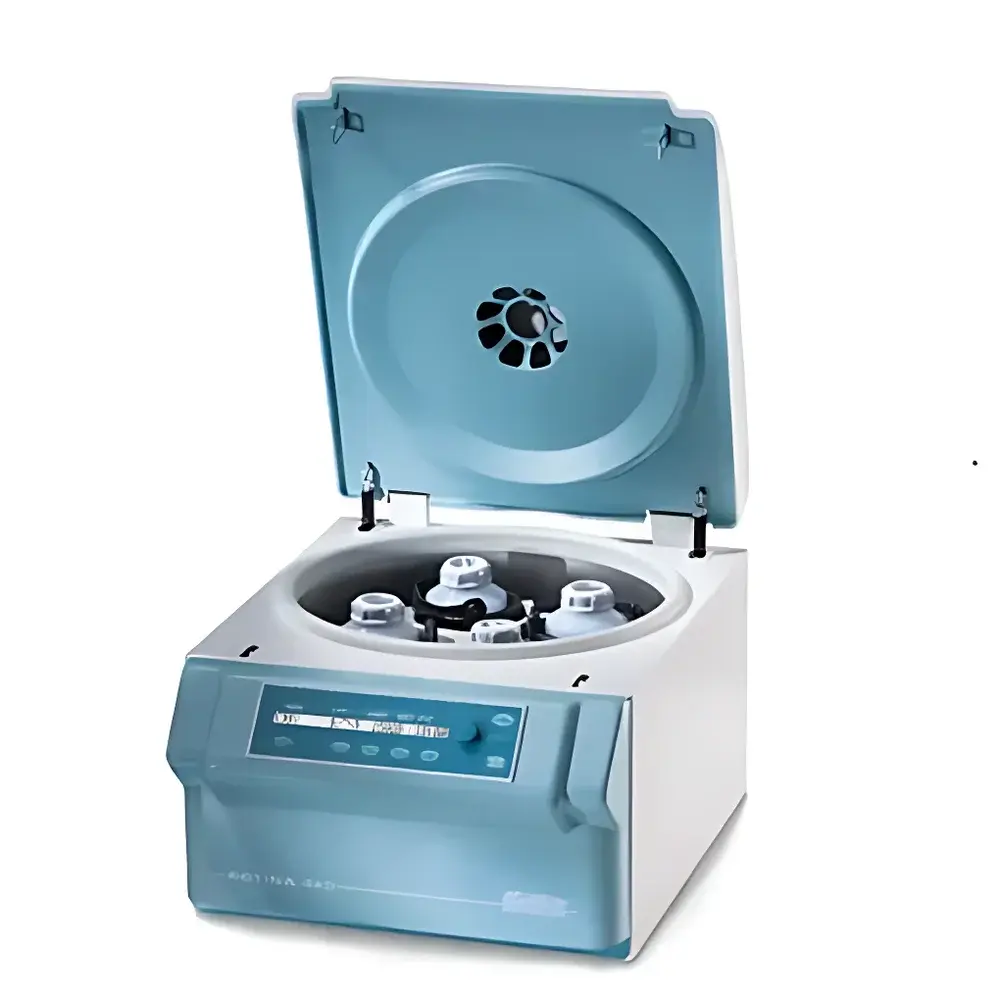
Hettich ROTINA 420 Benchtop High-Speed Centrifuge
| Brand | Hettich |
|---|---|
| Origin | Germany |
| Instrument Type | Benchtop Centrifuge |
| Rotor Configuration | Horizontal Swing-Out Rotor |
| Max Capacity | 4 × 600 mL |
| Max Speed | 15,000 rpm |
| Max RCF | 24,400 × g |
| Temperature Range | –20 °C to +40 °C (adjustable in 0.1 °C increments) |
| Dimensions (H×W×D) | 423 × 713 × 654 mm |
| Weight | 117 kg (ROTINA 420R) |
| Safety Compliance | EN/IEC 61326-1 Class B, EN 61010-1, IEC 61010-2-020 |
| Programmability | 99 user-defined protocols with recall function |
| Cooling | Active refrigeration with standby cooling |
| Rotor Recognition | Automatic detection via RFID or mechanical coding |
| Unbalance Protection | Real-time dynamic imbalance sensing and automatic shutdown |
Overview
The Hettich ROTINA 420 is a high-performance benchtop high-speed centrifuge engineered for laboratories requiring robust, reproducible separation of large-volume samples without sacrificing footprint efficiency. Designed around the principles of horizontal swing-out rotor dynamics and precision temperature-controlled sedimentation, it delivers consistent RCF generation across all tube positions—critical for applications demanding high sample integrity, such as plasma fractionation, cell pellet recovery, and nucleic acid isolation. Unlike conventional floor-standing models, the ROTINA 420 integrates industrial-grade thermal management, real-time rotor diagnostics, and ergonomic human-machine interface design into a compact chassis measuring under 0.7 m in width. Its operational envelope spans from ambient conditions to cryogenic separation at –20 °C, enabling cold-sensitive biomolecule preservation during prolonged runs.
Key Features
- Horizontal swing-out rotor system supporting up to 4 × 600 mL bottles, 140 × 13 mm blood collection tubes, or 16 × 96-well microtiter plates per run—maximizing throughput while maintaining balanced load distribution.
- Intelligent rotor recognition technology ensures automatic validation of installed rotor type, speed limits, and RCF profiles prior to acceleration—eliminating manual configuration errors and enhancing compliance traceability.
- Microprocessor-controlled refrigeration with continuous standby cooling maintains setpoint stability within ±0.5 °C, even during repeated start-stop cycles; compressor-based system complies with ISO 13485 environmental control requirements for diagnostic labs.
- Motor-driven lid lock mechanism with dual-safety interlock: mechanical engagement verified by Hall-effect sensors and software-enforced inhibition during rotation—fully compliant with IEC 61010-2-020 safety standards for centrifugal equipment.
- 99 programmable protocols stored in non-volatile memory include ramp rate control, deceleration profiles, hold times, and temperature setpoints—supporting audit-ready SOP execution under GLP/GMP frameworks.
- Stainless steel chamber interior and reinforced aluminum housing provide corrosion resistance and structural rigidity; transparent polycarbonate lid enables visual monitoring without interrupting operation.
Sample Compatibility & Compliance
The ROTINA 420 accommodates standard clinical and research consumables—including polypropylene conical tubes (15–50 mL), glass serum tubes, blood bags (up to 600 mL), and PCR plate carriers—without adapter modification. All rotors are certified to DIN EN ISO 15195 for metrological traceability in clinical laboratories. The instrument meets essential requirements of the EU Medical Device Regulation (MDR 2017/745) Annex I when used with CE-marked rotors and accessories. It supports FDA 21 CFR Part 11-compliant data logging when integrated with Hettich’s optional CentriSoft Connect software, including electronic signatures, audit trails, and user access levels.
Software & Data Management
CentriSoft Connect (v3.2+) provides full remote control, real-time parameter visualization, and automated report generation in PDF/CSV formats. Data export includes timestamped RCF curves, temperature logs, rotor ID, operator ID, and deviation alerts—all structured for LIMS integration via HL7 or ASTM E1384 interfaces. Audit trail functionality records every protocol change, start/stop event, and error condition with immutable timestamps, satisfying ISO/IEC 17025 clause 7.10.2 for testing laboratory data integrity.
Applications
This centrifuge serves core workflows in clinical chemistry (e.g., serum/plasma separation per CLSI GP44-A4), bioprocessing (harvesting mammalian cells at >10⁷ cells/mL), virology (viral pellet concentration prior to TEM analysis), and academic life sciences (subcellular organelle isolation using density gradients). Its low-noise operation (<58 dB[A] at 15,000 rpm) and vibration-dampened base make it suitable for shared instrumentation suites and ISO Class 7 cleanrooms.
FAQ
Does the ROTINA 420 support continuous operation at maximum speed and temperature?
Yes—engineered for uninterrupted runs up to 99 minutes 59 seconds or infinite mode, with thermal overload protection activating only if chamber temperature exceeds +42 °C for >30 seconds.
Is rotor calibration required before first use?
No—factory-calibrated rotors feature embedded identification codes recognized automatically; however, annual verification against NIST-traceable tachometers is recommended per ISO/IEC 17025.
Can the centrifuge be integrated into a building management system (BMS)?
Via optional RS485 Modbus RTU interface, enabling status polling, emergency stop signaling, and power consumption monitoring.
What safety certifications apply to the ROTINA 420R model?
CE marked under Directive 2014/35/EU (Low Voltage) and 2014/30/EU (EMC); certified to EN 61010-1:2010 + A1:2019 and EN 61010-2-020:2016.
How is imbalance detected during operation?
Through dual-axis accelerometer feedback combined with motor current signature analysis—triggering immediate deceleration if lateral displacement exceeds 0.8 mm RMS at any speed above 3,000 rpm.
Related Products



